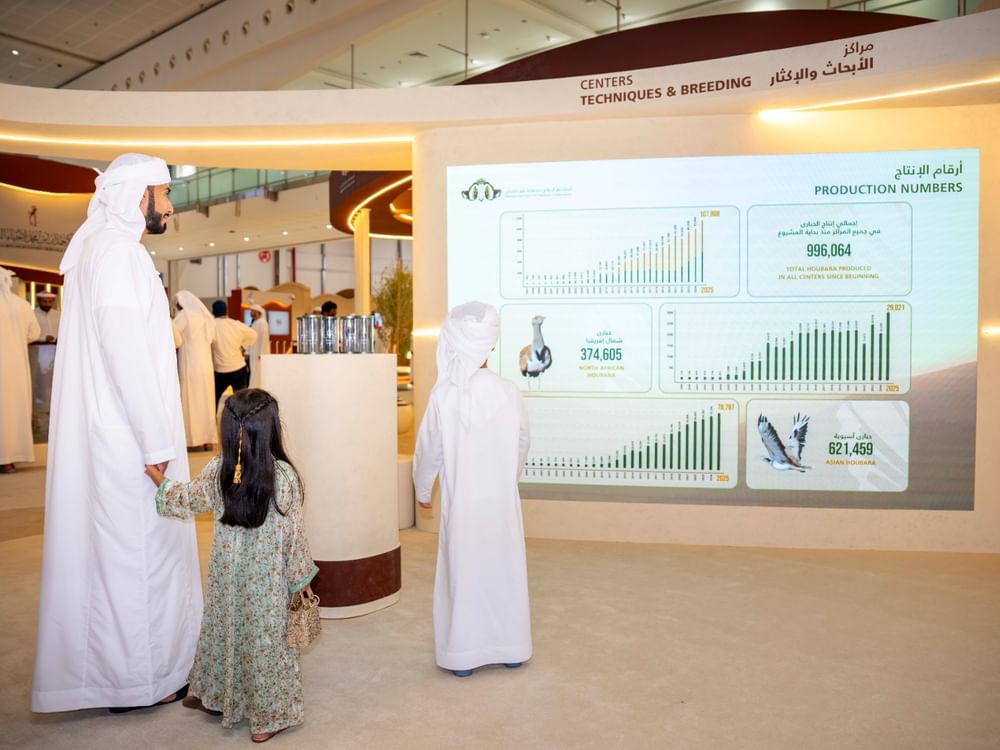
ABU DHABI, 3rd September, 2025 (WAM) -- The International Fund for Houbara Conservation (IFHC), an affiliate Erth Zayed Philanthropies, has showcased its key achievements at the Abu Dhabi International Hunting and Equestrian Exhibition (ADIHEX).
For the first time since its establishment, the Fund announced that its annual breeding of Houbara birds surpassed the 100,000-mark, reaching a total of 107,808 birds.
This brings the cumulative production since the Fund’s inception to 996,064 birds, of which 598,314 have been released to support biodiversity in 18 countries across the Houbara’s native habitats in Asia and North Africa.
One of the key highlights presented at the IFHC pavilion was data from falconers indicating that 75% of the recently hunted migratory birds were bred and released by the Fund in Kazakhstan and Uzbekistan. This provides vital evidence for the successful reinforcement of the Houbara’s migratory route to the UAE and the Arabian Peninsula.
H.H. Sheikh Theyab bin Mohamed bin Zayed Al Nahyan, Deputy Chairman of the Presidential Court for Development and Fallen Heroes' Affairs and Chairman of the IFHC Board of Directors, said, “This achievement reflects the Fund’s commitment to the vision of the late Sheikh Zayed. It adhered to a scientifically grounded and sustainable approach and fostered collaborative partnerships with both local and international entities. This demonstrates a steadfast dedication to biodiversity conservation and the sustainability of our environmental and cultural heritage for generations to come.”
As part of its partnerships with national universities, visitors were introduced to the "Houbara Robot", developed in collaboration with Khalifa University, which is now 80% complete. The robot will aid in tracking the birds and understanding their behaviour through artificial intelligence.
The pavilion also featured the participation of the “Houbara Ambassadors”, a group of veterinary students from the UAE University, who guided visitors through the exhibition. These students had previously completed their training at the Fund’s facilities as part of an ongoing research and training partnership.
In terms of global and regional contributions to the conservation of other endangered species, the pavilion highlighted the Arabian Houbara Conservation Project, which has made progress thanks to artificial insemination and cryopreservation technologies. Additionally, efforts to save the Great Indian Bustard - one of the rarest birds in the world - were showcased.
Since 2018, the Fund has been providing technical support and scientific consultation to the Wildlife Institute of India and its partners. The programme continues to achieve promising milestones, laying the groundwork for the reintroduction of this critically endangered species into its natural habitats soon.