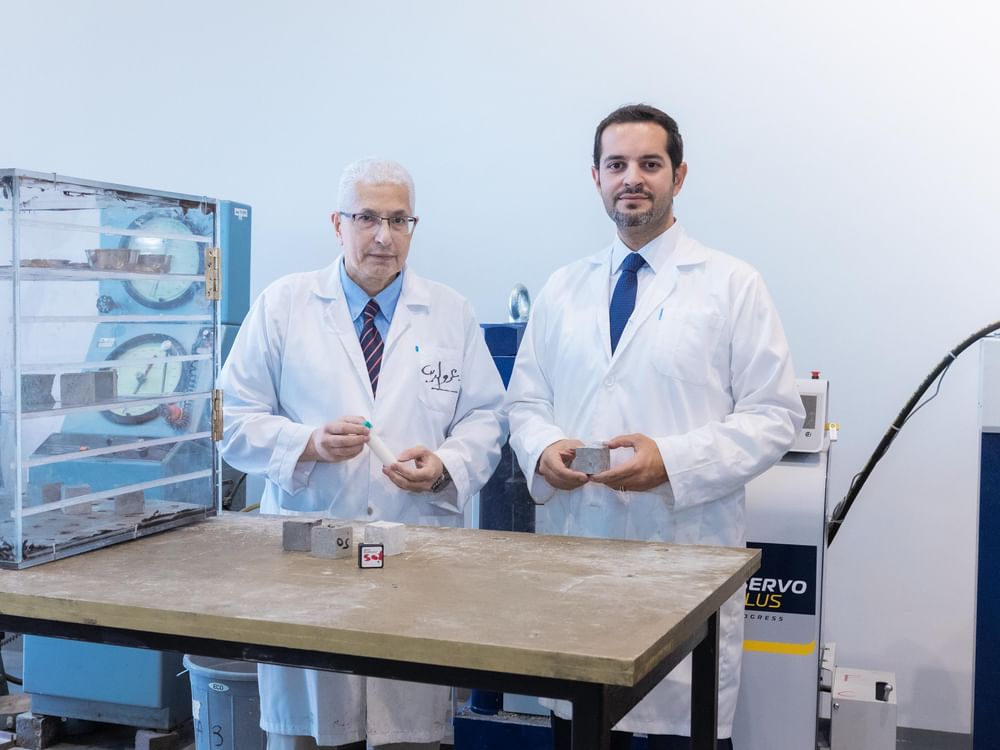
AL AIN, 15th December, 2025 (WAM) -- Researchers at the United Arab Emirates University (UAEU) have secured a US patent for a pioneering technology that converts industrial waste into an efficient, low-cost tool for capturing and permanently storing carbon dioxide, a development that could strengthen global efforts to confront climate change.
The innovation, led by Dr. Ashraf Aly Hassan, uses carbide slag, a common industrial by-product, to trap CO₂ and transform it into stable calcium carbonate without the need for additional chemicals or energy. The process relies solely on water and operates at room temperature, making it both environmentally friendly and economically viable.
According to the research team, which includes construction materials specialists Dr. Hilal El-Hassan and Dr. Amr Eldieb, as well as doctoral researcher Manisha Kothari, one tonne of carbide slag can absorb half a tonne of CO₂ and generate 1.5 tonnes of calcium carbonate.
The resulting material can be used as a substitute for limestone or incorporated into cement, offering added value for industrial producers.
The project was originally inspired by a sustainability challenge issued by Gulf Cryo, which sought a solution for the large volumes of carbide slag produced by its operations. By identifying the slag’s high lime content, the UAEU team was able to leverage its natural suitability for mineral carbonation, a process considered one of the most durable methods of CO₂ storage.
The patent underscores the university’s growing research capabilities and its alignment with the UAE’s net-zero 2050 strategy. The work was supported through internal research funding.
Looking ahead, the researchers plan to work with industry partners, including ADNOC, to scale up the technology and test its application in real-world industrial environments.