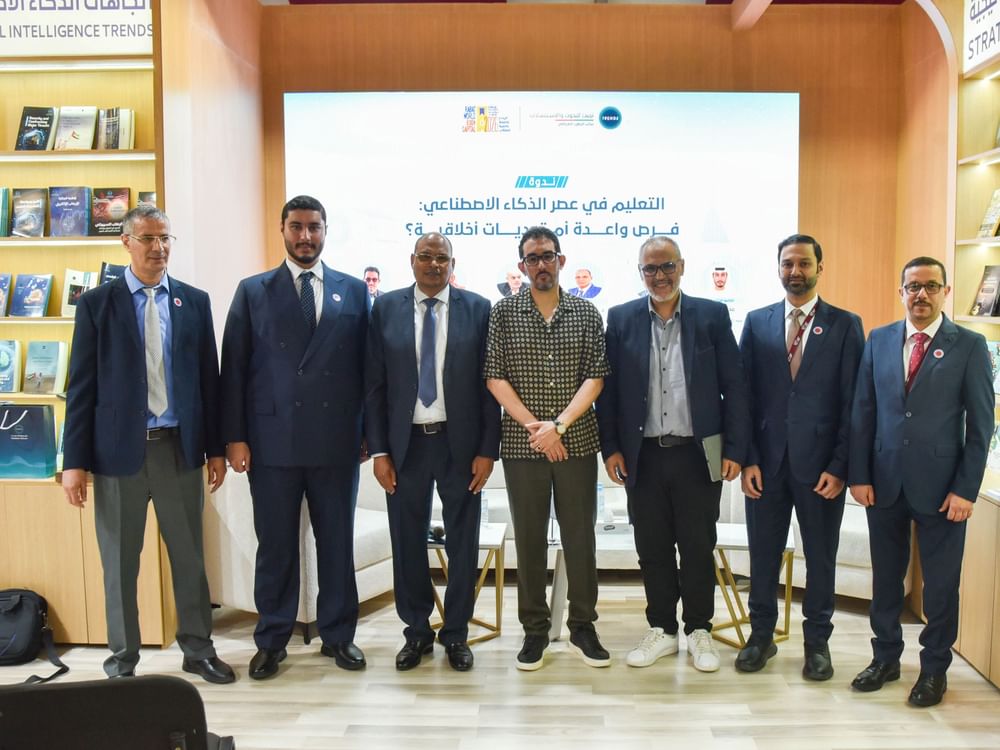
RABAT, 6th May, 2026 (WAM) -- TRENDS Group, through its Morocco Virtual Office, organised a symposium titled “Education in the Age of Artificial Intelligence: Promising Opportunities or Ethical Challenges?” as part of the intellectual and research programme accompanying its participation in the 2026 Rabat International Publishing and Book Fair.
The symposium brought together academics, experts and researchers to discuss the future of education in light of rapid advances in artificial intelligence (AI).
In his opening remarks, Mohamed Al Ahmed, researcher at TRENDS Research & Advisory, said the world is entering a phase where the knowledge revolution intersects with the algorithmic revolution, with the roles of teachers and learners increasingly linked to the capabilities of intelligent machines.
He noted that AI has evolved beyond being a supporting technical tool to become an influential force shaping curriculum design, personalised learning, performance assessment and even patterns of thinking.
Al Ahmed stressed that the real challenge lies not in the machine’s ability to learn, but in humanity’s ability to redefine learning itself, noting that education is not only about transferring knowledge, but also about building personalities capable of critical thinking, creativity and decision-making. He added that the future of education will depend on how AI is used within a clear ethical and human framework, enabling it to become a strong partner in developing more aware and creative generations.
Opening the symposium, which was introduced by Dr. Mohamed Bouchikhi, Director of TRENDS Virtual Office in Morocco, Dr. Moulay Ahmed Saber, a Moroccan writer and researcher, stressed that the risks of AI lie in its reach across virtually every sector, from the economy and education to human relationships. This is evident in the widespread collective engagement with digital platforms and social media.
Dr. Younes Al Wakili, Professor of Sociology and Anthropology at Mohammed V University in Rabat, said the use of AI in education is no longer theoretical but has become a practical reality. He referred to phases of interaction between education and AI, including “augmented intelligence”, which combines human thinking with machine capabilities to support vital sectors, including scientific research.
Dr. Abderrahman Mazuane, researcher and trainer in information technology and educational sciences, stressed the importance of engaging with AI in education amid the growing role of machines and their increasing ability to provide answers in various fields. He said the AI revolution has led to major transformations in teaching and learning methods.