
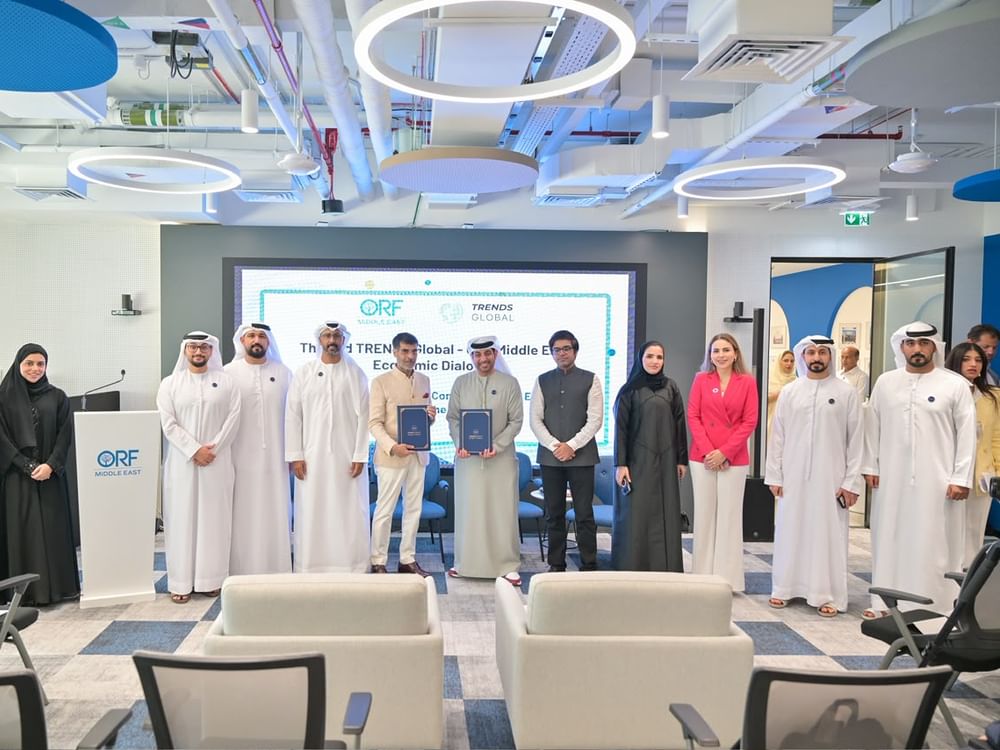
DUBAI, 24th August, 2026 (WAM) -- TRENDS Global, part of TRENDS Group, and the Observer Research Foundation Middle East (ORFME) launched the research outcomes and policy recommendations of the Second TRENDS Global-ORFME Economic Dialogue, held at ORFME’s office at the Dubai World Trade Centre.
The research outcomes, titled Balancing Connectivity and Economic Security: Post-Conflict Strategies for the Global South and MENA Region, included a redefinition of risk in the geopolitical era. Risks have shifted from peripheral concerns to existential challenges, with geopolitical tensions now directly affecting supply chains, energy markets and global trade. Economic security can therefore no longer be viewed separately from national and regional security.
The criteria for assessing global markets have also shifted away from efficiency and low cost towards added value, flexibility, resilience and system reliability. In addition, insurers and markets have become key drivers in reshaping global trade routes.
The dialogue emphasised that food security and energy security are two sides of the same coin, with both among the first casualties of conflicts and pandemics.
The Second TRENDS Global-ORFME Economic Dialogue recommended developing a new model of strategic connectivity in the Middle East, including integrated multimodal trade corridors, stronger ports and logistics infrastructure, protection of critical economic assets, and greater capacity to reroute trade when traditional routes are at risk.
It also recommended strengthening energy and food security by treating them as part of an integrated strategy. This includes diversifying energy routes, strengthening strategic reserves, bolstering strategic food stocks, diversifying supply sources, and investing across all stages of the food value chain.
The dialogue stressed the importance of developing alternative land, air and sea routes that extend beyond oil to encompass non-oil industrial exports and food imports. It also called for recalibrating the priorities of economic diversification plans to place greater emphasis on supply chain security, support for domestic manufacturing, and investment in human capital, skills and technology.
Dr. Samir Saran, President of ORFME, noted that cooperation among think tanks strengthens their ability to understand complex issues and deliver in-depth, forward-looking analysis through interactive sessions and open dialogue among experts and researchers.