
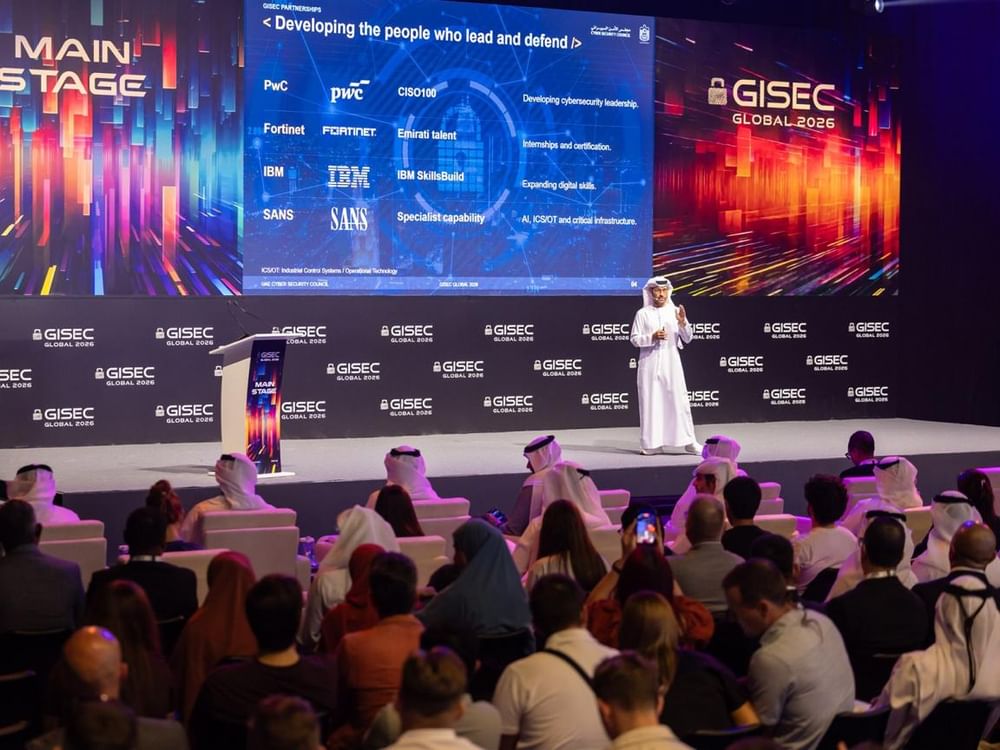
DUBAI, 17th September, 2026 (WAM) -- Day one of GISEC Global 2026 delivered a high impact programme that brought emerging AI enabled threats, national cyber resilience and critical infrastructure protection into sharp focus, as international experts examined the technologies and geopolitical forces reshaping the cybersecurity landscape.
Across the Main Stage, discussions examined how artificial intelligence is transforming both cyber defence and cybercrime. During ‘Cybersecurity Is Defining the New Order,’ Dr Mohamed Al Kuwaiti, Head of the UAE Cybersecurity Council, explored the strategic implications of AI-enabled cyber threats, with critical infrastructure remaining a major target. He stressed that cyber resilience is increasingly linked to national and economic security, and that cybersecurity depends on collective defence. “Cybersecurity culture is the responsibility of everybody. Our first line of defence is still the community,” he said.
In his keynote on ‘The Deepfake Decade: What Hollywood Learned First’, Emmy-nominated actor Michael Kelly highlighted how AI-generated deepfakes are challenging identity, consent and trust, with a person’s voice and likeness becoming part of their digital identity. Drawing on Hollywood’s experience, he stressed the importance of identity verification, content authentication and meaningful control over the use of AI-generated media. “Your voice and your likeness are your identity. No one should be able to use them without your knowledge and consent,” he said.
Reflecting these themes on the exhibition floor, exhibitors also highlighted the growing importance of cyber resilience as organisations adapt to increasingly AI-driven threats.
Ayman Hammoudeh, Senior Director, Sales Engineering, Cohesity, stated:''AI has transformed how organizations operate, innovate, and compete. It has also introduced an entirely new class of risk. The same AI agents that drive productivity, automate decisions, and power critical business processes can unintentionally disrupt operations, compromise trusted data, and amplify errors at scale. Protecting AI is no longer just about securing models. It requires safeguarding the agents, memory, data, and systems that underpin them. Protect and recover your AI systems, agents, and data, and build resilience that holds from the ground up"
Day one also examined the operational realities of protecting critical sectors. Sessions including ‘Operational Resilience in Oil & Gas’ and ‘Cyber Resilience in Critical Infrastructure’ explored how compromised OT environments, sensor inputs and digital twins can move cyber risk beyond IT systems and create physical, safety and operational consequences.
Khaled Al-Taneji, Head of Cybersecurity at ENOC Group, argued that organisations should assess cyber risk through its potential business, operational, cyber-physical and safety consequences rather than treating it simply as an IT-versus-OT challenge. He also highlighted the importance of non-cyber safeguards and the ability to switch to manual or degraded operations to maintain essential services during an incident.
The convergence of cybersecurity, national security and digital sovereignty continued across the CyberSecurity Congress, hosted by the UAE Cybersecurity Council, and the Government Stage, hosted by DESC, where discussions focused on international cooperation, sovereign cyber capabilities and securing rapidly evolving digital economies.
In ‘Building the World's Safest City in an Age of AI-Powered Threats’, Amer Sharaf, CEO of Cyber Security Systems and Services Sector at Dubai Electronic Security Center (DESC), examined Dubai's approach to resilience as AI accelerates both cyberattacks and cyber defence. He highlighted AI-powered defence, trusted digital identity, resilience by design, the “human firewall” and public trust, stressing: “Safety is not only in the physical world, but also in the digital world. Make cybersecurity a shared responsibility.”
Beyond the conference programme, GISEC translated the day's discussions into practical experiences through live ethical-hacking and OSINT demonstrations on the Dark Stage, alongside interactive challenges including the Dubai Cyber Challenge and GISEC Decode. The School of Cyber Defense also continued its programme of practical cybersecurity learning across the event.Live drills engaged attendees with interactive cyber challenges and technical experiences across the exhibition, including the Dubai Cyber Challenge and GISEC Decode, while longer-running initiatives such as the Global Quantum Drill and the School of Cyber Defense continue throughout the event programme.
At the invitation-only Global Leadership Roundtable, ‘The AI Sovereignty Imperative: Defending the US$28 Trillion Digital Economy,’ Dr Mohamed Al Kuwaiti joined Subra Kumaraswamy, SVP & Chief Information Security Officer, Visa, USA; Christophe Blassiau, Senior Vice President, Global CISO & CPSO, Schneider Electric, France; Alex Attumalil, Global Chief Information Security Officer, Under Armour, USA; and Solomon Gilbert, Cybersecurity Researcher and Former Hacker, to examine how governments and enterprises can strengthen cyber resilience, protect digital sovereignty and secure the technologies underpinning the global digital economy.
GISEC Global 2026 continues at Dubai Exhibition Centre, Expo City Dubai, until 18 September, with the next two days examining AI security, critical infrastructure, cloud security, cyber warfare, digital forensics and emerging technologies.