
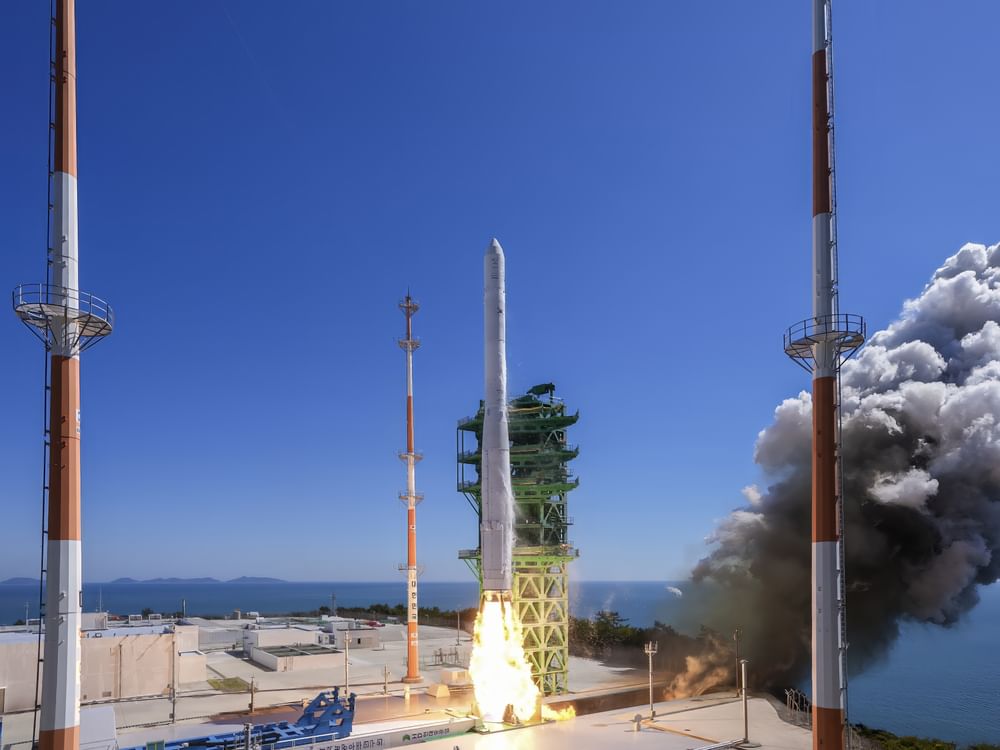
SEOUL, 7th October, 2026 (WAM) -- The Republic of Korea on Wednesday launched its homegrown Nuri rocket on its fifth flight, successfully placing 15 satellites into orbit, including five that will form part of the country's first domestically launched microsatellite constellation.
Yonhap News Agency reported that the 200-tonne Nuri rocket lifted off from the Naro Space Centre in Goheung, about 400 kilometres south of Seoul. The payload consisted of five New-space Earth Observation Satellite Constellation for National Safety (NEONSAT) microsatellites and 10 CubeSats.
The Korea AeroSpace Administration (KASA) said Nuri's first and second stages successfully separated before the rocket deployed the satellites at an altitude of around 575 kilometres.
After releasing all 15 satellites, Nuri will perform a collision-avoidance manoeuvre and vent its remaining fuel, completing its flight about 20 minutes after liftoff. The rocket will then remain in orbit before eventually re-entering Earth's atmosphere and burning up.
The fifth flight marks Nuri's first attempt to sequentially deploy multiple primary satellites designed to perform the same mission.
Each NEONSAT weighs less than 100 kilogrammes and carries an electro-optical camera capable of distinguishing objects as small as 1 metre in black-and-white images and 4 metres in colour images. The satellites will monitor the Korean Peninsula and surrounding areas for national security and disaster response.
The NEONSAT constellation will eventually consist of 10 satellites. Another five will be launched aboard Nuri's sixth flight, scheduled for next year, to complete the constellation.
Once fully operational, the constellation will be capable of imaging the Korean Peninsula more than three times a day and revisiting the same location within 24 hours.