
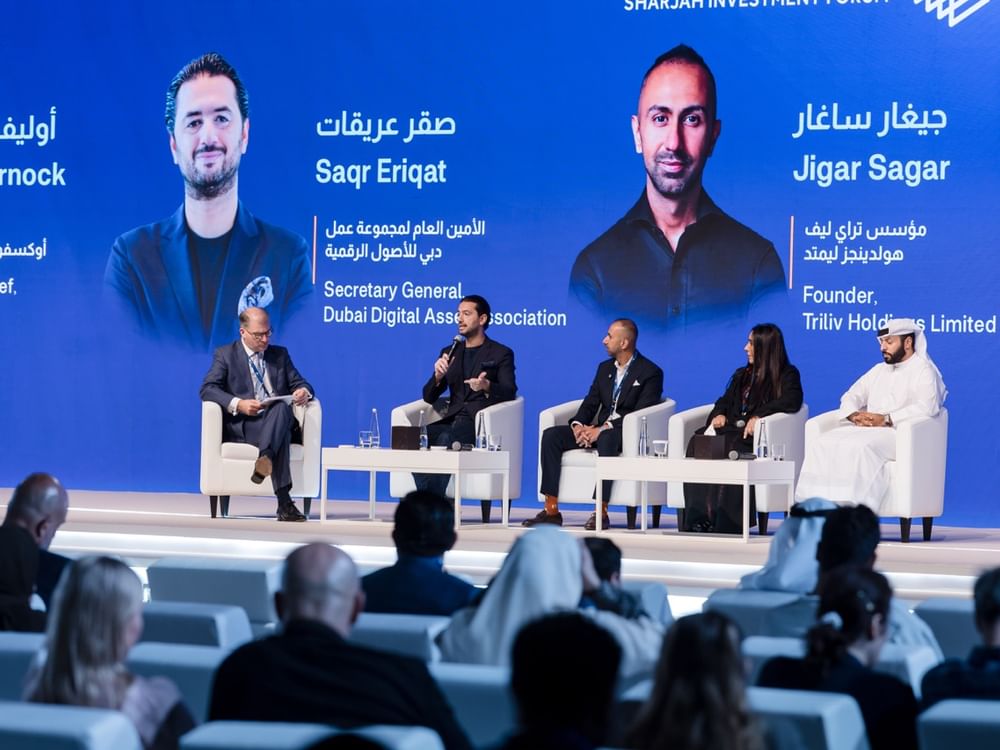
SHARJAH, 15th October, 2026 (WAM) -- The UAE is all set to become the main crossing point for capital moving between East and West. And all of this is to happen within the next five years, building on a regulatory framework that has drawn one of the world's largest groups of licensed digital asset companies, the head of the Dubai Digital Asset Association said on the opening day of the Sharjah Investment Forum (SIF) 2026 on Wednesday.
Speaking at a panel titled "Capital Without Borders: Where Smart Money Is Moving Next," Saqr Ereiqat, Secretary General of the association, was joined by Jigar Sagar, Founder, Triliv Holdings Limited, Amer Al Ahbabi, Chairman of Vertix Holdings and Khuloud al Omian, CEO & Editor-in-chief, Forbes Middle East – all of whom agreed that trust, custody and clear rules, rather than returns alone, now decide where mobile capital settles. The panel was moderated by Oxford Business Group editor-in-chief Oliver Cornock.
Ereiqat said the UAE has built its position “deliberately”. It was among the first governments to publish a blockchain strategy, it has become one of the largest state holders of digital assets, and it set up dedicated regulators such as Dubai's Virtual Assets Regulatory Authority (VARA). He said global exchanges, including Crypto.com, had chosen the UAE for its regulatory landscape, and that the country now competes with the UK on talent density.
“Today, the UAE has the cohort of the largest regulated entities anywhere in the world, and that happened very deliberately,” Ereiqat said. “Trust is the new currency, and the UAE is winning. The UAE has become the new Switzerland. In the next five years, I believe it will become the pivot point for capital moving from West to East and East to West.”
Amer Al Ahbabi, Chairman of Vertix Holdings, said the company spent two years reviewing digital asset businesses before partnering last month with a Spanish firm, because it holds investor assets in independent custody. "Any investor wants to be 100% assured that their assets are well managed, whether it is a building, a business or shares in a company," Al Ahbabi said. "Governance and integrity are not things we ask for; we have to impose them, using the technology and systems now being created."
Talking about family offices, Al Ahbabi spoke about how Vertix recently worked with Dubai Chambers to train more than 30 family offices in governance and board practice.
Prominent UAE-based serial entrepreneur and investor Jigar Sagar, who’s launched and scaled more than 30 ventures with a combined enterprise value exceeding $350 million, said the UAE leads on regulation, but the “harder test” was adoption across government and the market.
"Capital doesn't just move with opportunity; it moves with confidence," Sagar said, pointing to the Dubai Land Department's work on property tokenisation as an example of the state acting as the first client for a new concept. "Having laws is a great start, but execution is what brings the end result. Capital is abundant. What's lacking is access to it and traditional sectors such as financial services, education and healthcare will be among the first to use tokenisation to raise money."
Khuloud Al Omian, CEO and Editor-in-Chief of Forbes Middle East, said investors remain cautious about digital assets. Many still prefer tangible assets such as real estate.
"Investors look for stability, clear regulation, transparency and leadership, and they want risk reduced as much as possible," Al Omian said. "With digital investment there should be no grey area; we need to build the ecosystem and the culture around it. Long term, money will go to opportunities that change our lives for the better, in food and water security, healthcare and education."
Organised by the Sharjah FDI Office (Invest in Sharjah) in collaboration with the UAE Ministry of Investment, the two-day event is being held under the theme ‘Building Adaptive Economies.'