
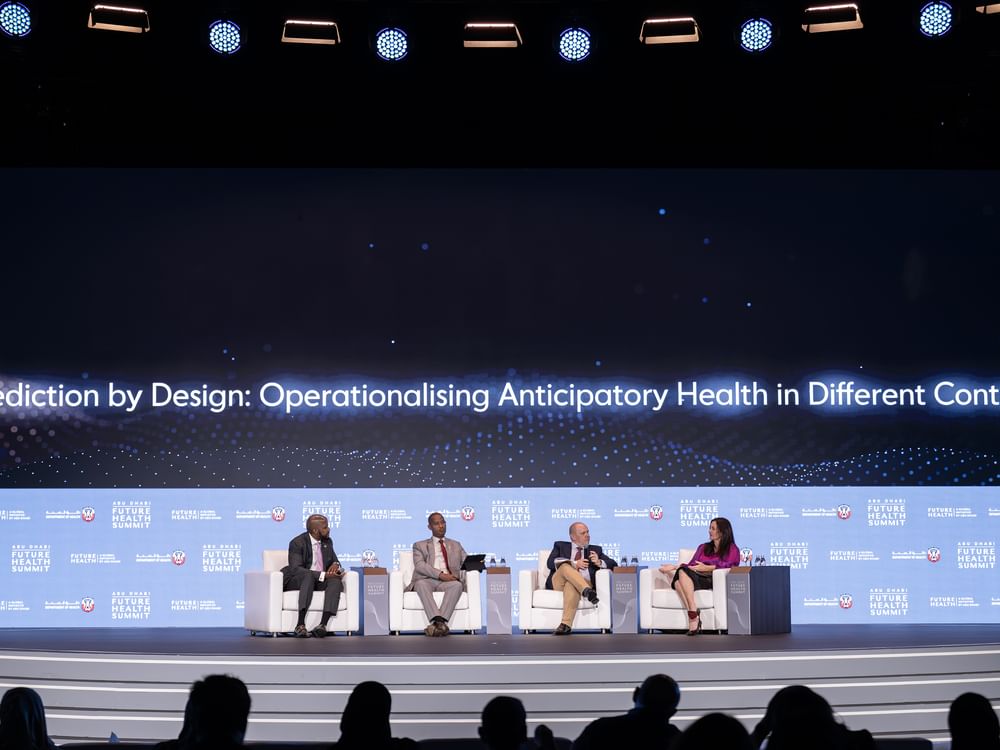
ABU DHABI, 21st October, 2026 (WAM) -- A session entitled "Prediction by Design: Operationalising Anticipatory Health in Different Contexts", held during Abu Dhabi Future Health Summit 2026, explored the use of health data, artificial intelligence (AI) and genomic sequencing to predict health risks and enable early intervention, with the participation of senior health officials from Botswana, Burundi and Russia.
Dr. Stephen Modise, Botswana's Minister of Health, emphasised the importance of harnessing genomics, precision medicine and AI to identify health risks and guide preventive and therapeutic interventions.
He said Botswana was working with partners in the UAE, particularly Abu Dhabi, to accelerate the use of genomic sequencing to improve health outcomes, with the ambition of positioning the country as a regional hub for these technologies in sub-Saharan Africa.
Referring to a case presented during the summit involving a one-month-old girl whose doctors had access to health information that could inform her care throughout her life, exceeding the information available about her grandfather, Dr. Modise said such data could help identify health risks and deliver appropriate interventions to individual patients at the right time.
He added that this approach could improve treatment outcomes and spending efficiency, alongside partnerships with pharmaceutical companies and healthcare institutions and the use of assistive technologies to develop services tailored to patients' needs.
On pandemic preparedness, he said Botswana was accelerating digital transformation, building capacity and developing institutions across sectors, drawing on lessons from the COVID-19 pandemic to improve information sharing, public communication and responses to health threats.
Dr. Fidèle Nkezabahizi, Burundi's Minister of Public Health, stressed that advancing anticipatory healthcare requires integrating digital solutions and health surveillance systems into national policies and routine healthcare services.
He outlined three priorities: governance, financing and coordination, supported by clearly defined responsibilities and investment in equipment, connectivity, maintenance and training, while ensuring that external assistance aligns with national priorities.
He said stronger coordination between central, district and community health services would help translate information into decisions and action, advance universal health coverage, improve access to and quality of care, and reduce financial burdens on patients.
He stressed that initiatives should be assessed by improvements in health outcomes, service efficiency and equitable access rather than the number of devices deployed. Strengthening community services and using routine health data, he added, could deliver meaningful benefits without requiring expensive technologies.
Vladimir Zelenskiy, First Deputy Minister of Health of Russia, highlighted the importance of using data to inform medical decisions and predict health risks.
He said Russia was drawing on electronic medical records and a decade of insurance claims data to develop individual clinical and behavioural profiles, identify healthcare needs and patterns of clinic attendance, and design proactive screening programmes, particularly for patients with chronic diseases, as well as new healthcare services.
He explained that approximately 90% of healthcare in Russia is covered by public health insurance. Rather than consolidating all clinical information in a single central database, the system retrieves relevant data from electronic medical records for specific purposes to reduce cybersecurity risks.
Zelenskiy said Russia's public health insurance covers wearable devices registered as medical devices, while expanding government coverage involves policy and financial considerations, unlike the greater flexibility of private insurance.
He stressed that the value of health data and technology depends on their practical application in organising care, predicting risks and designing incentive models, while other information may be useful for scientific research.
He noted that whole-genome sequencing was not necessarily required for everyone unless its results could be translated into meaningful benefits for individual patients.
Zelenskiy also cautioned that pursuing accuracy beyond 95% or 96% could substantially increase research and drug development costs, underscoring the need to balance precision with economic feasibility.
He highlighted the importance of training healthcare professionals to use emerging technologies, noting that Russia has approximately 850,000 doctors and more than 1.5 million nurses whose work could be supported by AI when appropriately deployed.
He added that population ageing and relatively stable physician numbers require new approaches to patient communication, care delivery and information collection, particularly as the needs of older people evolve.
Zelenskiy stressed that scaling healthcare innovations across government systems requires robust evidence of effectiveness to avoid the potentially high costs of mistakes when solutions are implemented on a large scale.