
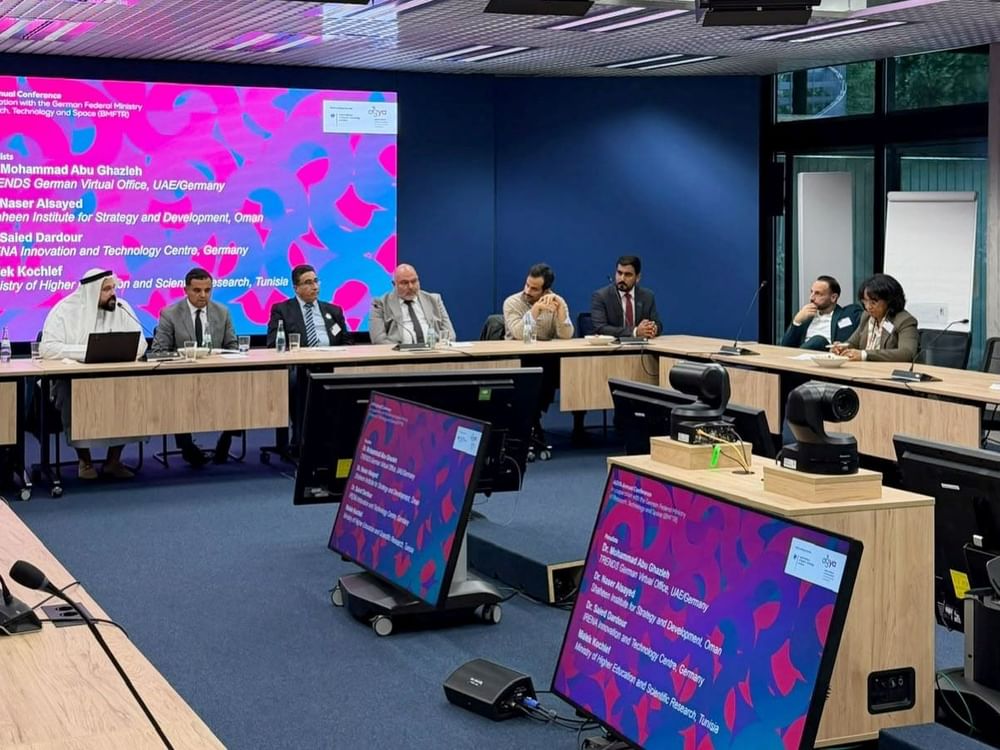
ABU DHABI, 27th October, 2026 (WAM) -- TRENDS Global, part of TRENDS Group, concluded its participation through its virtual office in Germany as a guest of honour at the Arab-German Young Academy of Sciences and Humanities (AGYA) annual conference.
Held in Bonn, Germany, under the theme "Polycentric and Participatory Knowledge Production: Research Collaboration Across Borders and Disciplines", the conference took place under the patronage of Germany’s Federal Ministry of Research, Technology and Space (BMFTR).
TRENDS researchers contributed to an extensive panel discussion titled "Technology, Minerals and Power". Their contributions focused on how governments can strengthen their strategic positions amid a rapidly evolving technological landscape, and how research institutions and think tanks can help policymakers respond to emerging challenges.
They emphasised that control over technology and critical minerals is shaping the multipolar international order, while the expansion of artificial intelligence and data centres is driving up global energy demand.
Dr. Mohammad Abu Ghazleh, Senior Researcher and Director of TRENDS’ virtual office in Germany, said technology and critical minerals are no longer merely economic assets but have become important sources of geopolitical influence.
He added that the rapid expansion of AI and data centres is increasing demand for reliable electricity. Countries that can combine abundant energy resources with advanced infrastructure could gain significant competitive advantages.
Dr. Abu Ghazleh noted that having energy resources does not necessarily mean controlling the technologies needed to use them. Governments must therefore invest not only in infrastructure but also in education, research, skilled talent, and domestic industrial capabilities. International cooperation remains essential.
Saif Al-Nuaimi, Researcher at TRENDS Research & Advisory, delivered a presentation titled "From Competition to Cooperation: Building Partnerships for the Future". He emphasised that intensifying international competition in the energy, technology and artificial intelligence sectors is a natural development as countries seek to secure their futures.
He stressed that the real challenge lies in managing this competition and turning it into productive cooperation, noting that partnership-building, knowledge exchange and mutual trust have become more urgent than ever.
Al-Nuaimi explained that research institutions' responsibility goes beyond identifying challenges to helping decision-makers understand them and anticipate potential solutions. This involves bringing together diverse perspectives, bridging the gap between research and policy communities, and translating knowledge into practical ideas.
He concluded that the future of energy security and artificial intelligence will be determined not by competition alone, but by the international community’s ability to establish partnerships built on trust and the exchange of expertise. While competition drives innovation, cooperation is what ensures sustained progress.