
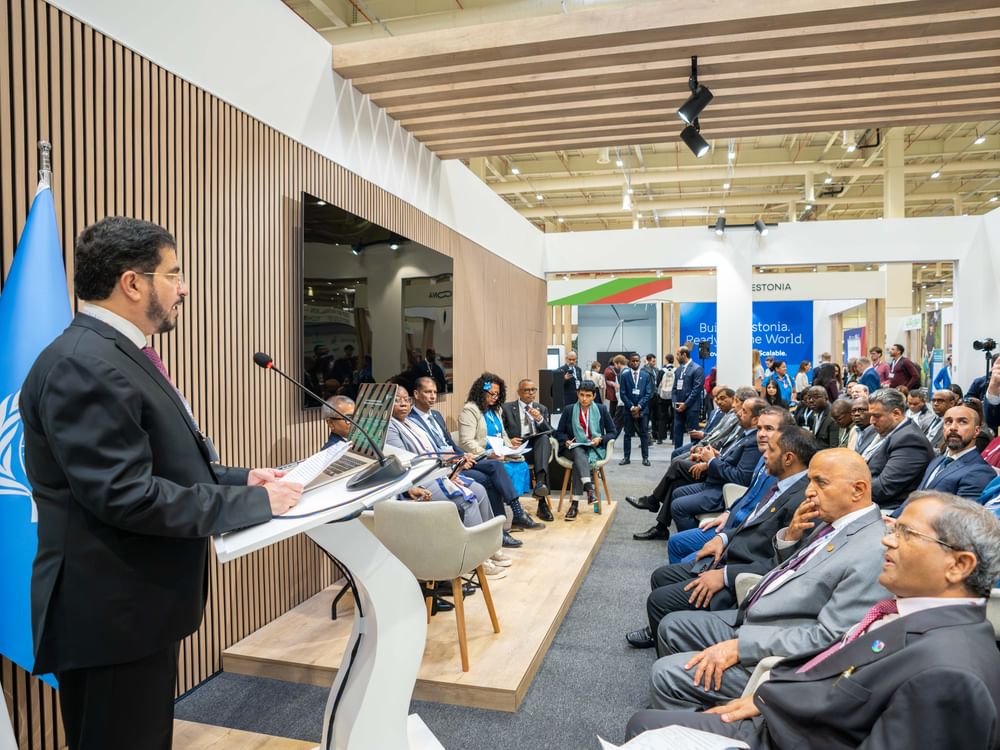
ANTALYA, Türkiye, 18th November, 2026 (WAM) -- Saeed Mohammed Al Tayer, Chairman of the World Green Economy Organisation (WGEO), is leading a high-level delegation from WGEO to participate in the 31st Conference of the Parties to the UNFCCC.
The presence of the WGEO at COP31 is marked by a prominent participation through a dedicated pavilion within the "Blue Zone," where the pavilion serves as a platform connecting governments, the private sector, and financial institutions to discuss supporting the green economy and sustainability momentum worldwide. WGEO’s pavilion hosted several events that provided a space for exchanging expertise and showcasing best practices, thereby reinforcing the pavilion's role as a practical platform linking climate ambition with the financial and technical tools needed to achieve it.
During his participations, Saeed Mohammed Al Tayer opened a high-level ministerial session titled “From Island Vulnerability to Resilience: Mobilizing Green and Blue Investment for SIDS (Small Island Developing States)”, held at the WGEO Pavilion during Ocean, Seas, Nature & Land Use Day at COP31 in Antalya, Türkiye.
The ministerial session was attended by Patric R. Brunings Ir., Minister of Oil, Gas and Environment, Suriname; Marie-May Jeremie, Minister of Environment, Climate, Energy and Natural Resources of the Republic of Seychelles; Dr. Kennedy Swaratsingh, Minister of Planning, Economic Affairs and Development, Republic of Trinidad and Tobago; Thoriq Ibrahim, Ambassador of the Republic of Maldives to the United Arab Emirates; Siniwasa Wakaraimas, Director of Climate Change at the Ministry of Environment and Climate Change of Fiji, representing Lynda Tabuya, Minister for Information, Environment and Climate Change, Fiji; and Dr. Radhika Dave, Senior Technical Advisor, Climate Adaptation and Head of Adaptation and Resilient Societies, United Nations Development Programme. The session concluded with remarks by Gustav N. Aitaro, Minister of State of the Republic of Palau.
In his opening remarks, Al Tayer said: “Our continued presence in the Blue Zone, as in previous Conferences of the Parties, reflects our firm commitment to the multilateral climate process and our conviction that international cooperation remains essential to advancing the global green economy transition. At COP28, hosted by the United Arab Emirates in Dubai, the historic UAE Consensus demonstrated what multilateral cooperation can achieve. Its call to triple renewable energy capacity globally and double the global average annual rate of energy efficiency improvements by 2030 provides a clear direction for action. COP31 comes at a decisive moment.
The international community has established a clear direction through the Paris Agreement and successive climate commitments. Our collective priority must now be to accelerate implementation, mobilize finance, strengthen adaptation and ensure that national ambitions translate into measurable economic and environmental progress.”
Al Tayer added: “We must also achieve climate justice, since developing countries and the poorest communities contribute the least to greenhouse gas emissions, yet they are the most affected by climate change. For Small Island Developing States (SIDS), rising sea levels, extreme weather, water scarcity and biodiversity loss threaten lives and livelihoods, while dependence on imported fossil fuels and limited fiscal space constrain resilience.
Our priority is to focus on renewable energy, resilient infrastructure, water security, sustainable tourism, coastal ecosystems and fisheries, supported by nature-based solutions that can help turn island vulnerability into lasting resilience. The negotiations underway are therefore of particular significance. We support the COP31 Presidency’s efforts to advance outcomes that strengthen international cooperation, facilitate access to climate finance and enable countries, particularly developing economies, to deliver on their commitments. Yet governments cannot achieve this transformation alone.
The private sector has an indispensable role in translating policy commitments into investment, innovation, infrastructure and employment. Whether through expanding renewable energy, improving industrial efficiency or developing climate-resilient infrastructure, meaningful progress depends on aligning public policy with private sector capabilities and investment.”
Al Tayer continued: “This is precisely where the World Green Economy Organisation has a distinctive role. Our mandate brings together governments and the private sector, creating the conditions for cooperation that extends beyond dialogue towards practical implementation. Through our Global Alliance on Green Economy (GAGE), we connect leaders and institutions across 96 countries, providing a framework for international collaboration, knowledge exchange and the advancement of national green economy priorities. This engagement enables us to better understand the needs of governments while facilitating the participation of businesses, financial institutions and development partners in addressing them. Today’s thematic discussions on nature, oceans and land use further illustrate the importance of this approach. Protecting natural resources and strengthening economic resilience require coordinated public policies, as well as private investment in areas such as water efficiency, sustainable agriculture and the restoration of ecosystems.”
Al Tayer concluded: “I commend the Government of Türkiye and the COP31 Presidency for their leadership and recognize Australia’s important contribution to guiding the negotiations. The Türkiye–Australia partnership demonstrates the importance of shared responsibility, constructive dialogue and consensus-building in advancing the multilateral climate agenda. From this platform at COP31, our message to the world is clear: it is time to move beyond negotiations and commitments, accelerate implementation, mobilize investment, and translate global climate ambitions into tangible results on the ground.”