
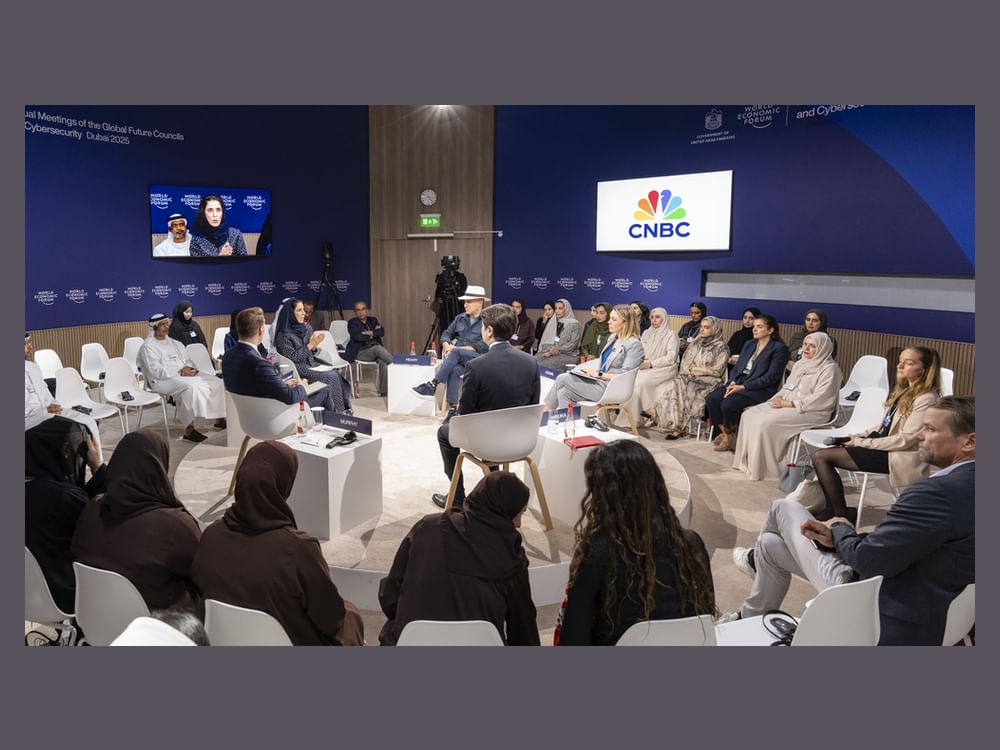
DUBAI, 16th October, 2025 (WAM) – At the Annual Meetings of the Global Future Councils and Cybersecurity 2025, organised by the UAE Government and the World Economic Forum (WEF) on 14-16 October in Dubai, Maryam bint Ahmed Al Hammadi, Minister of State and Secretary-General of the UAE Cabinet, asserted that “We look at regulation not as a barrier, but as a bridge to progress, prosperity, and justice."
This came during the session titled “Regulation: Friend or Foe?”, in the presence of Sheikha Shamma bint Sultan bin Khalifa Al Nahyan, President and CEO of the UAE Independent Climate Change Accelerators (UICCA).
The session explored the strategies that can help governments stay ahead of rapid change and make regulatory systems more agile, adaptive, and forward-looking, with Dan Murphy, Anchor and Correspondent for CNBC, moderating the discussion.
Focusing on emerging technologies like AI, quantum computing, and synthetic biology, the panel brought H.E. Maryam bint Ahmed Al Hammadi together with Rachel Adams, Founder and CEO of the Global Centre on AI Governance, South Africa; Prof. Hiroki Habuka, Research Professor at Kyoto University’s Graduate School of Law in Japan; and Jack Hidary, CEO of SandboxAQ, USA.
"Adaptive regulations will always be relevant and will keep trust in your system alive,” Maryam bint Ahmed Al Hammadi explained, revealing that the UAE strives to ensure regulations are clear, transparent, and adapted by design. “In the UAE, we build flexibility in our legislation system so it can adapt in real time. Emerging technology is moving very fast; it will not wait for our laws and regulation systems to catch up. And that is why we have to plan proactively for it.”
“Furthermore, we co-design our regulations with all our stakeholders, including academics, NGOs, businesses, government entities, startups, and others, so that they are part of the ecosystem we are building in the UAE,” she added, noting that efforts are also under way to expand this collaborative process globally. “We work with the World Economic Forum on the Global Regulatory Innovation Platform, where we invite all countries to share their practices and experiences to start a dialogue.”
For his part, Prof. Hiroki Habuka remarked that it is almost impossible for regulation to capture every detail of fast-moving technology. “In Japan, drafting a law can take two or three years, which is like ten years in the AI industry,” he said, adding that regulations should be more outcome-based and principle-driven rather than rigid and rule-based, where guidelines, standards, and other “soft law” tools can evolve more quickly, ensuring agility and accountability.
“It is not the right approach to try to make uniform regulation all over the world,” Prof. Habuka continued. “And that is why the Japanese government strives for interoperability, not the hegemony of certain values.”
As the head of a company that is bullish in its adoption of advanced technologies, Jack Hidary said: “Often one of the greatest dangers of a new technology is not that it will be used, but that it will not be used. The old methods meant taking 15 years to develop a potential drug, for example, so I think there is a good sense now that we should focus on outcomes.”
“One thing that we recommend building into regulation is the ability to convene because one of the powers of government that is the strongest but most underused is the power of convene,” he added, noting that the UAE is a great model in this regard. “Here, government workers see themselves as entrepreneurs. I think encouraging that is fundamental if we are going to adopt these technologies in a productive way, rather than seeing regulation as control.”
On the same topic, Rachel Adams stressed that, “When we speak of AI governance, we need to ask: who needs to be regulated? We don’t want to be regulating or putting too large a compliance burden on local small innovators, but we also want to be creating fair markets and ensuring that there isn’t dominance of particular players in particular areas.”
“My big concern is that the benefits and opportunities of AI are not equally distributed. Law making is slow, deliberately so, so that we have meaningful public participation and deliberation, and so that we think through the various consequences,” she explained, adding that global cooperation is essential because big tech operates across borders.