By Binsal Abdulkader
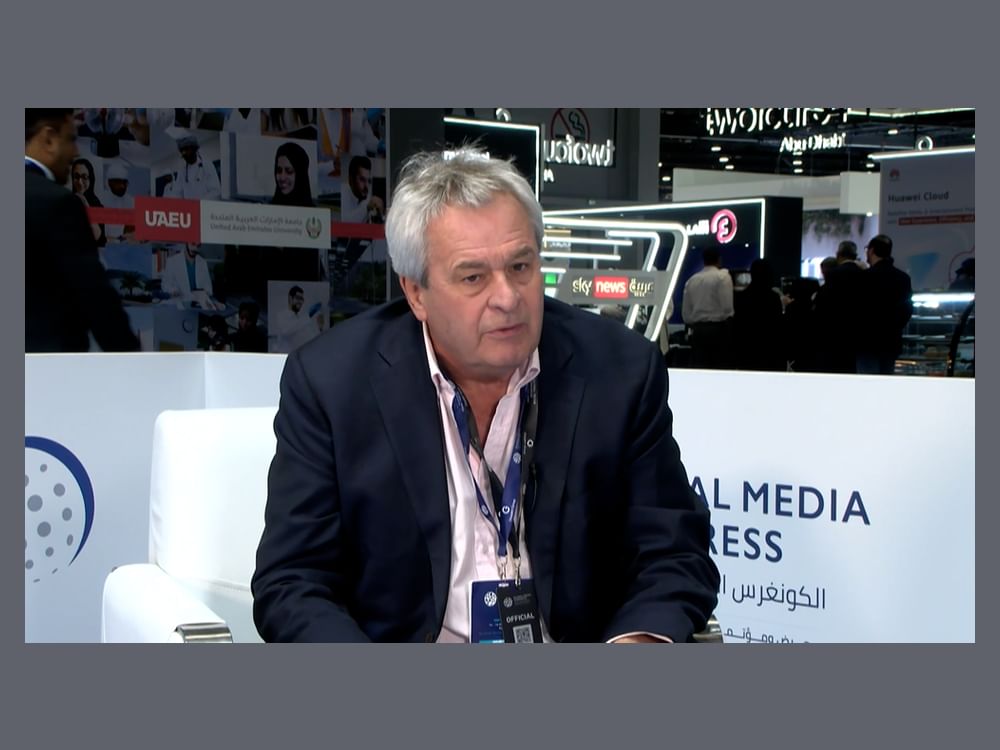
ABU DHABI, 9th January, 2024 (WAM) -- Dismissing the news as irrelevant to their lives, a segment of the younger generation is hindering their ability to change the world, says veteran British journalist Jonathan Clayton.
Following the news is crucial for understanding environmental policies, choosing a university, and staying informed about sports, says Clayton who has worked as foreign correspondent, writer and editor for more than 40 years.
“Most youngsters say today they would like the world to be different. They would like to change society. In order to change, you should know what makes that society tick, what is happening,” he tells the Emirates News Agency (WAM) in an interview during the recently held Global Media Congress (GMC) in Abu Dhabi, where he was a speaker.
Advocating for better policies
He gives the example of young individuals aspiring for improved environmental policies. Youngsters cannot advocate for something better if they do not know the existing policy and what their governments are doing in that regard, points out Clayton who is a passionate environmentalist and involved in several conservation projects around the world.
“So, you have to be involved if you want to change the world.” Regardless of personal interest, he suggests, awareness of news, including serious topics such as sports, is crucial. Following the news is also important for keeping up with your favourite football team and other teams, he emphasises.
A prominent journalist with experience of running Reuters East Africa bureau in the 1990s, Clayton was also Africa correspondent for The Times of London from 2002-2014.
Neglecting one’s responsibilities
News is important for the youngsters who want to go to university, asserts the senior journalist. “You have to know what areas are growing [to choose the type of higher education].”
An aspiring doctor has to know about the potential areas of higher studies in medicine. “So, really, it is not good enough to say I am not interested in the news,” he stresses, saying they are not interested might sound appealing, but it is simply an irresponsible excuse.
The veteran journalist had reported developments in Somalia, Sierra Leone and Liberia, the 1994 Rwandan genocide, and Nelson Mandela’s liberation in post-apartheid South Africa as the Africa correspondent; and the Balkan civil wars.
Short content, in-depth works
Asked about the debate on whether short-form content or long-form content is appropriate for the present-day audience, Clayton answers, “I do not think it is what we call a zero-sum game. I do not think you have to choose between the more in-depth, academic articles, and short, attractive content. Ideally, what you want to do is attract people with a small, hard-hitting attractive thing and lead them into the bigger more in-depth article.”
He points out that everyone does not want long articles, except those who look for specialised information and want to dig deeper. “So, there is a role for both.”
At the same time, Clayton believes that for an in-depth article to attract audience, it should be presented in an interesting way. “That is the art of journalism. It should be attractive. It does not need to be like PhD papers in scientific journals. It can still be presented in a way that is understandable, easily absorbed, and readable.”
AI challenge
Regarding advancements in artificial intelligence (AI), the prominent media person says AI is coming up really fast, posing a huge challenge to our personal and professional life.
“How do we ensure that it is used for the right reasons such as advanced medical research and helping people who do not have access to doctors? At the same time, there is disinformation, the misuse of this advance technology by disreputable politicians, businessmen and criminals.”
According to Clayton, the Global Media Congress (GMC) has effectively addressed the impact of AI on the media sector.
“When I look at artificial intelligence and the challenges it is going to have for newsrooms and for media production, it has really made me very much more aware of how we have to be ready at all levels to deal with this new challenge.”
Clayton reported on the 2015 refugee influx into Europe and directed coverage of the first-ever team of refugee athletes at the Rio Olympics in 2016. He was founding Editor-in-Chief of the New Humanitarian, the award-winning humanitarian information service, and recently set up a new reporting network focusing on emerging militants and other threats to Africa.
Global Media Congress
Under the patronage of His Highness Sheikh Mansour bin Zayed Al Nahyan, Vice President, Deputy Prime Minister and Chairman of the Presidential Court, the second edition of the Global Media Congress themed ‘Shaping the Future of the Media Industry, took place in November. The three-day international event was organised by ADNEC Group in strategic partnership with WAM at the Abu Dhabi National Exhibition Centre.
The latest GMC saw a phenomenal increase in attendance, with 23924 visitors, compared to 13556 the previous year, showing a 76.48 percent increase. The number of participating countries also increased, with 172 countries, among them 31 new countries participating for the first time. Covering 32,000 square metres, the Congress’s footprint grew 78 percent from last year, attracting 160 overall speakers from 18 different countries.