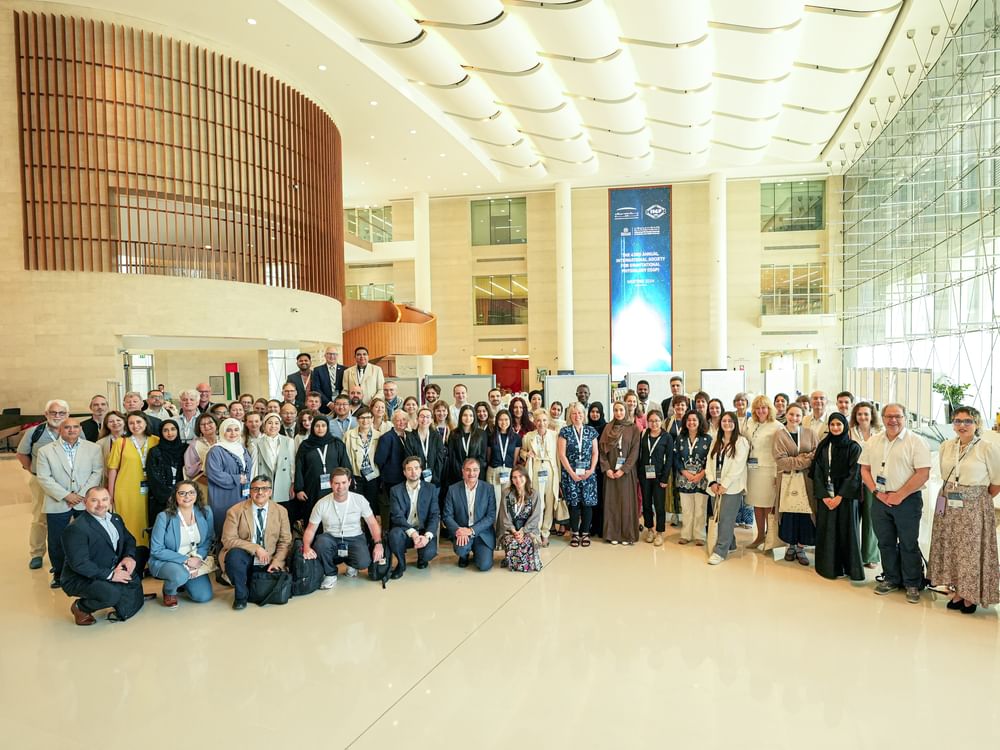
DUBAI, 30th May, 2024 (WAM) -- The 43rd Annual International Society for Gravitational Physiology (ISGP) Meeting, hosted by the Mohammed Bin Rashid Space Centre (MBRSC) and held for the first time ever in the Arab world, came to an end with a closing ceremony on Thursday. Over the course of four days, the gathering fostered an exchange of knowledge on the biological and physiological effects of gravity on living organisms, which is crucial for overcoming the challenges of long-duration space missions and enhancing our understanding of life beyond Earth.
The annual meeting began on May 27, with an opening ceremony that was held in the presence of Salem Humaid AlMarri, Director General, MBRSC, Dr. Amer Ahmad Sharif, CEO of Dubai Academic Health Corporation and President of MBRU, Prof. Marc-Antoine Custaud, President of ISGP, Hazzaa AlMansoori, Astronauts Office Manager, MBRSC and other dignitaries.
The event, which took place at the Mohammed Bin Rashid University of Medicine and Health Sciences (MBRU), brought together more than 125 attendees, including scientists, representatives from global space agencies such as National Aeronautics and Space Administration (NASA), European Space Agency (ESA),German Aerospace Center (DLR) DLR, young researchers, and students.
Salem Humaid AlMarri, Director General, MBRSC, said, “We are proud to have hosted this year’s ISGP Annual Meeting for the first time in the Arab world. The extensive participation and the high calibre of discussions have truly highlighted the significance of international collaboration in the field of gravitational physiology. The UAE is dedicated to not only participating in but also leading the global dialogue on space research, and this event has been a testament to our strategic vision and continued pursuit of excellence. We look forward to the continued impact and collaborative efforts that will enable the execution of transformative ideas and pioneering research to drive the future of space exploration.”
Adnan AlRais, Assistant Director General - Space Operations and Exploration Sector, MBRSC, said, “The 43rd ISGP Annual Meeting has been a remarkable platform for enhancing international cooperation in gravitational physiology. The insightful presentations and fruitful dialogues have opened new avenues for investigation and research. We are proud to have facilitated such a key event and look forward to the scientific breakthroughs that will emerge from the discussions held here.”
The 4-day meeting featured plenary sessions on key topics, including 'The Lunar Challenge: Lunar dust and the human being in Moon mission' and ‘LBNP as countermeasure,’ while papers were presented on a range of subjects, such as SIRIUS and isolation studies, immunology, cardiovascular system, hypergravity, health and cellular function, among others. Furthermore, the organisers provided a networking event to support the growth and connection of young scientists within the field.
The event also saw a session by astronaut Dr. Sultan AlNeyadi, during which he highlighted the value of conducting biology and medical experiments aboard the ISS and further talked about the key milestones of his journey since joining the UAE Astronaut Programme. Fatma Lootah, Manager, Space Life Sciences Section, MBRSC, also gave an overview of the MBRSC’s programmes and missions, while in another session, Dr. Saif Salah Alqassim, Assistant Professor of Biochemistry, MBRU, and Prof. David Sheehan Dean of College of Arts and Sciences, Khalifa University, discussed the Protein Crystal Growth experiment which was conducted by AlNeyadi in space.
Another highlight of the event was the Young Investigators Award, which provided a platform for students and young researchers to present their studies in the field of gravitational physiology. With 38 research abstracts submitted, the top 12, including two from the University of Sharjah, presented their work in plenary sessions over the course of the meeting.
Judged by a panel of senior scientists from academia, industry, and space agencies, the first place for the Young Investigators Award was given to Victoria Ly from the University of California, San Diego, USA, for the abstract titled ‘Self-Generated Lower Body Negative Pressure Exercise, a Low Power Countermeasure for Deep-Space Missions’. The second place was awarded to Shannon Marchal from the Otto-von-Guericke University, Magdeburg, Germany, for the abstract titled ‘Research into “Lunar Hay Fever” on Earth – Finding Answers in an in Vitro Airway Model?’, while third place went to Zhiyao Ma from the University of Alberta, Edmonton, Canada, for the abstract titled ‘Exploring the Impact of Simulated Microgravity on Osteoarthritis Development: The Role of CD36 and Sex-Specific Responses in a Mouse Model’.
Annual International Society for Gravitational Physiology concludes in Dubai