
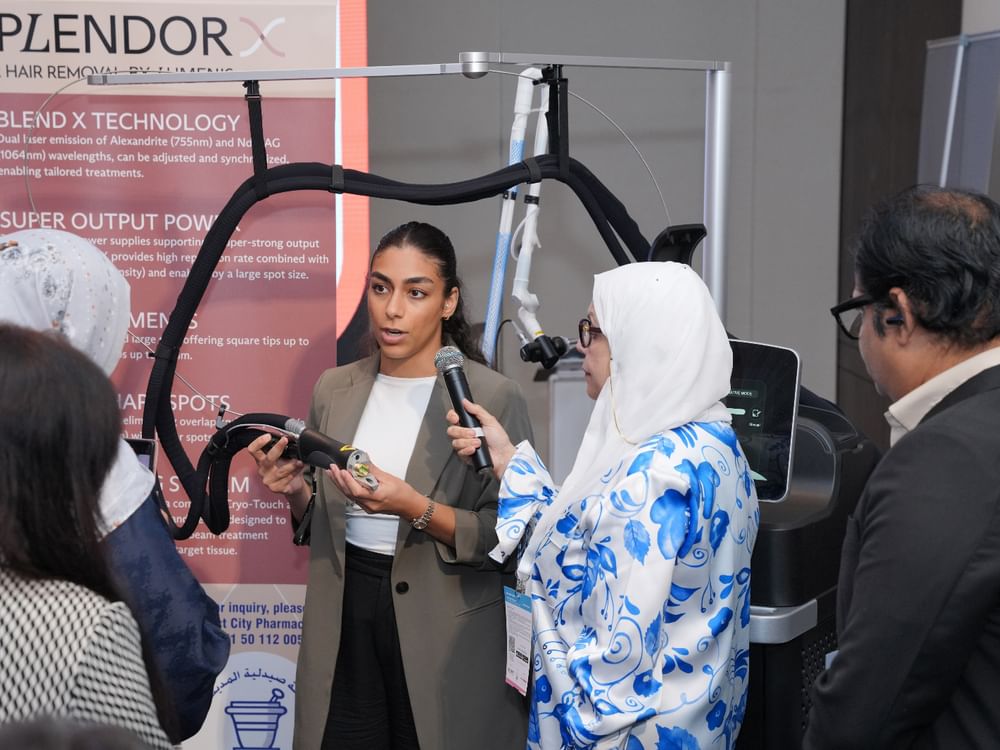
ABU DHABI, 4th May 2025 (WAM) -- Delegates attending the 11th edition of the International Conference in Dermatology and Aesthetics (AIDA) in Abu Dhabi emphasised the significance of ongoing professional development for newly qualified medical practitioners, with a view to acquiring additional experience and refining their competencies.
Furthermore, emphasis was placed on the significance of providing support to newly qualified doctors through workshops help them familiarise with the most recent developments in medical techniques, practices, and treatment methods. They further help doctors acquire the skills necessary to utilise contemporary devices and technologies, thereby ensuring greater precision and safety in the delivery of treatment.
The participants further stressed the importance of organising scientific competitions for newly qualified doctors is vital, as they provide doctors with more knowledge and practical experience in the field of dermatology and aesthetics.
The speakers emphasised the significance of augmenting the utilisation of artificial intelligence in medical and plastic surgical contexts. They highlighted the potential of AI in medical practices to facilitate treatments that are more intelligent, secure, and dependable.
The conference's scientific committee said that the discussions during the three-day sessions, which were attended by a group of top dermatology experts and specialists, focused on a group of skin diseases that affect the quality of life of millions of people around the world. The most common of these conditions are psoriasis, acne, alopecia areata and problems with general hair care.
These diseases are not just about how someone looks. They are serious long-term health problems that are often linked to the immune system. They need to be treated for a long time, and doctors need to have a lot of scientific knowledge.
As stated by the scientific committee of the conference, the discussions centred on pigmentation disorders, onychopathies, and most pertinently, cutaneous malignancies, which have become a significant public health concern in numerous regions. The conference highlighted the necessity for early diagnosis, public awareness, and effective treatment methods for this disease.
The committee also said that the conference focused on important things that medical practitioners need to know and provided an opportunity to review current developments in dermatology, helping to keep up to date with new research and clinical guidelines. It also gave specialists the tools to use this knowledge to look after patients, whether that was finding rare skin conditions, dealing with difficult cases or picking the best treatment. These sessions help us to make better clinical decisions.
The conference facilitated the exploration of novel therapeutic interventions for various dermatological conditions, encompassing biological therapies for autoimmune skin disorders and innovative delivery mechanisms for conventional medications. The discourse was anchored in empirical evidence, ensuring the relevance of the discussed treatments to actual patient care.
The practical workshops provided valuable opportunities to interact with the latest diagnostic tools, such as ultrasound imaging in dermatology, which is proving increasingly useful in diagnosing and monitoring skin diseases. It is vital to emphasise the importance of safe injections through proper training. The use of ultrasound-guided injections is now more practical than ever, thanks to the development of fingertip ultrasound. This facilitates the procedure without the need for hands.
The conference further showcased the SibUS™ innovation, a pioneering advancement in the domain of ultrasound injection technology for dermatological and aesthetic applications. The system has been developed for the primary purpose of assisting practitioners in the prevention and management of complications associated with aesthetic procedures. It represents a pioneering development as the first miniaturised ultrasound system specifically designed for aesthetic procedures.
The device is equipped with a digital probe that is mounted on the fingertip, thus facilitating direct imaging of the hand and enabling precise control.
Developed by Dr. Asher and an international panel of experts, the FDA-cleared and CE-certified SibUS-In® is lightweight and easy to integrate into daily practice, enabling seamless and effective treatments. The technology provides real-time anatomical insights for safer, more precise treatments and better complication management. The device is ergonomic and ideal for use in curved and complex areas. It can be operated with either hand, allowing consistent access to the desired injection point.
The last day’s sessions were conducted remotely and attended by a significant number of specialists and experts in dermatology and aesthetics, as well as representatives of specialised dermatological, cosmetic and laser societies from the GCC countries, Middle East and international institutions.