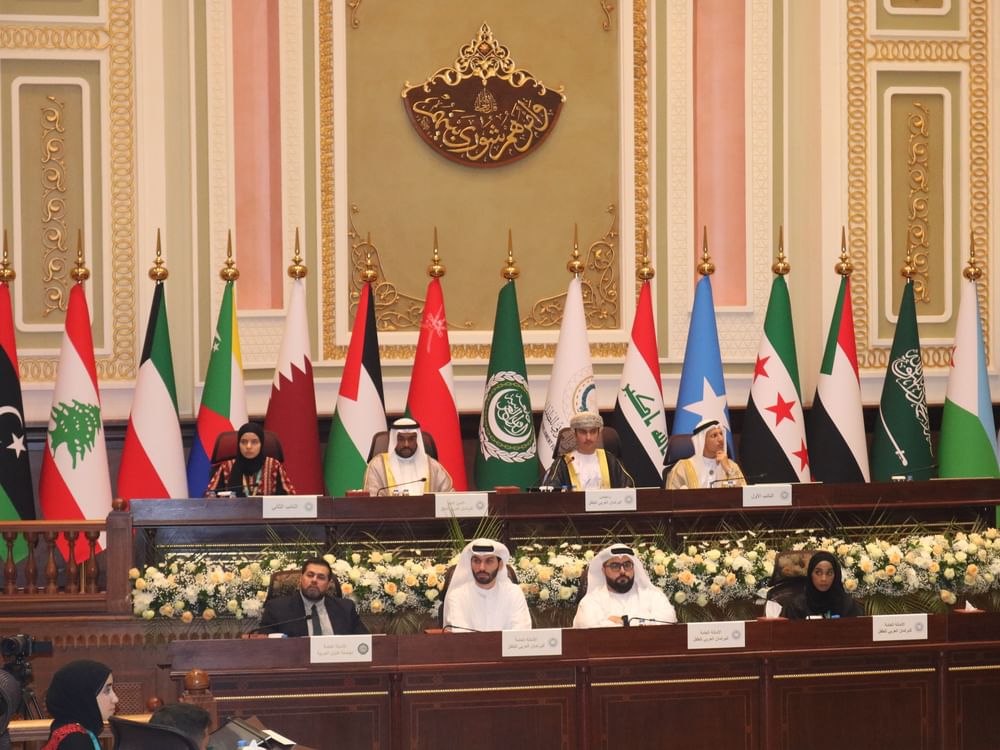
SHARJAH, 27th July, 2025 (WAM) – The Arab Parliament for the Child held its second session yesterday as part of the activities of its fourth parliamentary term, at the Consultative Council of the Emirate of Sharjah. The session was attended by 56 child parliamentarians from 14 Arab countries, in the presence of Mohammed Al Yamahi, President of the Arab Parliament, Halima Al Owais, Vice Chairperson of the Sharjah Consultative Council, several members of the Council’s Office and Committee Chairs.
The session, titled “The Cultural Identity of the Arab Child”, reaffirmed the Arab Parliament for the Child’s commitment to instilling cultural and civilisational belonging in the hearts of the emerging generation and enhancing the presence of the Arabic language, along with authentic customs and traditions, in the face of cross-cultural challenges seen globally.
The session was chaired by Elias Al-Maani from the Sultanate of Oman, President of the Arab Parliament for the Child, reaffirming the Parliament's approach to enabling children to assume leadership responsibilities during parliamentary sessions, and to refine their discussion and expression skills while promoting initiative and participation.
Ayman Othman Al-Barout, Secretary-General of the Arab Parliament for the Child, emphasised the importance of raising the issue of cultural identity during this critical stage of Arab childhood awareness. He said: “The question of identity is no longer a cultural luxury; it has become an existential necessity to protect the self from dissolution in a fast-changing world.''
Al-Barout added that the Parliament today serves as a unified Arab platform for promoting identity and developing children’s skills through training, empowerment, and active participation.
The session witnessed strong engagement from members, who presented diverse contributions addressing the importance of preserving the Arabic language, and the role of the family, school, and media in safeguarding cultural identity and confronting digital and foreign cultural challenges.
Several speakers stressed that the Arabic language is the backbone of identity and that a child’s connection to their mother tongue must be strengthened through educational curricula and cultural activities. Others pointed to the importance of developing media content tailored to children that reflects Arab values and presents positive role models in an engaging and safe environment.
The members of the session affirmed that preserving the cultural identity of the Arab child can only be achieved through joint and organised Arab efforts, stemming from a shared vision aimed at safeguarding the Arabic language, culture, and collective consciousness of future generations.
In this context, a set of purposeful recommendations was presented, most notably: the development of a dedicated Arab digital platform for children that offers interactive content to strengthen the Arabic language and promote cultural identity, as well as a proposal to establish an Arab National Day for Cultural Identity, followed by an annual week in schools and community centres to instil a sense of belonging in young people.