
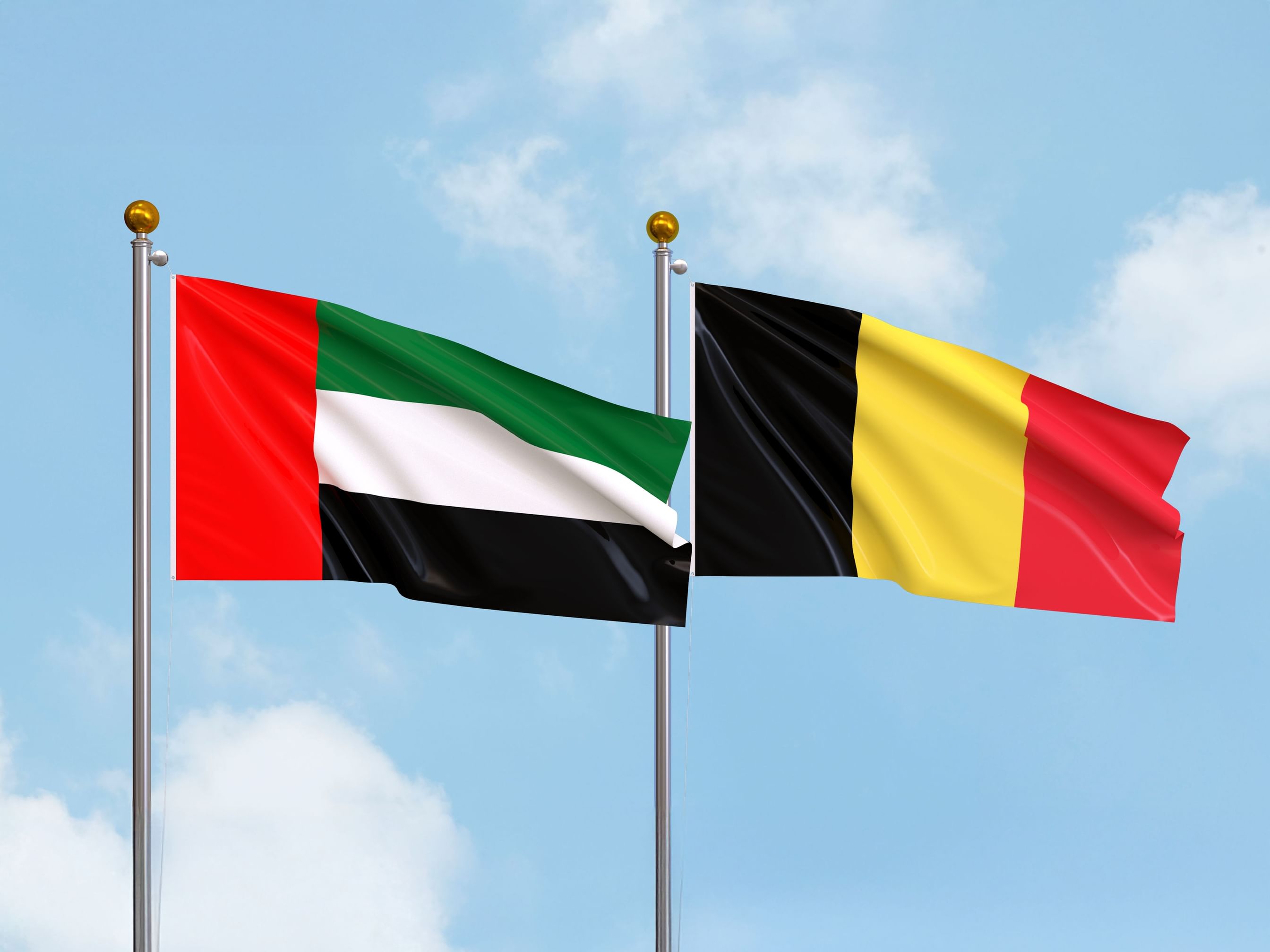
BRUSSELS, 27th August 2025 (WAM) -- The Brussels Times, Belgium’s largest daily news media in English, affirmed that the partnership between the United Arab Emirates and Belgium has become a strategic necessity dictated by the interest of global stability, and goes beyond symbolism in the fields of security, economy, and innovation.
Brussels Times stated in an article on its news platform about the importance of relations between the United Arab Emirates and Belgium that, in this new era of shared uncertainty, Belgium and the UAE can no longer afford to view their partnership as secondary. It must be recognised for what it truly is: a vital, strategic alliance that advances shared interests—not only in security, but also in trade, investment, and innovation—at a time when resilience requires both economic and geopolitical alignment.
The war in Gaza has brought this reality into sharp focus. Belgium has become the centre of a fraught internal debate over Middle East policy. In June, Brussels saw one of its largest pro-Palestinian rallies—an estimated 75,000 to 100,000 people demanding a ceasefire and formal recognition of a two-state solution.
Public pressure has encouraged policymakers to demonstrate Belgium’s commitment through practical measures. While most parties continue to endorse a two-state solution, Belgium’s governing coalition has yet to reach consensus on diplomatic recognition.
In the interim, Belgium has turned to humanitarian measures to signal its commitment. Among the most visible is the use of military aircraft to air-drop aid into Gaza. Under Operation Cerulean Skies 2, the Belgian Defence Ministry has carried out multiple missions since early August, delivering 190 tonnes of food, water, and medical supplies—making Belgium the second-largest contributor in this multinational effort, after the UAE.
The Emirates, which has been conducting humanitarian airdrops into Gaza since late 2023 alongside partners like Jordan, had already carried out multiple missions, demonstrating decisive action and a recognition that traditional delivery routes were no longer sufficient. Belgium’s participation in similar operations reflects a growing convergence with this pragmatic, solutions-oriented approach.
What makes this alignment particularly significant is how it is being institutionalised in Brussels itself. On the sidelines of the European Humanitarian Forum in May 2025, Dubai Humanitarian—one of the world’s largest humanitarian logistics hubs—signed a landmark administrative arrangement with the EU’s Directorate-General for Civil Protection and Humanitarian Aid Operations (DG ECHO).
The agreement, witnessed by Belgian and EU officials, commits both sides to closer coordination in supply chains, crisis response, and emergency preparedness.
For Belgium, this was more than a diplomatic footnote. It underscored the country’s role not just as Europe’s capital but as the bridge through which the UAE’s humanitarian leadership is projected onto the continent.
In doing so, it reframed the relationship: no longer symbolic gestures of goodwill, but a recognition that responding to crises like Gaza—or any future disaster—requires partnerships that are fast, efficient, and strategically rooted in shared values.
Belgium’s broader approach to the MENA region mirrors the UAE’s in critical ways. Both nations understand that diplomacy, not military adventurism, is the only viable path forward in a region fractured by complex rivalries.
This is also the approach that the UAE has adopted in recent years: prioritising de-escalation, building bridges between rivals, and embracing diplomacy over confrontation. These shared instincts are not coincidental; they are the bedrock of why Belgium and the UAE are natural partners.
Economically, the foundation is strong but still under-leveraged. The UAE is Belgium’s second-largest trading partner in the Arab world, with bilateral trade valued at €7 billion in 2023.
These figures capture only the trade in goods; Belgium’s economic footprint in the UAE is even broader when services are included, with companies like BESIX—a Belgium-based international construction group renowned for landmark projects such as the Burj Khalifa and the Sheikh Zayed Grand Mosque—leaving a lasting mark and underscoring Belgium’s role as a long-term partner in the Emirates’ development.
Belgium’s expertise extends offshore as well, through some of the world’s largest dredging and marine engineering companies. Belgium-based Jan De Nul, one of the world’s top dredging contractors, is overseeing the marine works for Palm Jebel Ali—Dubai’s newest megaproject that will add 90 kilometres of coastline. The firm also played a pivotal role in shaping Saadiyat Island in Abu Dhabi, reclaimed in 2006 and now home to the Louvre Abu Dhabi, the soon-to-open Guggenheim Abu Dhabi, NYU Abu Dhabi, and the Abrahamic Family House, an interfaith complex comprising a mosque, a church, and a synagogue.
Belgium’s role already extends beyond construction and energy, positioning the partnership for growth in emerging areas such as renewable energy, logistics, and digital innovation. Scaling this relationship will mean extending cooperation into the next generation of strategic industries.
This is only the beginning. In a region moving toward a post-oil future, the energy transition—anchored in renewables, hydrogen, and sustainable technologies—offers Belgium and the UAE unprecedented space for collaboration. Logistics, advanced manufacturing, defence cooperation, and fintech represent further sectors where bilateral ties can expand rapidly.
The recent launch of EU-UAE free trade negotiations marks a pivotal moment. But Belgium cannot afford to view this solely through the EU lens. National-level initiatives are equally crucial if Belgium is to secure its interests—and strengthen its role as a bridge between Europe and the MENA region.
“As we are living in an era of increased division fuelled by great power rivalries, Belgium and the UAE stand out as pragmatic actors, consensus-builders that prioritise diplomacy, stability, and multilateralism. This shared diplomatic identity is more than symbolic; it is a strategic asset, both to each other and to global stability,” read the article.
In today’s world, the cost of inaction is too high. Whether addressing humanitarian crises, serving as the stable mediator during times of crisis, or securing sustainable economic growth, the partnership between Belgium and the UAE is no longer optional, it is essential.