
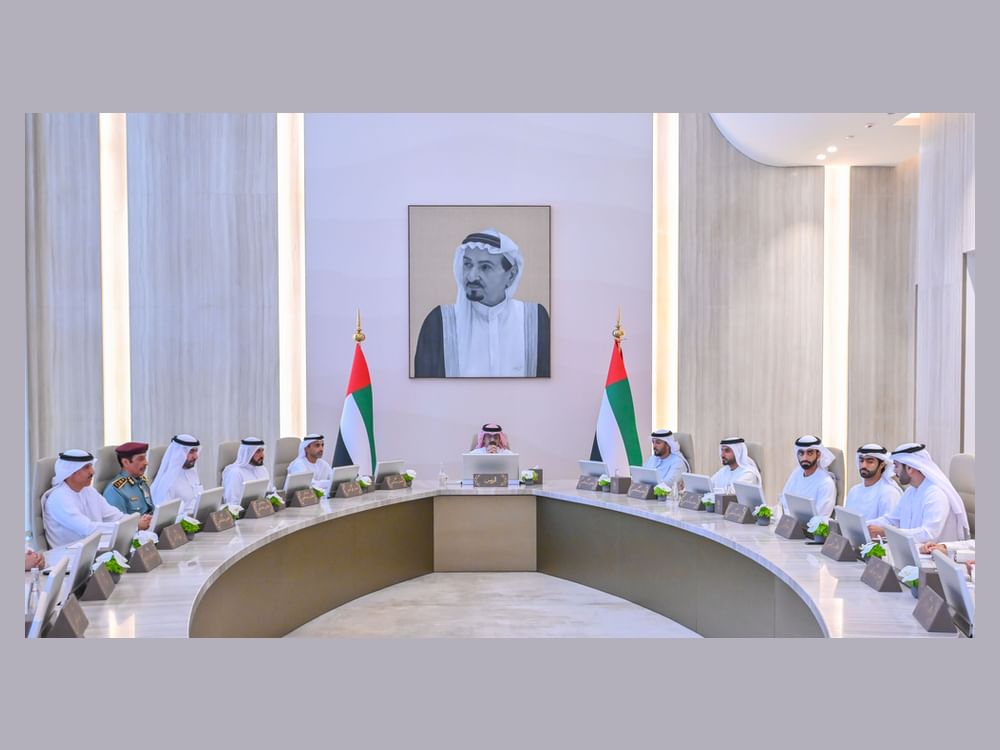
AJMAN, 7th October, 2025 (WAM) -- Under the chairmanship of H.H. Sheikh Ammar bin Humaid Al Nuaimi, Crown Prince of Ajman and Chairman of Ajman Executive Council, the Council approved the government media policy for the emirate of Ajman and the first package of outcome indicators for Ajman Vision 2030, during its meeting today.
The Council also discussed several key files related to higher education, economy, tourism, culture and media.
H.H. Sheikh Ammar affirmed that the approval of the media policy and performance indicators marks a qualitative step in advancing government work, reflecting the emirate’s commitment to enhancing transparency and efficiency in line with Ajman Vision 2030, and strengthening its position within the federal framework.
“The media is a key partner in development, and its role goes beyond reporting news to raising awareness and showcasing the emirate’s achievements in serving the community. We want a government media system that reflects Ajman’s values and vision, working as one team within the national communication ecosystem,” he said.
The unified policy aims to promote a positive image of the emirate locally and internationally, foster a professional environment that supports media creativity, and ensure message consistency across government entities.
The government media policy provides a comprehensive framework for coordinating communication efforts among government bodies to strengthen unified official messaging and enhance media readiness across all situations.
The approval follows a detailed presentation by the Ajman Government Media Office highlighting the evolution of the emirate’s media landscape and the initiatives that strengthened its local and international presence by building a unified media narrative expressing Ajman’s identity as a thriving development hub.
The presentation also reviewed the stages of policy development and implementation mechanisms aligned with the UAE’s direction towards a modern, credible and interactive government media model that engages society and shares best practices.
The policy aims to build public trust through coordinated and professional practices that reinforce transparency and effective communication with various audiences, fostering collaboration among government entities.
The Council also approved the first package of outcome indicators for Ajman Vision 2030, comprising 13 indicators across four strategic directions: eight focused on business environment and economic growth, two on national human capital development, one on quality of life and urban attractiveness, and two on culture and arts to promote cultural identity and support creative industries. This package aims to activate the strategic performance measurement system and ensure continuous monitoring of the vision’s implementation.
These indicators serve as a reference framework for measuring developmental impact across the economy, society and quality of life, reflecting the government’s performance progress and alignment with the vision’s goals.
H.H. Sheikh Ammar noted that approving these indicators represents a shift towards data- and results-driven governance, adding, “The next phase will place greater focus on measuring the real impact of policies and initiatives, as the true value of any achievement lies in its effect on people’s lives and the quality of services provided.”
He stressed that the strategic indicators will enhance government monitoring efficiency and decision-making, strengthening the emirate’s competitiveness and aligning with national progress in performance management.
The Council also approved the implementation plan for Law No. (1) of 2025 on regulating real estate contributions in Ajman, aimed at enhancing transparency in the property market, safeguarding investors’ rights, and supporting a sustainable investment environment that drives growth in the real estate sector as a key pillar of the local economy.
The move aligns with Ajman Vision 2030’s objectives to achieve balanced urban development that enhances quality of life and creates an attractive environment for business and investment.
The Council directed the formation of a joint committee to draft regulatory specifications and policies in preparation for implementing a pilot system in selected urban sectors.
Additionally, the Council approved the implementation plan for the local legislation of the Department of Tourism, Culture and Media to establish an integrated ecosystem that enhances Ajman’s status as an influential tourism, cultural and media destination locally and globally.
The legislation aims to empower the department’s regulatory and supervisory roles, support cultural and artistic activities, develop creative industries, and attract events that highlight the emirate’s identity and its tourism and cultural assets, in line with Ajman Vision 2030’s aspiration to build a vibrant and creative city.
The Council also approved the final accounts for 2024, commending the government entities’ financial discipline and emphasising the importance of continuing to enhance spending efficiency and financial governance in line with principles of transparency and sound management.
Furthermore, the Council discussed the agreement on licensing and accrediting higher education institutions in the emirate in collaboration with the Ministry of Higher Education and Scientific Research, aimed at regulating the sector and ensuring the quality of academic outcomes in line with national higher education policies.
The meeting concluded with an emphasis on the continued implementation of issued resolutions to strengthen government integration and achieve the targets of Ajman Vision 2030.