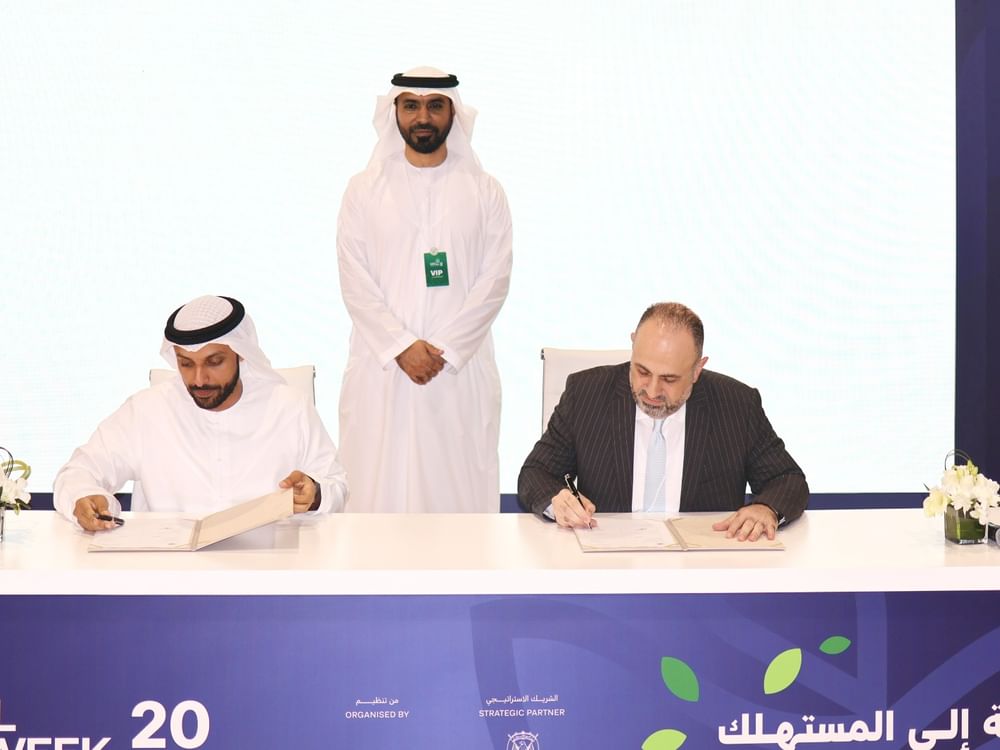
ABU DHABI, 21st October, 2025 (WAM) -- The Abu Dhabi Agriculture and Food Safety Authority (ADAFSA) has signed six strategic cooperation agreements with a number of leading government, academic, and community organisations on the sidelines of the second edition of Global Food Week in Abu Dhabi, an international platform dedicated to advancing food security and agricultural sustainability through knowledge exchange and innovation.
These agreements reflect ADAFSA’s ongoing efforts to expand institutional partnerships and enhance integration across sectors, contributing to the development of the agricultural and food industries in Abu Dhabi and the UAE, and supporting the leadership’s vision of establishing a sustainable and resilient food system.
The first agreement was signed with the Zoo and Aquarium Public Institution in Al Ain – Al Ain Zoo (ZAPIA) to enhance data integration between both entities. It aims to feed Abu Dhabi’s One Health Laboratory Platform with vital and laboratory data related to animal diseases and agricultural pests. The agreement includes sample exchange, activation of performance measurement and quality control programmes, and access to ADAFSA’s Food Security Data Platform to support rapid response and decision-making. It also covers joint laboratory analyses, development of a biological bank, and collaborative scientific research to strengthen the emirate’s biosecurity system.
ADAFSA also signed two agreements with Khalifa University of Science and Technology. The first is a research collaboration focused on two specialised scientific studies, one on producing functional foods from palm waste, and the other on enhancing poultry nutrition using fodder additives. The agreement includes data exchange, joint laboratory experiments, and the publication of scientific findings.
The second is a memorandum of understanding (MoU) centred on capacity building and the development of specialised training programmes for ADAFSA employees. It also includes the organisation of workshops and scientific lectures in collaboration with university experts, joint implementation of applied research, access to academic and research resources, and the exchange of biological samples to support analytical development.
The fourth agreement, signed with the Authority of Social Contribution – Ma’an, aims to strengthen community engagement in supporting agricultural and food initiatives. The partnership will promote volunteerism, design community participation programmes for various groups, including people of determination and senior citizens, and launch joint awareness campaigns to highlight the importance of community involvement in food security. The agreement also covers collaboration with social enterprises and non-profit organisations, sharing expertise in agricultural entrepreneurship, and providing support packages for community-based projects.
The fifth MoU, signed with the National Agricultural Centre, focuses on promoting agricultural sustainability and enabling Emirati farms to achieve UAE GAP (Good Agricultural Practices) certification. The partnership will support the adoption of climate-smart practices and modern agricultural technologies. Areas of cooperation include legislative development, supply chain optimisation, reduction of production losses, and the organisation of national and international events to promote local produce. The MoU also calls for joint promotion of initiatives, exchange of non-confidential data, and support for applied research to improve the quality and competitiveness of agricultural production.
The sixth agreement, signed with Global Academy Limited, seeks to enhance collaboration in research and development, training, and innovation. It establishes a framework for the exchange of expertise, utilisation of human capital, and sharing of available data.
The MoU also outlines the development of joint programmes serving both stakeholders and the wider public, alignment of institutional efforts with strategic objectives, and the application of the highest cybersecurity standards in data exchange, reflecting both parties’ commitment to digital governance and regulatory compliance.
ADAFSA affirmed that these agreements mark a strategic step towards strengthening the food security and agricultural sustainability ecosystem through broader institutional collaboration and the integration of government, academic, and community efforts. They are designed to deliver tangible positive impacts across society while reinforcing Abu Dhabi’s position as a regional hub for agricultural and food innovation.