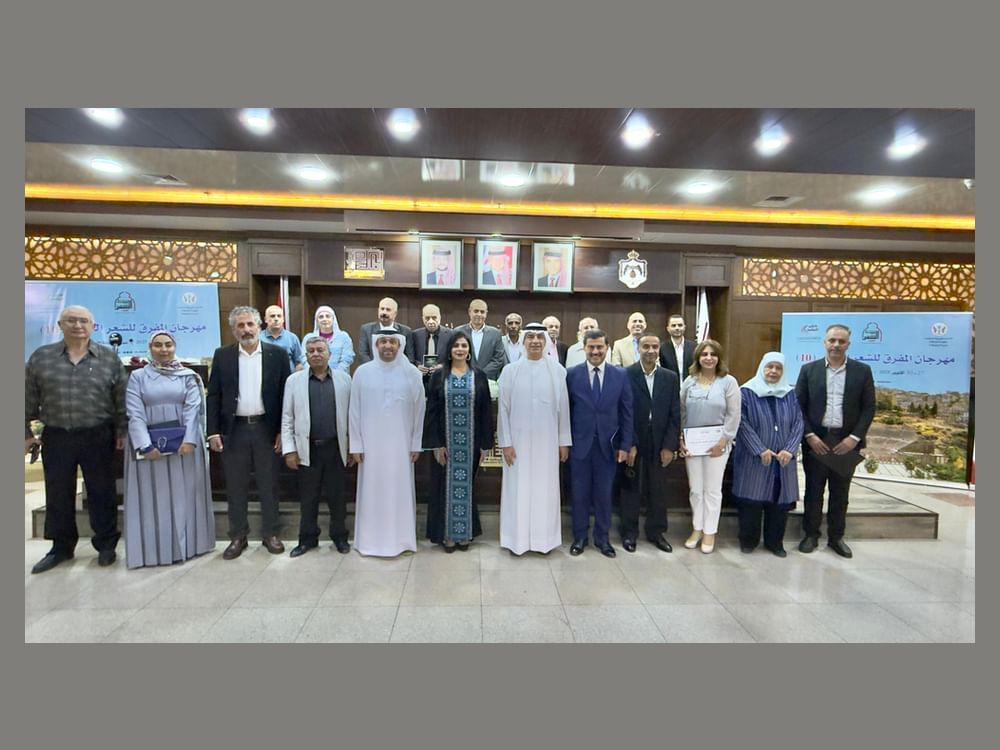
SHARJAH, 31st October, 2025 (WAM) -- Al Mafraq Arabic Poetry Festival, at the conclusion of its tenth session, wrote a new chapter in the history of Arab poetry, marking a decade since its founding, under the generous patronage of His Highness Sheikh Dr Sultan bin Mohammed Al Qasimi, Supreme Council Member and Ruler of Sharjah.
The festival was organised by the Sharjah Department of Culture, in cooperation with the Jordanian Ministry of Culture, over four days with the participation of more than 30 poets from Jordan and various Arab countries.
The festival's activities continued at the National Library in Amman, in the presence of Abdullah bin Mohammed Al Owais, Head of the Sharjah Department of Culture; Muhammad Ibrahim Al Qasir, Director of the Department of Cultural Affairs; Dr Sultan Al Zaghoul, Director of the Irbid Culture Directorate; Faisal Al Sarhan, Director of the Poetry House; and a large number of intellectuals, writers, academics, and students.
In his closing remarks at the festival, Al Zaghoul emphasised that poetry houses across the Arab world are complementing the pioneering role played by Sharjah, under the guidance of its enlightened and noble ruler, in preserving Arab and Islamic cultural identity and supporting the Arab poetry scene by highlighting the creative works of Arab poets that elevate and enrich the landscape of Arabic poetry.
The Director of the Irbid Culture Directorate stated that the tenth edition of Al Mafraq Arabic Poetry Festival concluded at the Irbid Cultural Centre, after its inaugural event at the National Library in Amman. This move of the festival from the capital, Amman, to Irbid, the largest governorate in Jordan in terms of both area and population, and in terms of its influence on the Jordanian poetry and cultural scene, propels the poetry landscape forward.
Al Zaghoul added, highlighting the contributions of the poetry house to the cultural scene that Al Mafraq Poetry House, one of the first poetry houses established in Arab countries at the direction of His Highness the Ruler of Sharjah, has introduced new poetic voices that have made the desired contribution.
He continued saying that through its regular poetry evenings and festivals, the House has achieved many of its founding objectives by highlighting the evolution of Arabic poetry, showcasing prominent Arab poetic voices, and nurturing emerging poetic voices.
Al Zaghoul noted that the festival attracted new poetic voices who presented themselves with strength and enthusiasm, earning their rightful place in the Arab poetry scene. This was achieved through emotional and patriotic poems that highlight the beauty of Arabic poetry and its role in preserving the nation's cultural identity.
The readings were distinguished by a striking presence of language and intense poetic imagery that resonated with the pulse of reality. They also varied in their themes, combining emotional, humanistic, and nationalistic sentiments to create a vibrant tapestry of creativity. This reflected the diversity of experiences and poetic visions presented by the participants, amidst enthusiastic audience engagement that blended seamlessly with the brilliance of the poetry.
The second day of the festival featured a poetry evening with the participation of poets Hussam Shdeifat, Makki Nazzal, Muhammad Al-Jahalin, Mariam Al Saifi, Ahmad Abdel Ghani, and Muhammad Kanaan.
The readings continued on the third evening of the festival with the participation of poets Muhammad Nassif, Dr Iman Abdel Hadi, Ayoub Al Zayoud, Rana Bseiso, Shafiq Al Atawneh, and Jasser Al Bazour.
The festival then moved from the capital, Amman, to the governorate of Irbid in northern Jordan for its final days, where the Irbid Cultural Centre hosted the closing evening with the participation of poets Dr Harbi Al Masri, Rand Al Rifai, Dr Tayy Hatamleh, Dr Khaled Al Mayyas, Hamza Bani Yassin, and Ibrahim Al Hasban.
Poets and intellectuals celebrated the tenth anniversary of the House of Poetry in Mafraq, emphasising the pioneering role of His Highness the Ruler of Sharjah in supporting Arab culture. They noted that the Houses of Poetry initiative has become vibrant spaces that celebrate poetry and solidify its presence on the Arab cultural scene.