
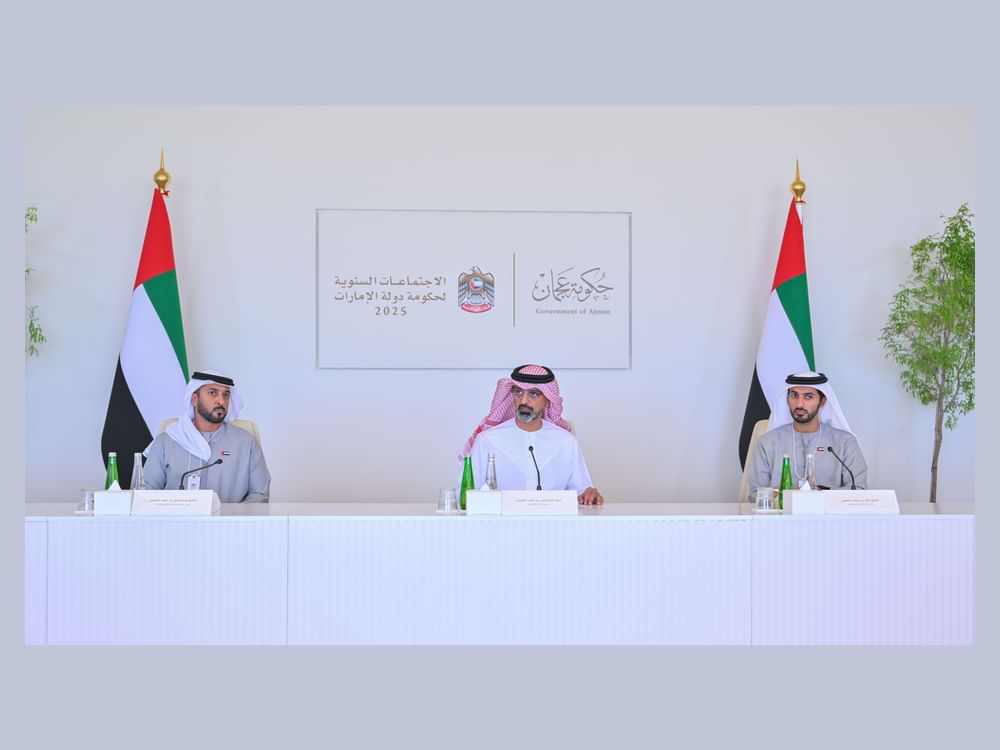
ABU DHABI, 5th November, 2025 (WAM) -- H.H. Sheikh Ammar bin Humaid Al Nuaimi, Crown Prince of Ajman and Chairman of the Executive Council, presided over the Council's meeting held as part of the UAE Government Annual Meetings taking place in Abu Dhabi. The meeting aimed to strengthen national-level coordination and continue improving quality of life in line with the Ajman Vision 2030 objectives.
In his opening remarks, H.H. Sheikh Ammar bin Humaid Al Nuaimi emphasised that the Government of Ajman’s work is part of a shared national responsibility, stating that the coming stage focuses on moving “from vision to impact… from planning to real experiences for people.”
H.H. Sheikh Ammar noted that evaluation is no longer based on models and reports, but rather on people’s real lives, how they spend their day, how services are provided to them, and how much they feel the government’s presence in their daily experiences.
The Council approved a project to develop a new Human Resources Law for the Government of Ajman, a strategic step designed to align government work policies with Ajman Vision 2030, enhance the quality of life of government employees and their families, and establish an attractive institutional environment based on work-life balance.
The law introduces a modern leave system supporting families and parents, more flexible career paths, and empowerment of people of determination within government workplaces. It also adopts flexible work models suited to different entities and job types, including distributed working hours and remote work options, both inside and outside the UAE, aimed at boosting productivity, improving job satisfaction, and fostering a sustainable work culture.
The meeting also announced the establishment of the Ajman Lifelong Learning Council, tasked with providing insight and guidance in the lifelong learning domain and uniting partners from education, skills development, and the labor market to build individuals capable of continuous growth and competitiveness.
H.H. Sheikh Ammar underscored that human development is the foundation of Ajman’s competitiveness and the main driver of sustainable development and leadership across vital sectors.
H.H. Sheikh Ammar approved the conceptual framework for public services in Ajman, encompassing 11 key sectors directly impacting the community. The framework signifies the government’s shift from a role of executor to a creator of public value, assessing services through the lens of human experience.
He also directed the expansion of the “mystery shopper” programme to cover public facilities and field services and the launch of a “realistic simulation” programme to test beneficiaries’ experiences in real-life scenarios.
The Council reviewed the Urban Empowerment Strategy, which includes 83 urban projects aimed at developing the city according to principles of inclusion and integration, covering initiatives such as Corniche development, bicycle paths, rainwater drainage, and inclusive urban infrastructure.
H.H. Sheikh Ammar instructed efforts to ensure 100% readiness of all public facilities and government buildings, stressing that inclusivity is not just about modifying structures but about changing the philosophy of urban planning to make the city accessible to everyone without exception.
In the environmental and sustainability domain, the Council reviewed Ajman’s Environmental Targets 2030, which include: Reducing carbon emissions by 40%, Planting 50,000 mangrove trees, Raising waste treatment to 80%, and Establishing 43 new parks covering a total area of 875,000 square meters
The Council also reviewed key infrastructure projects, including: development of 260 km of roads, construction of 99 km of cycling and pedestrian paths, expanding rainwater drainage networks to 66% by 2030, increasing smart lighting coverage to 83%.
Additionally, the Council approved policies supporting partnerships between the government and the private sector to invest in environmental projects, ensuring faster implementation, resource sustainability, and making environmental protection a shared responsibility across all sectors.
At the conclusion of the meeting, Sheikh Ammar bin Humaid Al Nuaimi emphasised that the next phase must deliver real results that people can feel, saying, “The next session must present success stories and real examples. We want impact that is visible and achievements that are recorded.”