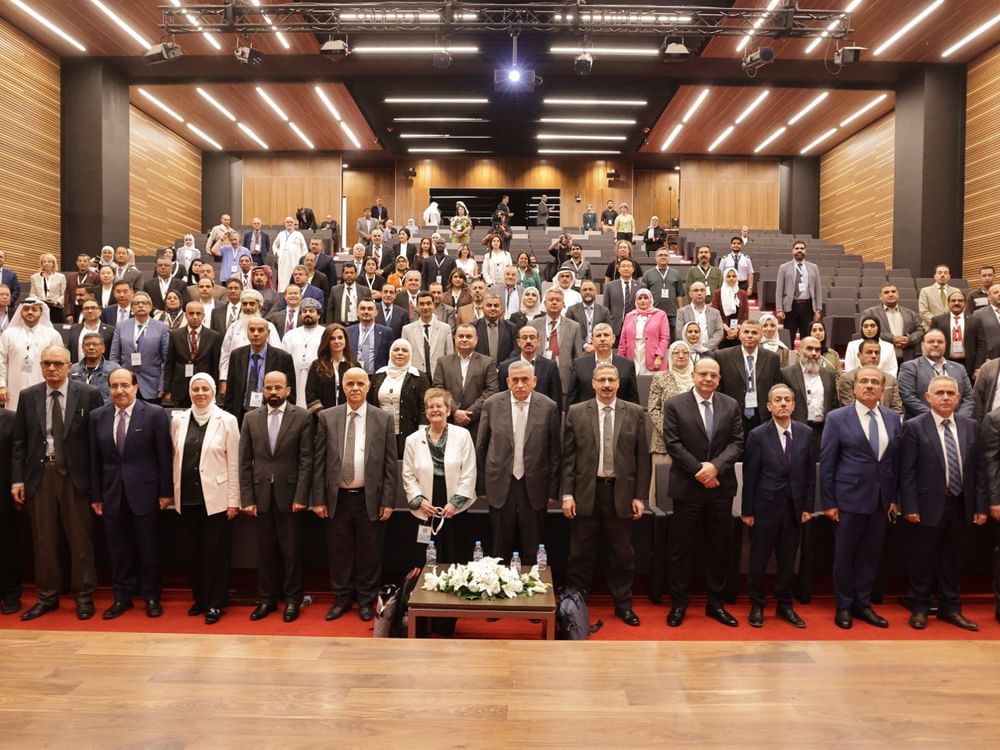
SHARJAH, 13th November, 2025 (WAM) -- The Sharjah Academy for Astronomy, Space Sciences, and Technology at the University of Sharjah has reinforced its commitment to advancing scientific research and regional collaboration through its participation in the seventh regional meeting of the International Astronomical Union for the Middle East and Africa in Amman.
Held from 11th to 13th November under the theme Developing space and astronomy for a sustainable future, the conference was organised jointly by the Academy, the Arab Union for Astronomy and Space Sciences, and the University of Jordan, providing a platform for leading scientists and researchers to exchange knowledge and strengthen cooperation across the region.
Addressing participants, Professor Hamid M.K. Al Naimiy, Director-General of the Academy, highlighted the essential role of Arab, regional, and international collaboration in reaffirming the Arab world’s scientific and technological standing. He noted that space and astronomy now underpin key fields including security, communications, energy, health, and the environment, while equipping future generations with advanced technical skills to support sustainable development.
Professor Al Naimiy pointed to the progress achieved by Arab countries in developing research infrastructures and observatories, emphasising that continued scientific collaboration is vital for producing innovative technologies that serve humanity. He reaffirmed the Academy’s role as a regional model for integrated education and research through its postgraduate programmes at the University of Sharjah.
During the conference, the Academy presented research on near-Earth objects and planetary defence, and studies on evaluating astronomical sites in the Arab region, supporting ongoing efforts to advance the region’s astronomy infrastructure. The Academy also engaged with regional observatories and universities to explore new research partnerships, share technical expertise, and participate in scientific sessions and specialised workshops.
Several research papers were presented by Academy scholars across observational astronomy, astrophysics, and space science applications.
Professor Zouhair Benkhaldoun showcased a study on assessing atmospheric sites for astronomical observation in the Middle East and North Africa, identifying favourable mountain locations in the UAE and Oman for future observatories.
Fatima Al Khatri presented findings on observing near-Earth asteroids using the Sharjah Optical Observatory, assessing potential impact risks and demonstrating the value of regional monitoring for early detection. Anood Al Zaabi discussed the use of artificial intelligence to classify wide- and narrow-tailed radio sources, improving the accuracy of identifying bent-tail radio galaxies.
Mohammed Raihan outlined the development of a low-cost radio telescope designed for research, education, and community outreach, while Ammar Issa highlighted community engagement initiatives linked to the Academy’s observatories during the 2024–2025 academic year.
Engineer Youssef Farroukh presented two studies: one examining coating adhesion and erosion on lunar surfaces, and another offering an overview of the Academy’s Satellite Laboratory, highlighting recent achievements in satellite development, payload design, and lunar science research.
The Academy’s participation in MEARIM7 affirmed its role as a regional hub for astronomical research and its commitment to advancing scientific collaboration across the Middle East and Africa.