
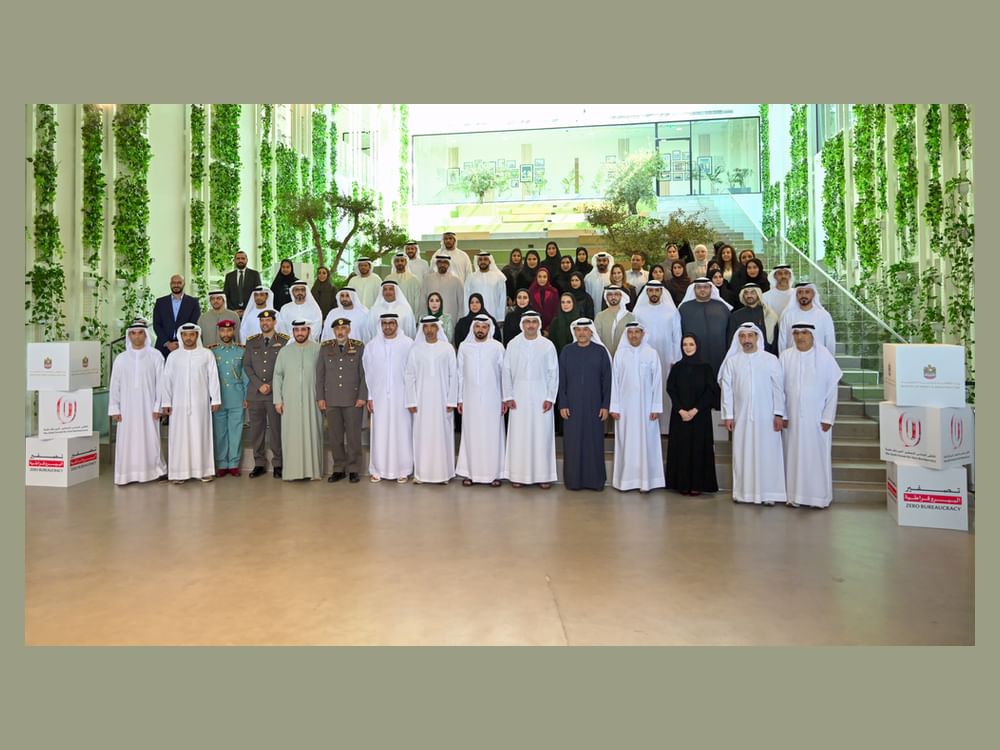
DUBAI, 8th January, 2026 (WAM) -- As part of the national Zero Bureaucracy Program, the Ministry of Energy and Infrastructure (MoEI), in cooperation with the Prime Minister’s Office, organised the sixth Zero Bureaucracy Program Forum.
The forum showcased leading government models and experiences that embodied strategic directions aimed at achieving a qualitative transformation in the government services ecosystem, in line with the directives of His Highness Sheikh Mohammed bin Rashid Al Maktoum, Vice President, Prime Minister and and Ruler of Dubai.
These directives focus on innovating and implementing practical solutions that contribute to simplifying procedures, reducing requirements, and enhancing the customer experience, within a comprehensive vision that strengthens government performance efficiency and places people at the heart of service design.
Held in Dubai with the participation of government leaders, experts, work teams, and partners from various entities, the forum served as an interactive platform featuring specialised presentations focused on best practices in zero bureaucracy. These included simplifying procedures, redesigning services from the customer’s perspective, accelerating transaction completion, enhancing government integration, and expanding digital transformation.
The forum also showcased models of institutional thinking and agile governance, while highlighting practical practices that have successfully accelerated delivery and improved performance efficiency. This reflects the maturity of the UAE’s experience in embedding zero bureaucracy as a sustainable institutional approach, supporting the development of a proactive, digital government that is closer to its customers.
In his opening remarks, Sharif Al Olama, Under-Secretary foe Energy and Petroleum Affairs at MoEI, emphasised that zero bureaucracy in the UAE has become a fully integrated institutional approach, managed with an impact-driven mindset and measured by its outcomes on people and the economy.
He noted that the zero-bureaucracy efforts led by MoEI have contributed to reducing service delivery time by more than 92 percent and customer effort by 91 percent, in addition to redesigning 42 government services. This qualitative shift reflects the government’s transition from merely improving procedures to reinventing customer experiences.
He added that the outcomes of zero bureaucracy have translated into direct economic value, with initiatives contributing to savings of more than AED49 million and the elimination of over 740,000 repetitive procedures, alongside a 96 percent reduction in required documents.
He affirmed that these indicators reflect greater efficiency in resource allocation, faster decision-making cycles, and enhanced competitiveness of the government services ecosystem, particularly in vital sectors related to energy, infrastructure, transport, and housing.
Al Olama said, “The achievements of the Ministry of Energy and Infrastructure in zero bureaucracy reflect the UAE’s vision of building an agile and proactive government that places people at the heart of policy and service design, and links digital transformation to the creation of sustainable added value. The next phase will focus on expanding the scope of zero bureaucracy, deepening integration among entities, and strengthening smart governance.”
He added, “The Ministry is working to institutionalise an approach based on redesigning procedures and leveraging advanced technologies and data to enhance the customer journey. This contributes to faster service delivery, improved performance efficiency, and greater readiness of the government ecosystem to meet future requirements, in line with the UAE’s direction toward a more efficient, flexible, and sustainable government.”
For his part, Mohammed bin Taliah, Head of Government Services for the UAE Government, said, “The UAE Government has achieved qualitative accomplishments in the zero-bureaucracy pathway, with this approach becoming an integral part of institutional work culture and the daily practices of government entities. It has developed advanced operating models aimed at enhancing government performance efficiency, accelerating transaction completion, and enabling entities to deliver more flexible, proactive, and customer-centric services.”
He also pointed to the Community Participation in Zero Bureaucracy initiative, recently launched by the government, which enables members of the community to actively contribute to evaluating government services and procedures and to provide feedback that helps guide policy development priorities and improve the customer experience.
Bin Taliah noted that these initiatives reflect the government’s commitment to empowering the community, enhancing transparency, and building a more agile and efficient government ecosystem capable of delivering leading services in line with the highest standards, with the goal of making UAE Government services the best in the world. This, in turn, contributes to strengthening the country’s competitiveness, attractiveness for investment, and the achievement of sustainable value for society and the economy.
Within the climate change, environment, and digital zeroing track, Mohammed Saeed Al Nuaimi, Under-Secretary of the Ministry of Climate Change and Environment, highlighted the integration of digital transformation with environmental policies and its pivotal role in accelerating procedures, improving service efficiency, and enhancing institutional readiness to meet sustainability requirements.
Showcasing MoEI’s success stories, Laila Al Blooshi, Director of the Strategy and Future Department at MoEI, highlighted pioneering models, foremost among them the Maritime Bundle, which represents an unprecedented Emirati model as the world’s first maritime bundle that unifies a wide range of maritime transport services within a comprehensive digital framework.
She explained that the bundle includes 28 services delivered in partnership with 62 government, local, and international entities, serving more than 38,000 beneficiaries annually and achieving a customer satisfaction rate of 92 percent. This integration has translated into tangible results, including a 99 percent reduction in the number of procedures, a 94 percent reduction in total processing time, the elimination of conditions and requirements by 100 percent, and a 95 percent reduction in required documents.
The forum also highlighted the Ministry of Justice’s experience in managing the media file of Zero Bureaucracy, where the Ministry presented best practices and leading initiatives in unifying messaging, raising public awareness, and enhancing transparency in communicating achieved impact. Saud Bouhandi Al Mansoori, Advisor in the Legislation and Legal Opinion Department and Head of the Zero Bureaucracy Media Team at the Ministry of Justice, highlighted the role of institutional media in supporting the zero-bureaucracy pathway and transforming government initiatives into clear and impactful success stories.
The forum also witnessed the participation of the Ministry of Finance, where Buthaina Dahi Markhan, Head of the Institutional Excellence Section, emphasised the importance of financial and operational integration in supporting the Zero Bureaucracy pathway, and linking procedural simplification with improved spending efficiency and the achievement of financial sustainability for government services.