
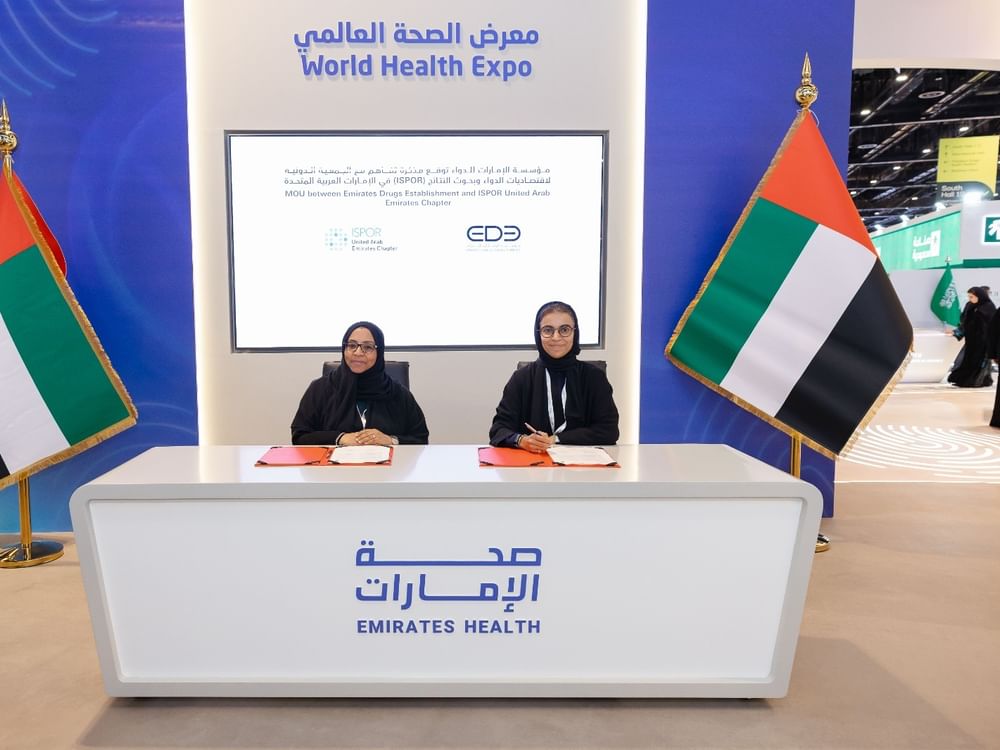
DUBAI, 11th February, 2026 (WAM) -- The Emirates Drug Establishment (EDE) has signed two strategic memoranda of understanding (MoU) during the World Health Expo (WHX) 2026, taking place at Expo City Dubai from 9-12 February.
The agreements aim to drive environmental sustainability and regulatory innovation in the medical products sector, support efforts to achieve climate neutrality, and reinforce evidence-based decision-making.
In parallel, the Establishment showcased its “Organ on Chip” project, an innovative scientific platform designed to test drug efficacy using advanced technology.
Dr Fatima Al Kaabi, Director General of the Emirates Drug Establishment, signed a memorandum of understanding with ISPOR, the professional society for health economics and outcomes research. The agreement was signed on the other side by Professor Nadia Al Mazrouei, Chair of ISPOR UAE Chapter.
The MoU aims to further develop health economics and strengthen health technology assessment in the UAE. It will also support exchanging international experts, launching specialised training programmes, and implementing collaborative research projects related to medical products, thereby enhancing the performance of the national healthcare sector.
Dr Al Kaabi also signed a second MoU with Roche Diagnostics Middle East, represented by Guido Sander, General Manager Middle East, Roche Diagnostics Middle East and Mohammed Al Amri, Head of Diagnostics. This partnership seeks to promote sustainability, achieve carbon neutrality and zero waste in pharmaceutical laboratories, and enrich technical expertise in the design of green laboratories in the UAE.
The two partnerships fall under the strategic direction of the Emirates Drug Establishment to advance regulatory leadership, environmental sustainability, and evidence-based decision-making, further reinforcing the UAE’s position as a leading regional and global hub for medical product regulation and healthcare innovation.
The Establishment is also showcasing the Organ on Chip initiative, an initiative that reflects the EDE’s commitment to adopting advanced technologies and promoting innovation in pharmaceutical research and development.
Dr. Shaikha Al Mazrouei Director of Reference National Laboratory Drug Department, Emirates Drug Establishment, said that “Organ on Chip” technology provides highly accurate human-based models for drug testing, helping to improve the quality of scientific outcomes and accelerate research and therapeutic development, while reducing reliance on animal models.
Al Mazrouei added that adopting such advanced scientific solutions enhances the efficiency of drug testing, strengthens the reliability of results, and supports national pharmaceutical security.
The Emirates Drug Establishment affirmed that the project aligns with its mission to upgrade the national pharmaceutical system, encourage specialised research and development studies within the UAE, and promote the adoption of innovative solutions that contribute to building an advanced and sustainable national pharmaceutical ecosystem.
The project provides a cutting-edge scientific solution that simulates human organ functions using micro-engineered electronic chips, enabling the testing of drug efficacy and toxicity on highly accurate physiological models that surpass traditional cell culture and animal-based methods.
The initiative is fully aligned with the Establishment’s mission to upgrade the national pharmaceutical model, encourage specialized research and development studies, and support the adoption of innovative solutions that contribute to building an advanced and sustainable national pharmaceutical ecosystem, while ensuring alignment with leading global standards in drug testing.