
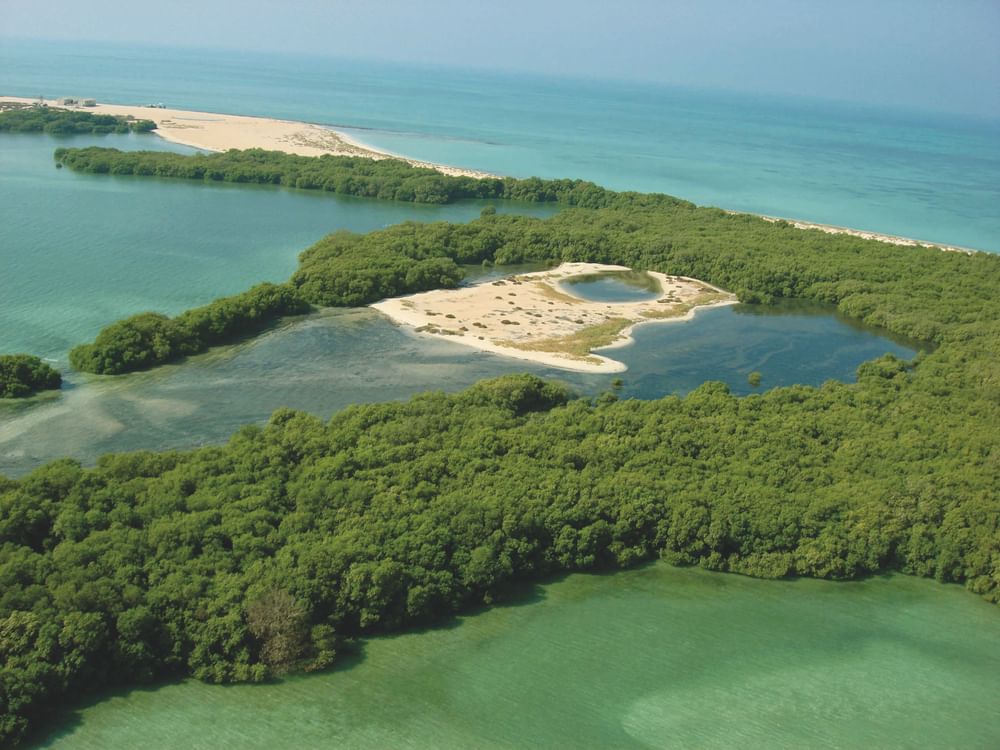
ABU DHABI, 25th July, 2026 (WAM) -- The Environment Agency – Abu Dhabi (EAD) has launched the ADMI mangrove observatory, a digital platform developed to monitor, coordinate and advance mangrove restoration efforts across the emirate.
Developed under the Abu Dhabi Mangrove Initiative (ADMI) and funded by Dolphin Energy Limited as part of its five-year sponsorship commitment, the platform consolidates restoration data from 19 active projects and multiple partners across Abu Dhabi into a single, integrated system.
Drawing on field surveys, satellite imagery and partner-reported data, it provides up-to-date insights into restoration progress, growth rates and project performance across more than 1,775 hectares of restored habitat.
Across Abu Dhabi’s active restoration sites, the platform currently tracks more than 18.5 million mangroves planted, with a recorded total growth count exceeding 10.4 million and an average restoration success rate of 46.94 %.
Designed to support science-based restoration planning and long-term ecosystem recovery, the tool enables EAD and its partners to track active projects, improve monitoring and identify gaps in coverage, coordinate restoration zones among stakeholders, verify and validate project sites, and ensure that restoration activities do not disturb existing natural habitats.
Maitha Mohamed Al Hameli, Acting Director of Terrestrial and Marine Biodiversity Division at EAD, said, “Mangrove restoration is most effective when it is guided by science, coordinated across stakeholders and supported by long-term monitoring. The Abu Dhabi Mangrove Observatory brings together large volumes of environmental data into a single comprehensive system, strengthening decision-making, improving accountability and helping ensure restoration efforts deliver meaningful ecological outcomes.
“Success in mangrove restoration can no longer be measured by the number of trees planted alone. It must also be measured through ecosystem recovery, habitat resilience and long-term environmental impact. By integrating field data, satellite imagery and partner reporting, this platform gives us a stronger scientific foundation for restoration planning and management across Abu Dhabi.”
The launch reflects EAD’s broader approach to mangrove restoration, which prioritises long-term ecosystem resilience, scientific validation and cross-sector collaboration. The platform will continue to evolve as additional restoration data and partner reporting are integrated over time.
Abrar Al Mahmoud, Director of Corporate Communications at Dolphin Energy, said, “By leveraging data, technology, and innovation, we enable smarter decisions that strengthen ecosystem resilience and ensure our sustainability commitments deliver lasting impact. Environmental protection is a business imperative and our support for initiatives such as ADMI reflects a strong track record of delivering measurable conservation outcomes.”
This work forms part of the broader ADMI, launched in 2022 to establish Abu Dhabi as a global hub for mangrove conservation, restoration research and innovation. ADMI brings together 15 local and 8 international partners, including government entities, research institutions, and private-sector organisations, working across five pillars: research, protection, partnership, innovation, and education and engagement. Since its launch, the initiative has raised more than AED5 million to support mangrove research, restoration and education programmes.
The initiative has also advanced regional scientific collaboration through the development of mangrove monitoring resources and the first International Mangrove Conservation and Restoration Conference, hosted in Abu Dhabi in 2024, which brought together leading experts, decision-makers, and researchers from around the world to discuss international best practices in mangrove conservation and rehabilitation.
Abu Dhabi is home to the largest extent of mangrove habitat in the UAE, with approximately 176 square kilometres concentrated primarily along the emirate’s eastern coastline. These ecosystems play a critical role in biodiversity conservation, coastal protection and climate resilience.