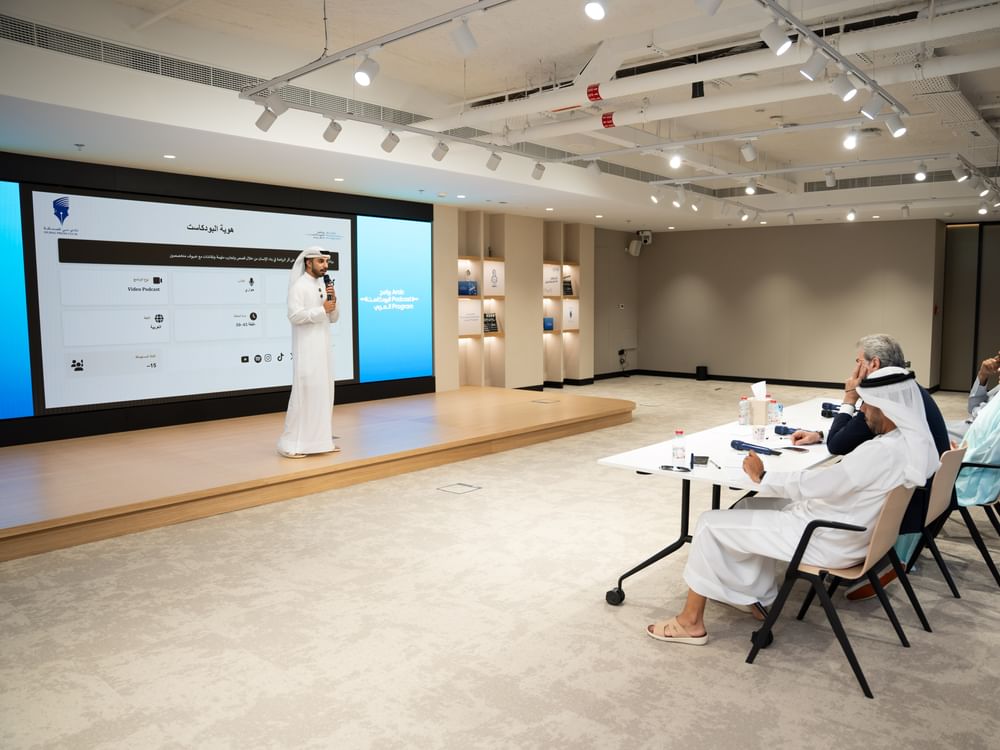
DUBAI, 26th July, 2026 (WAM) -- Participants in the third edition of the Arab Podcast Programme have advanced from developing their concepts and creative identities to producing practical models of their podcast projects during the second week of specialised training organised by the Dubai Press Club (DPC).
Building on the opening week’s focus on conceptualisation and identity creation, the second phase centred on ‘Technical Production and Execution’.
Through 17 hours of practical workshops, participants developed the audio, visual and technical skills needed to transform their ideas into pilot episodes and move their projects closer to production.
The workshops covered project presentation, sound engineering and professional audio processing, visual and cinematic direction, modern editing techniques, AI-assisted script development and smart production strategies.
The week concluded with participants applying these skills to develop pilot episodes ahead of the Programme’s publishing, promotion and final evaluation stages.
The second week opened with a project presentation session titled ‘Project Showcase: Evaluation and Readiness Selection Platform’.
Participants presented their initial projects and received feedback on the clarity of their concepts, target audiences and overall identities, helping them refine their ideas before advancing to production.
The evaluation panel comprised Maryam Al Mulla, Director of the Dubai Press Club; Emirati writer and publisher Jamal Al Shehhi, founder of Kuttab Café; Patrick Samaha, representing Next Audio; and Abdulla Al Nuaimi, host of the ‘Kursi al Athnein’ podcast.
Barry Kassab, Associate Manager, Market Development at Shure MEA, led a workshop titled ‘Sound Engineering and Professional Audio Processing Techniques’.
The session introduced participants to the fundamentals of sound quality, selecting suitable recording equipment, processing audio files and enhancing the listening experience in line with professional production standards.
Ahmed Eid Salem, Regional Training Lead at Sony MEA, and Moris Dakar, Director of Photography at Sony MEA, delivered a workshop titled ‘Visual and Cinematic Direction for Podcasts’.
They explored the principles of visual composition, the effective use of lighting and camera angles, and scene management to help participants create engaging, professionally produced video podcasts.
Bilal Ahmed Habib, Senior Certified Trainer at Blackmagic Design, led a workshop titled ‘Modern Podcast Editing Techniques’. The session covered episode editing, audio and visual pacing,
content sequencing and the use of editing tools to produce coherent episodes suitable for publication across digital platforms.
Meryem Raji, Senior Strategic Partner Manager at YouTube, delivered a workshop titled ‘Smart Preparation: Prompt Engineering and Podcast Script Development’.
The workshop focused on using artificial intelligence tools to develop ideas, write scripts and structure themes and questions while preserving the originality of the content and the podcaster’s distinctive voice.
Amr Zaki, founder and host of the ‘Zaka Mish Istina’i’ podcast, led a workshop titled ‘The AI Revolution: Smart Podcast Production Strategies’.
He highlighted how artificial intelligence can streamline workflows, accelerate research, planning and production, and enhance efficiency at every stage, from developing the initial concept to publishing the final episode.
The week concluded with a workshop titled ‘Practical Production and Pilot Episode Development’, led by Alaa Nawar, Business Development Manager at MediaCast. Participants applied the knowledge and skills acquired during the Programme to produce pilot episodes and test their scripts, audio, visuals and overall project identities.
Maryam Al Mulla, Director of the Dubai Press Club, said the second week marked an important stage in moving participants from developing their concepts and identities to practical execution.
She noted that the focus on technical and production skills strengthened their ability to create more professional and integrated content.
Al Mulla said, “The second week strengthened participants’ readiness to move their projects from concept to practical execution. The specialised workshops gave them a deeper understanding of audio and video production requirements and helped them develop their projects in line with professional standards that enhance their competitiveness and audience reach.”
She added, “Through the Arab Podcast Programme, we aim to provide an integrated training experience that combines creativity, technology and practical application. The Programme enables participants to test and refine their ideas and transform them into projects ready for production and publication, contributing to the growth of high-quality Arabic podcast content.”
Wedad Kahoor, Section Head – Media Talent Development at DPC, said, “The second phase was designed to closely reflect a real production environment. Participants progressed from developing initial concepts to testing audio, video and editing tools and creating practical models that meet the requirements of professional podcast production.”
She added, “We brought together specialists with diverse industry expertise to give participants practical insight into the different aspects of podcast production. Their feedback will help participants further refine their projects before advancing to the publishing and promotion phase.”
The Arab Podcast Programme will continue with its third phase, focused on publishing and promotion, before participants present their completed projects to a panel of industry experts for final evaluation.