
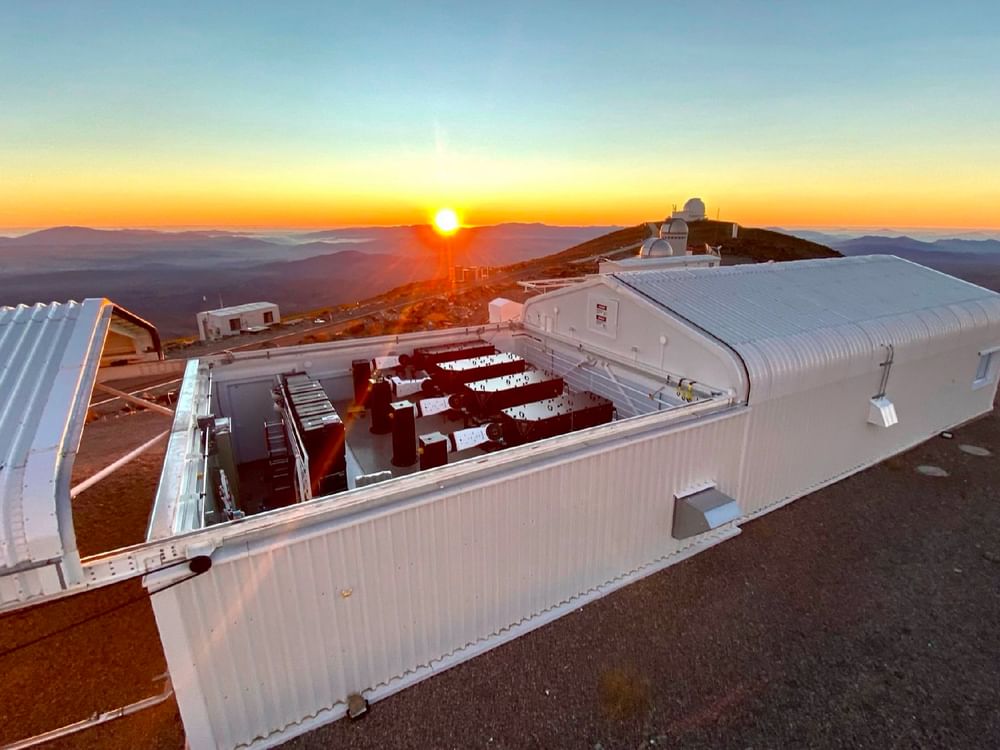
ABU DHABI, 31st July, 2026 (WAM) -- Researchers at NYU Abu Dhabi (NYUAD) have contributed to a landmark international astronomy project, Sloan Digital Sky Survey - V (SDSS-V), that is giving scientists around the world an unprecedented opportunity to investigate how stars are born, interact with the gas around them, and shape the evolution of galaxies.
Released as part of the Sloan Digital Sky Survey's (SDSS) 20th public data release (DR20), the new observations come from the Local Volume Mapper (LVM), a survey of our home galaxy, the Milky Way, and nearby galaxies.
Unlike traditional images, the survey splits light into thousands of individual colours, allowing astronomers to measure the composition, temperature, and movement of the gas between stars. These observations reveal details that cannot be seen in ordinary photographs, providing new insights into the physical processes that drive galaxy evolution.
NYU Abu Dhabi researchers have contributed to the international collaboration since the Local Volume Mapper began collecting data in 2023. Research Scientist Ivan Katkov has contributed to the processing and calibration of LVM data and led the development of LVMvis, an interactive web platform released alongside DR20 that enables scientists, students, and the public to explore the survey's observations directly through a web browser.
"Modern astronomy produces enormous amounts of data, and making that data easy to explore and visualise is just as important as collecting it," said Katkov. "I developed LVMvis to help researchers better understand the survey, but today it allows anyone to explore observations of nebulae and galaxies, examine what the telescope has measured, and interact with the data through a simple web interface."
NYU Abu Dhabi Associate Professor of Physics Joseph Gelfand, who contributes to the SDSS-V collaboration, said making the data openly available will accelerate research across the astronomy community.
"Understanding how stars interact with the gas around them is fundamental to understanding how galaxies evolve," said Gelfand. "By making these observations publicly available, this project gives researchers around the world an extraordinary resource to investigate these processes in far greater detail than ever before."
NYU Abu Dhabi Centre for Astrophysics and Space Science (CASS) Fellow Ahmad Nemer uses theoretical photoionisation models to investigate how shock waves generated by stellar explosions interact with the surrounding interstellar gas. The Local Volume Mapper’s wide-field spectroscopic observations provide a powerful opportunity to test how accurately these models reproduce the physical conditions and emission observed across extended nebulae.
The Sloan Digital Sky Survey is one of the world's largest and longest-running astronomy collaborations, bringing together hundreds of researchers from more than 70 institutions across 13 countries.
Since 2003, its public data releases have accelerated discoveries across astronomy by making observations freely available to researchers worldwide.
Together with New York University, NYU Abu Dhabi was an institutional member of the previous phase of the Sloan Digital Sky Survey (SDSS-IV). Today, it is the only institution in the Arab world participating in the current phase, SDSS-V.