
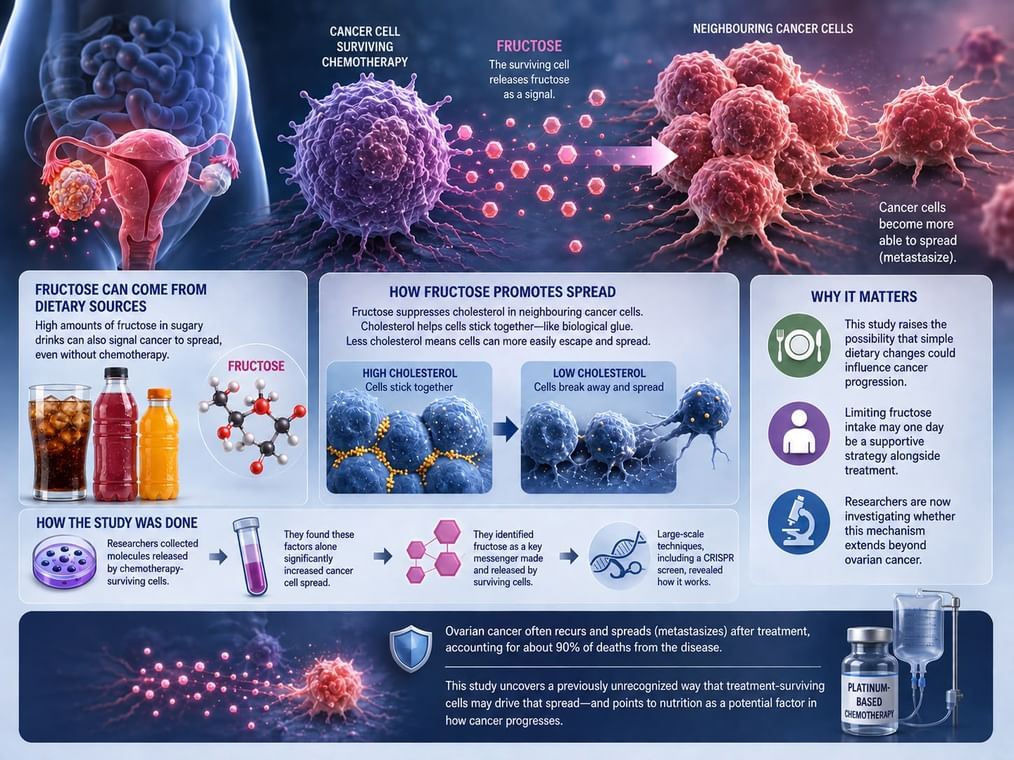
PHILADELPHIA, 7th August, 2026 (WAM) -- A new study from The Wistar Institute has uncovered an unexpected link between fructose — a common dietary sugar — and the spread of an aggressive form of ovarian cancer.
Published in Nature Aging, the study found that cancer cells not killed by chemotherapy send signals to neighbouring tumour cells, helping them become more capable of spreading. The researchers identified fructose as a key messenger in this process, revealing a previously unrecognised way that treatment-surviving cancer cells may promote the spread of cancer.
“Some cancer cells that survive chemotherapy aren’t dividing anymore, but they’re still biologically active,” said Aidan Cole, Ph.D., a postdoctoral fellow in the lab of Katherine Aird, Ph.D., at The Wistar Institute and first author on the study. “Instead, they continue to release molecules that send signals to nearby cells. Our study is among the first to show that a nutrient—in this case, fructose—can act as one of those signals.”
Ovarian cancer is treated almost universally with platinum-based chemotherapy, and many patients respond well at first. However, the disease recurs in most patients and almost always spreads through the abdominal cavity. That spread, called metastasis, accounts for roughly 90 percent of deaths from the disease.
Prior research has suggested that cancer cells not killed by chemotherapy play a role in recurrence in part through the ability of these cells to release a complex mix of signaling molecules.
Cole and his colleagues began their research by designing a unique experiment: they collected the molecules released by chemotherapy-surviving cells and found these factors alone could significantly increase the spread of cancer cells.
That finding sent the team looking for what was being released that caused the cancer cells to spread. Fructose, it turned out, was being made by the surviving cells and sent as the signal for increased spread. They found that without chemotherapy treatment, consuming the high levels of fructose found in sugary drinks can also signal cancer to spread.
The fructose-finding is especially compelling because it raises the possibility that simple dietary changes could help shape how cancer progresses.
While the effectiveness of limiting fructose intake hasn’t yet been tested directly in patients, the study raises the possibility that nutrition could influence cancer progression in previously unrecognised ways.
The researchers next aimed to understand why fructose increases cancer cell spread. Through a variety of large-scale analytical techniques, including the use of a CRISPR screen, they discovered that fructose suppresses cholesterol within the neighbouring cells. Cholesterol is important for cells to stick to each other like a biological glue, so decreased cholesterol allows cells to more easily escape and spread.
The researchers are also looking into how this mechanism might extend beyond ovarian cancer.