
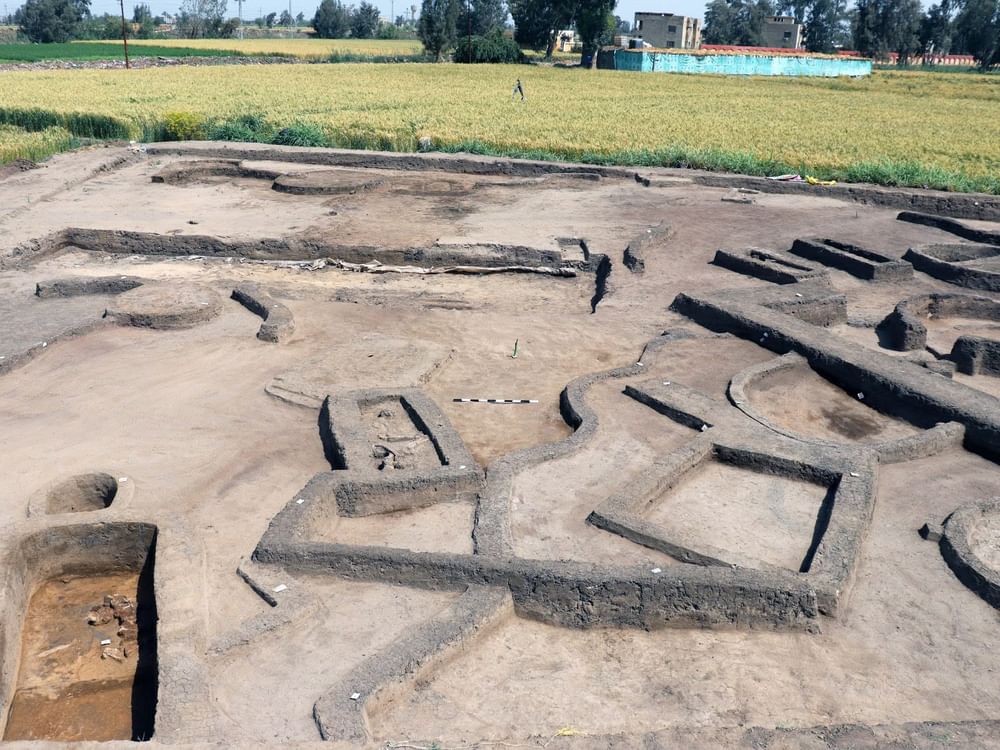
CAIRO, 8th August, 2026 (WAM) -- An Egyptian archaeological mission has uncovered a burial ground dating from the Predynastic Period to the Greco-Roman era, as well as a settlement from the Second Intermediate Period, the Ministry of Tourism and Antiquities said.
The discoveries were made at the Kom el-Khilgan archaeological site in Dakahlia governorate, in Egypt's eastern Nile Delta, highlighting the area's long history of human settlement and cultural development.
The oldest finds date to the first and second phases of Lower Egyptian culture, known as Buto and Buto l, during the first half of the fourth millennium BC, the ministry said.
Archaeologists found simple oval-shaped graves cut into sandy soil. The burials were arranged in different positions and contained modest funerary goods, including small handmade pottery vessels and marine shells.
The density of the burials suggests that the site was home to a sibeable community during the period, officials said.
The mission also uncovered a residential area and graves dating from the Second Intermediate Period through the New Kingdom. The remains included mud-brick buildings, grain silos, ovens and hearths, providing evidence of daily life and economic activity
Wavy, or sinusoidal, walls surrounding residential and funerary structures were also found. Such walls were common from the Middle Kingdom through the New Kingdom.
Archaeologists recovered pottery, stone tools and large quantities of fish, bird and animal bones, offering clues about the diet and lifestyle of the site's inhabitants.
Several graves dating from the 15th to 17th dynasties and the beginning of the New Kingdom were also identified, confirming settlement during the Hyksos period. The site lies near Avaris, the Hyksos capital in the eastern Delta
The graves included mastabas and structures with cornices, and contained jewellery, amulets, scarabs, tools, bronze weapons, pottery and vessels of the Tell el-Yahudiyeh type, which is characteristic of the period
One mud-brick tomb dating to the early 18th Dynasty contained pottery vessels and bronze tools. The mission also found the foundations of a thick-walled mud-brick building containing pottery fragments and stone tools dating to the beginning of the New Kingdom.
For the Ptolemaic period, archaeologists uncovered several simple burial pits, including the burial of a child placed inside two amphorae reused as a coffin.
Tourism and Antiquities Minister Sherif Fathy described the discoveries as an important scientific contribution to understanding the history and development of the Delta, while highlighting the expertise of Egyptian archaeologists.