
ABU DHABI, 18th August, 2026 (WAM) -- The UAE marks World Humanitarian Day on 19th August each year, guided by the enduring humanitarian legacy of the late Sheikh Zayed bin Sultan Al Nahyan, who placed helping people and supporting those in need at the heart of the nation’s values.
President His Highness Sheikh Mohamed bin Zayed Al Nahyan continues to lead the UAE’s humanitarian efforts, reinforcing the country’s position as a global model for humanitarian response and building bridges of solidarity with peoples and communities around the world.
The year 2026 has witnessed significant momentum in UAE humanitarian initiatives and projects, reflecting the diversity and breadth of the country’s humanitarian work.
The Edge of Life campaign has been among the UAE’s most prominent humanitarian initiatives this year. Launched by His Highness Sheikh Mohammed bin Rashid Al Maktoum, Vice President, Prime Minister and Ruler of Dubai, the campaign aims to save five million children from hunger worldwide. It raised more than AED2.822 billion, with contributions from 44,208 individuals, companies and humanitarian organisations.
His Highness Sheikh Mohammed bin Rashid also announced the launch of an initiative to support efforts to eradicate river blindness, targeting seven million direct beneficiaries and 35.4 million indirect beneficiaries over three years.
In education, the Khalifa bin Zayed Al Nahyan Foundation opened the Sheikh Khalifa bin Zayed Al Nahyan Institute for Vocational Education in the Republic of Senegal, with a capacity of approximately 1,000 students. The institute aims to equip young people with vocational and technical skills and enhance their employment prospects.
UAE charitable organisations have also implemented educational projects in several countries, including the construction of schools and classrooms, support for students and educational environments, and initiatives to expand access to education for those most in need.
The Emirates Red Crescent (ERC), meanwhile, implemented relief programmes benefiting more than 1.5 million people in the UAE and 44 countries as part of its Ramadan programmes for 2026. Humanitarian initiatives also included projects supporting disadvantaged villages, providing essential services, and implementing health and social programmes in several countries.
The International Charity Organisation (ICO) implemented projects worth more than AED353 million during the first half of 2026 across healthcare, education, water, food assistance and humanitarian relief.
The Zayed for Good Foundation, meanwhile, marked its 34th anniversary this August, celebrating more than three decades of humanitarian and development achievements.
Since its establishment on 5th August 1992, the Foundation’s programmes have reached more than 180 countries, with the cumulative value of its humanitarian assistance exceeding AED2 billion. Its initiatives span humanitarian relief, food security, community development, infrastructure, healthcare and education, reflecting the global reach of the UAE’s humanitarian efforts and its commitment to sustainable community development.
The UAE supported those affected by the earthquake in the southern Philippines by distributing thousands of food parcels and supplies of potable water. It also allocated US$10 million to assist those affected by the earthquake in Venezuela and subsequently dispatched 70 tonnes of relief aid. In addition, the UAE announced an urgent humanitarian response worth US$10 million to support those affected by the earthquake in Colombia.
The UAE also supported people affected by floods in Syria, Ghana and Bangladesh, while the ERC completed a project to rehabilitate and rebuild homes for families affected by floods in Malaysia’s Pahang state, as part of efforts to support recovery and improve quality of life.
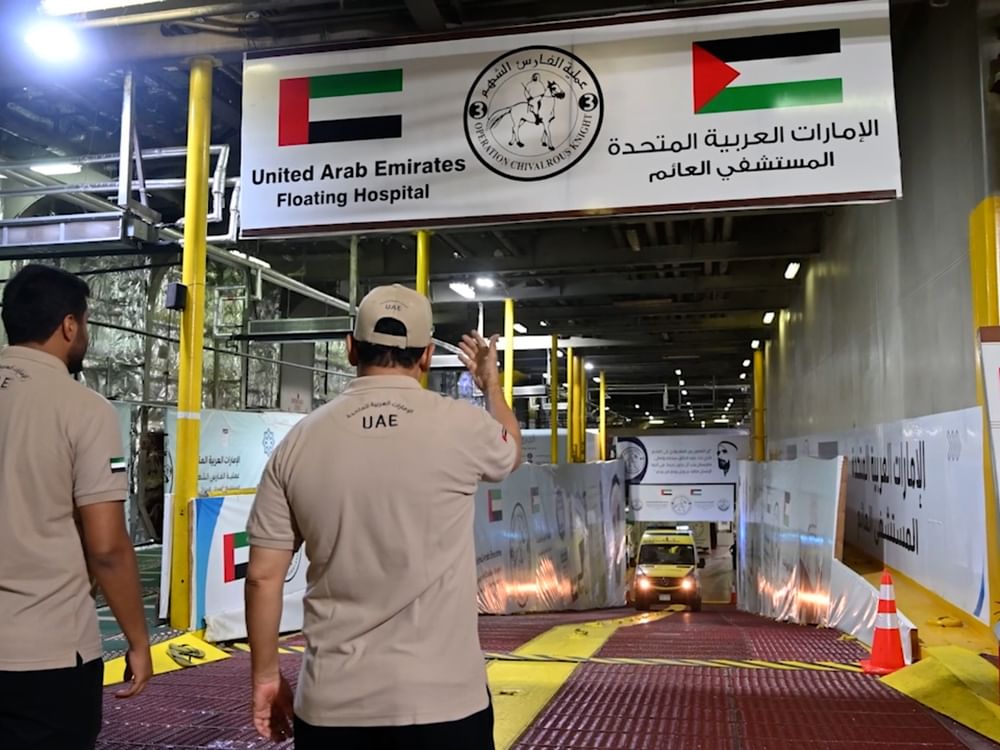
The UAE has established an integrated model of humanitarian response for the Gaza Strip through Operation Chivalrous Knight 3, which marked 1,000 days of continuous humanitarian operations this August. During this period, the UAE provided more than US$3.89 billion in humanitarian assistance, including over 126,000 tonnes of relief, medical and food aid delivered through more than 770 flights, 25 ships and over 13,000 trucks, ensuring the sustained delivery of aid to beneficiaries despite ongoing humanitarian and logistical challenges.
The UAE has operated the UAE field hospital and the UAE Floating Hospital in Al Arish, providing medical treatment to more than 230,000 cases. Its humanitarian response has also included the “Step of Hope” programme, launched under Operation Chivalrous Knight 3 in cooperation with the International Charity Organisation to provide prosthetic care and rehabilitation services for Palestinians who have suffered limb amputations.
The UAE continued to provide various forms of humanitarian support to the Sudanese people. Total assistance provided to Sudan over the past decade, from 2015 to 2025, amounted to approximately $4.24 billion, while humanitarian assistance provided since the outbreak of the crisis in 2023 has exceeded $800 million.
The UAE has emerged as the second-largest donor of aid to Sudan after the United States, according to data from the United Nations Office for the Coordination of Humanitarian Affairs (OCHA).
The UAE allocated $11 million through a cooperation agreement with the International Federation of Red Cross and Red Crescent Societies (IFRC), including $10 million to support communities hosting Sudanese refugees in Chad, South Sudan, Uganda and Ethiopia, and $1 million to the Disaster Response Emergency Fund (DREF). It also contributed $5 million to the Sudan Humanitarian Fund, managed by OCHA, and $20 million to the World Food Programme (WFP) to strengthen food security.
The UAE has also contributed to supporting humanitarian stability in Ukraine through its mediation efforts between Russia and Ukraine, which facilitated prisoner exchanges, bringing the total number of prisoners exchanged through 25 UAE mediation efforts to 7,791.