
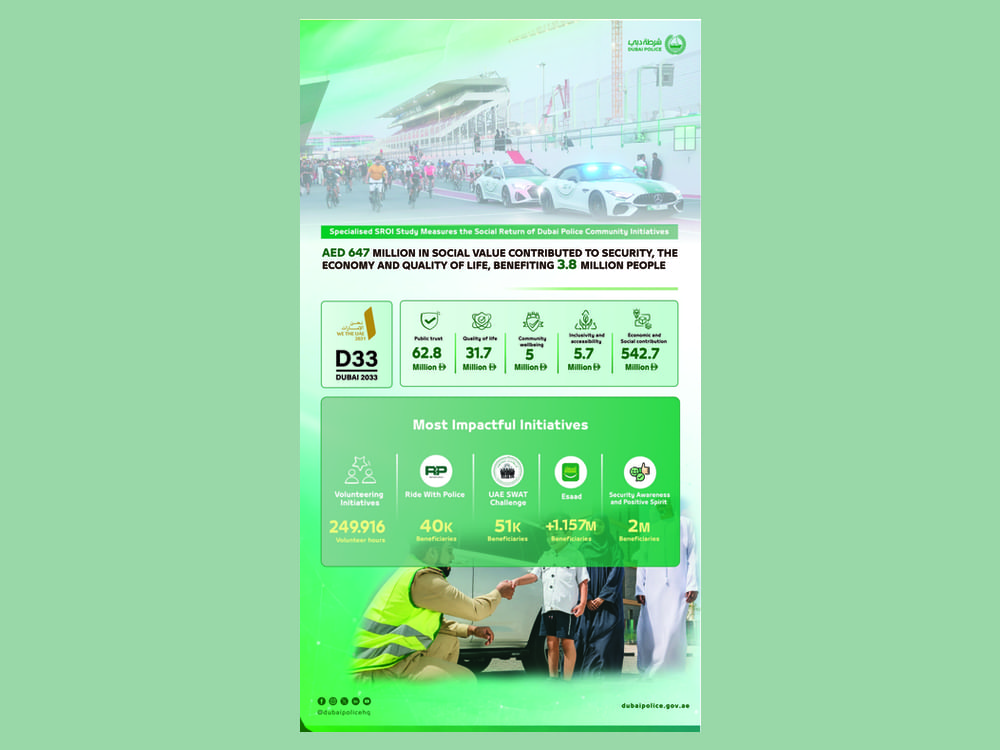
DUBAI, 19th August, 2026 (WAM) -- A specialised Social Return on Investment (SROI) study has quantified the impact of 80 Dubai Police community initiatives at AED647.9 million, reflecting their contribution to security, economic and social outcomes and quality of life for 3.8 million beneficiaries between 2017 and 2026.
The study, conducted by the Future Foresight Centre at Dubai Police, assessed initiatives across education, health, public awareness and sport, examining their contribution to public safety, crime prevention, trust in police, and quality of life.
The findings demonstrate how community initiatives support broader government priorities, including the Dubai Social Agenda 33, the Dubai Economic Agenda D33, and We the UAE 2031, while contributing to Dubai’s acclaim as a safe city and a leading destination to live, work and visit.
Lieutenant General Abdulla Khalifa Al Marri, Commander-in-Chief of Dubai Police, said the results reflect the unstinting support of the UAE leadership, the Dubai Government, and the Ministry of Interior for Dubai Police’s efforts to implement sustainable community initiatives targeting different segments of society.
He said the findings demonstrate the effectiveness of Dubai Police’s approach to designing and implementing sustainable community initiatives based on the actual needs of society, while strengthening community partnerships and supporting quality of life.
Lieutenant General Al Marri added that the initiatives’ security, social and economic outcomes provide a clear indicator of their positive impact and success in achieving their objectives. He stressed that community initiatives represent an important pillar of sustainable security by increasing trust in police, strengthening perceptions of safety, and contributing to crime prevention.
The study found that the SROI generated through the initiatives was distributed across several areas of community impact.
Economic and community contributions accounted for AED542.7 million, while AED5.7 million was attributed to community initiatives distinguished by their accessibility and opportunities for participation by all members of society.
A further AED5 million was attributed to community wellbeing initiatives that contributed to enhanced levels of safety, support, and social engagement.
Quality of life initiatives accounted for AED31.7 million, while AED62.8 million was attributed to initiatives classified as contributing to public trust, helping reinforce a sense of belonging among community members.
The study adopted a scientific methodology for measuring community impact and SROI by linking community initiatives with security and social indicators. It analysed their impact on perceptions of safety, crime prevention, and quality of life in line with international best practices for impact measurement.
Statistical and quantitative models were also used to measure the social and economic value generated and to objectively link the inputs of individual initiatives with their outputs and outcomes.
The study additionally used the Pearson Correlation Coefficient, a statistical method for measuring the strength and direction of relationships between variables.
Positive values indicate that increased implementation of community initiatives coincides with improvements in associated indicators, while negative values indicate an inverse relationship, where increased implementation coincides with decreases in undesirable indicators such as crime rates.
The Pearson analysis identified positive correlations between Dubai Police’s community and awareness initiatives and several social and security indicators.
The initiatives recorded a 0.44 positive correlation with the Happiness Index and a 0.45 positive correlation with the Happiness, Security and Awareness Index.
They also recorded a 0.44 positive correlation with the indicator measuring enhanced perceptions of safety among community members.
The findings indicate that increased implementation of community initiatives coincides with stronger trust in police, greater perceptions of safety and higher levels of happiness, contributing to a more cohesive and stable society.
The study also identified inverse correlations between the implementation of community initiatives and certain crime-related indicators, highlighting their preventive role in supporting community safety.
The findings showed a negative 0.41 correlation with the rate of concerning crimes, indicating that increased implementation of community initiatives coincided with lower levels of this category of crime.
The study also recorded a strong negative 0.796 correlation between customer happiness and crime rates, indicating that higher levels of customer satisfaction and happiness coincided with lower crime rates.
The findings reinforce the importance of community initiatives in supporting preventive security and strengthening partnerships between police and society.
The study also examined the direct and indirect impact of individual Dubai Police community initiatives.
Dubai Police’s community-focused initiative ‘Positive Spirit’ recorded the largest reach, benefiting two million people, followed by the force’s privilege card initiative ‘Esaad’, which benefited 1,158,717 people.
The Ride with Dubai Police initiative reached 40,000 people, while events associated with the UAE SWAT Challenge benefited 51,000 people.
Together with dozens of other programmes, these initiatives formed part of the 80 community initiatives assessed over the nine-year period.
Volunteering also contributed significantly to the initiatives’ wider impact. Between 2017 and 2026, 7,189 volunteers from within and outside Dubai Police participated in initiatives covered by the study.
Together, they contributed 249,916 volunteer hours, generating estimated financial savings of AED21,742,692.
The study demonstrates that Dubai Police’s community and awareness initiatives extend beyond raising awareness and strengthening communication with society. Their measurable relationship with security and social indicators demonstrates their role in supporting quality of life, public trust, preventive security and community stability.
The findings highlight the wider value of community policing, showing how sustained engagement with society can contribute to safer communities, stronger public trust, improved quality of life and greater social stability.