
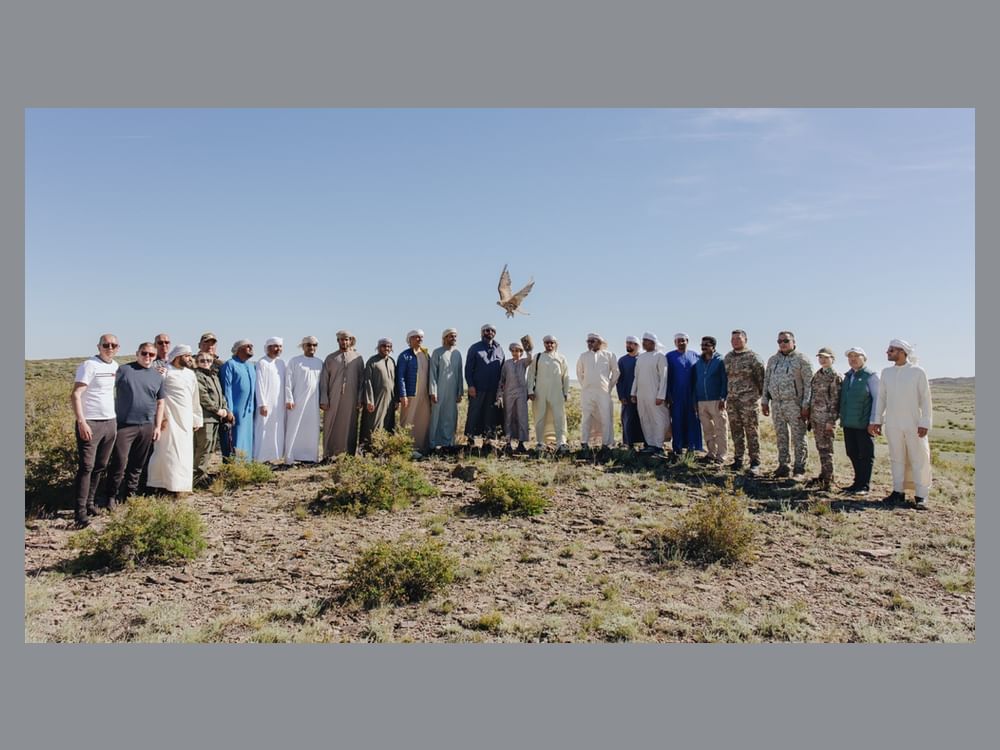
ABU DHABI, 19th August, 2026 (WAM) -- Guided by the vision and support of President His Highness Sheikh Mohamed bin Zayed Al Nahyan, the UAE continues to advance wildlife conservation through initiatives combining the preservation of national heritage with modern scientific and environmental practices.
These efforts build on the legacy of the UAE's Founding Father, the late Sheikh Zayed bin Sultan Al Nahyan, who made environmental and wildlife protection a cornerstone of the nation's development. Inspired by this vision, the Sheikh Zayed Falcon Release Programme (SZFRP) was established to return wild falcons to their natural habitats and support ecological balance.
Since its establishment in 1995, SZFRP has released more than 2,400 Saker and Peregrine falcons across Central Asia and along Peregrine migratory routes towards Siberia, reflecting the UAE's commitment to wildlife conservation and sustainable falconry.
The UAE also supports captive-breeding programmes to reduce pressure on wild populations. President His Highness Sheikh Mohamed bin Zayed Al Nahyan established the Mohamed bin Zayed Raptor Conservation Fund to protect birds of prey and their habitats.
In Mongolia, the Fund's artificial nest project contributes between 2,000 and 3,000 falcons annually, while other initiatives help protect an estimated 18,000 birds of prey each year, including around 4,000 Saker falcons, from electrocution on power transmission lines.
The Mohamed bin Zayed School of Falconry and Desert Lore also works to pass falconry knowledge and values to new generations while promoting respect for wildlife.
The International Fund for Houbara Conservation (IFHC), meanwhile, has become a leading institution in Houbara breeding and conservation, with annual production approaching 100,000 birds to support release programmes and sustainable hunting.
Mohamed Ahmed Al Bowardi, Vice Chairman of the Board of Directors of the Environment Agency – Abu Dhabi (EAD) and the Mohamed bin Zayed Raptor Conservation Fund, said, "The programme demonstrates that preserving heritage extends beyond celebrating it. It also means developing it in ways that align with environmental and ethical values. It reinforces our responsibility towards nature and presents a UAE model that combines the preservation of heritage with the protection of wildlife and its sustainability for future generations."
He commended the partnership between EAD, the Ministry of Climate Change and Environment, the Mohamed bin Zayed Raptor Conservation Fund, IFHC and the Abu Dhabi Falcon Hospital (ADFH), with the support of the Presidential Court and the UAE Embassy in the Republic of Kazakhstan.
Al Bowardi also praised the Forestry and Wildlife Committee of Kazakhstan's Ministry of Agriculture and relevant authorities for facilitating the programme and its field operations.
This year, the programme continued in Kazakhstan for the 18th consecutive year, releasing 49 Saker and Peregrine falcons across natural habitats and along seasonal Peregrine migration routes towards Siberia.
Twenty falcons were fitted with satellite-tracking devices to collect scientific data on survival, dispersal and migration routes and support the continued development of rehabilitation and release methods. All released falcons were also fitted with electronic microchips and identification rings.
In a significant scientific development, Russian scientists directly observed for the first time the nesting of a female Peregrine falcon released through the programme. The bird was monitored on the Taz Peninsula in Siberia through egg-laying, hatching and care of its chicks, with identification markings confirming it was among the falcons released in Kazakhstan.
The observation supports previous satellite-tracking data indicating that some released falcons migrate north to breed in Siberia.
It also demonstrates their ability to adapt, survive and return to suitable breeding habitats, providing further evidence of the programme's long-term conservation impact and the importance of international cooperation in protecting falcons and other threatened species.