
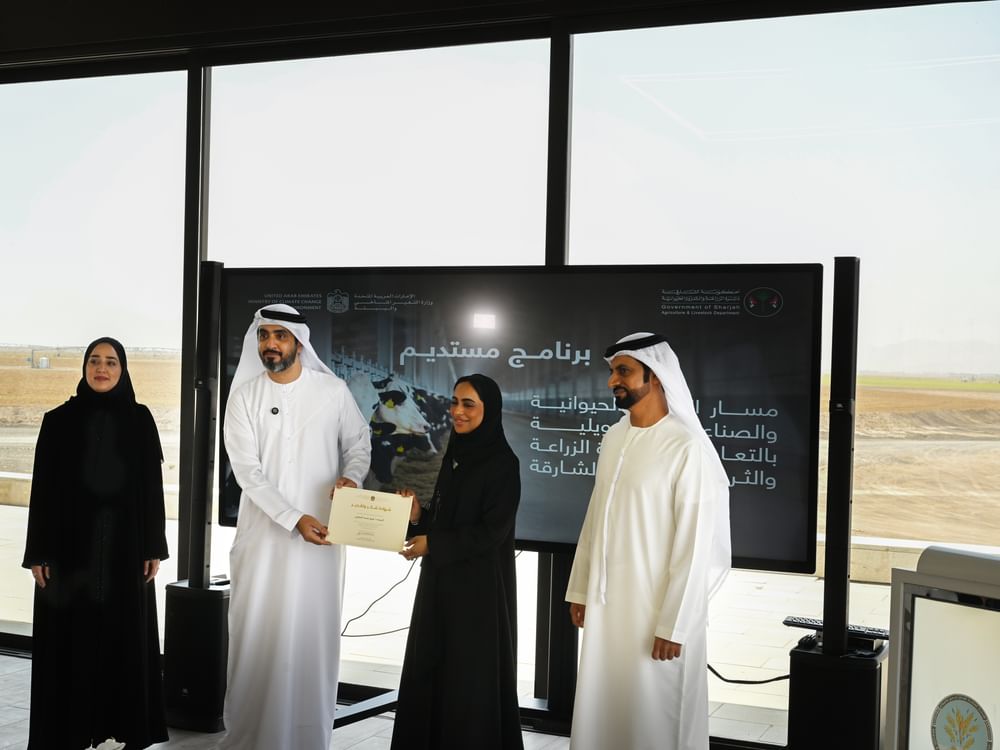
SHARJAH, 20th August, 2026 (WAM) -- The Ministry of Climate Change and Environment (MOCCAE) has successfully concluded the ‘Livestock and Processing Industries’ track of the third edition of the ‘Mustadeem’ programme, in collaboration with the Sharjah Department of Agriculture and Livestock.
The four-day event featured interactive sessions, field tours and practical challenges, held at the Mleiha Dairy Farm and Factory in Sharjah.
This track empowers the next generation to safeguard food security by providing practical expertise in livestock production, veterinary care, biosecurity, and food quality. By inspiring young minds to explore rewarding careers in this field, the programme drives innovation to overcome industry challenges, shaping a resilient, sustainable, and thriving agricultural sector for the UAE.
These strategic initiatives directly align with the UAE’s national vision to engage youth in food security and environmental stewardship. By providing hands-on exposure to modern livestock technologies, such as smart barn systems, cattle health electronic tagging, and advanced dairy processing, the programme makes a significant investment in national talent. It prepares future leaders to innovate, protect natural resources, and advance the UAE’s sustainable development goals.
The final day of the ‘Livestock and Processing Industries’ track was held at the wheat farm in Mleiha and attended by Marwan Abdullah Al Zaabi, Assistant Undersecretary for the Regions Sector at the Ministry of Climate Change and Environment (MOCCAE). Officials and experts from MOCCAE, Sharjah Department of Agriculture and Livestock, and Mleiha Dairy Farm and Factory also attended the event. Attendees reviewed the student teams’ final presentations and saw their innovative solutions firsthand. The projects showcased a deep mastery of the concepts taught throughout the programme, particularly in livestock management and dairy supply chains.
Marwan Al Zaabi emphasised that food security is a top strategic priority on the national agenda, as it is an integral part of the UAE’s broader national security framework. This is particularly important in light of the rapid climatic and economic changes the world is witnessing, which are prompting nations to reassess their food policies and strengthen their self-reliance to respond effectively to emerging challenges.
He said: “Investing in young national talent and equipping them with advanced scientific and technical expertise in food and livestock production is an urgent national priority. Developing this next generation builds a resilient, highly skilled workforce capable of leading the sector and navigating its evolving challenges.”
He added: “The third edition of the ‘Mustadeem’ programme reflects the UAE’s vision of linking the National Food Security Strategy with an integrated education and training ecosystem. This approach enables students to understand the strategic dimensions of the sector, from veterinary care and biosecurity to food production, processing and supply chains. Investing in this generation is a long-term commitment to strengthening the stability of the national food system and enhancing the UAE’s ability to address future challenges with confidence and self-reliance. It also reinforces the UAE’s position as a leading model for advancing food sustainability.”
For his part, Erhama Al Shamsi, Director of the Support Services Department at the Sharjah Agriculture and Livestock Department, affirmed that hosting the ‘Livestock and Processing Industries’ track as part of the third edition of the ‘Mustadeem’ Programme reflects the Department’s commitment to supporting national initiatives aimed at empowering younger generations, familiarising them with the fundamentals of the livestock sector, and raising their awareness of the importance of food security and sustainability.
He explained that the programme provided students with an opportunity to gain first-hand exposure to an integrated system of modern practices and technologies in the livestock sector, starting with herd management, veterinary care and biosecurity, through to milk production and the processing of its derivatives. This enabled students to translate theoretical knowledge into practical and field-based experiences that enhanced their skills and strengthened their capacity for innovation.
Al Shamsi also commended the students’ high level of engagement and the innovative ideas and solutions they presented, affirming that investing in young talent and introducing them to future opportunities in the livestock sector is a fundamental pillar in developing a generation capable of contributing to the UAE’s food security and sustainable development objectives.
The ‘Livestock and Processing Industries’ track ran for four consecutive days and brought together a selected group of students from Grades 6 to 8. The programme was designed to combine theoretical knowledge with practical, field-based experience in an integrated production environment, with activities structured around four key pillars.
The students’ projects reflected the knowledge and practical skills they acquired during the
The ‘Livestock and Processing Industries’ track and the ‘Discovering the Ocean’ track, which took place earlier this August, are key highlights of the third edition of the ‘Mustadeem’ programme. Together, they reflect the initiative’s commitment to providing Emirati youth with specialised, hands-on experience across environmental and biological sectors.
Through these tracks, the programme helps develop a generation equipped to contribute to the UAE’s sustainability and food security goals. By empowering the next generation to advance national sustainability and food security, the programme reinforces the UAE’s standing as a global model for youth-driven sustainable development.