
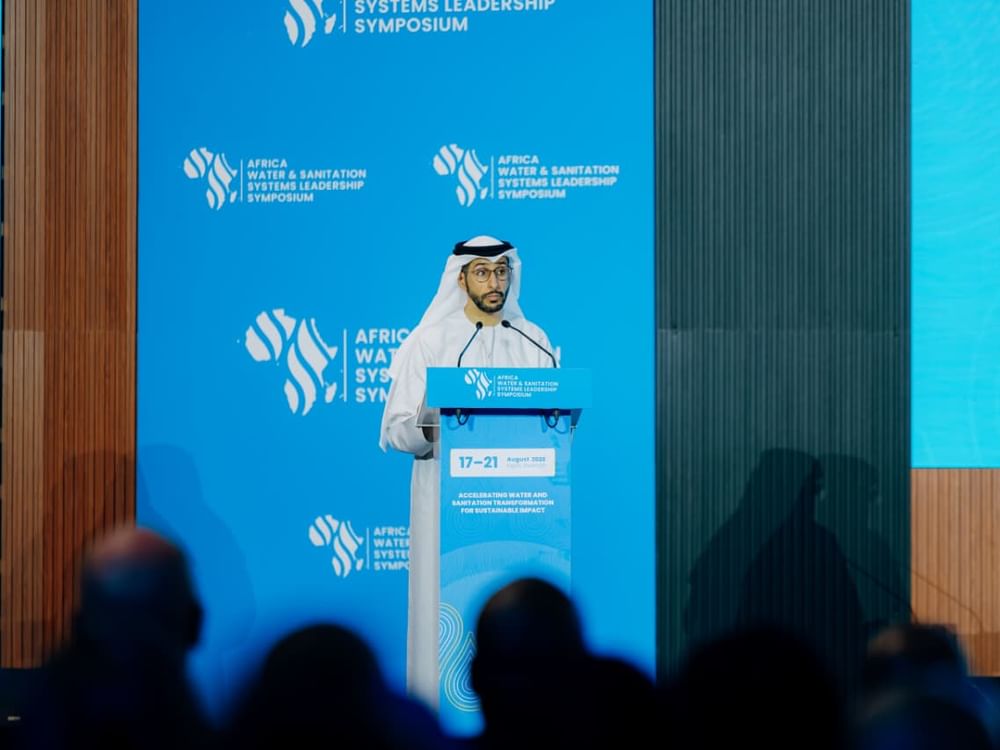
KIGALI, 24th August, 2026 (WAM) -- As part of the preparations to host the United Nations Water Conference 2026, the United Arab Emirates participated in the Africa Water & Sanitation Systems Leadership Symposium 2026.
During the event, the country emphasised the strategic importance of water to Africa’s sustainable development and resilience, and the need to translate political commitment into investments, partnerships, practical solutions, and advanced technologies.
Abdulla Balalaa, Assistant Minister of Foreign Affairs for Energy and Sustainability, led the UAE delegation at the high-level Symposium in Kigali, Rwanda, where he participated in the opening plenary on ‘Political Leadership, National Reforms and Investment Confidence for Africa’s Water Vision 2063’.
During his remarks, Ballad highlighted the importance of the Symposium and reiterated the economic and development opportunities presented by the water sector, “Today, the symposium has highlighted a critical challenge facing the water sector: the need for stronger pipelines of investable projects, greater institutional capacity and the reforms required to attract finance and investment at scale. Yet, this challenge also presents an economic opportunity. Water is not only a development imperative - it is an economic need, and a huge opportunity. Stronger water systems support jobs, productivity, food security and long-term prosperity. Unlocking investment in water means facilitating investment in Africa’s future.”
He highlighted the importance of the Symposium’s focus on institutional strengthening, governance by capacity building, regulatory reform, and creating the necessary environment to strengthen confidence and provide finance for water and sanitation systems across the continent.
The UAE’s active engagement in the symposium builds on its sustained efforts to place water at the center of international discussions on development, resilience and economic prosperity.
From the High-Level Preparatory Meeting in Dakar to the World Bank and IMF Spring Meetings in Washington, DC, London Climate Action Week, and the High-Level Political Forum at the UN in New York, the UAE has consistently underscored the importance of stronger partnerships, investment, innovation, and accelerating progress on water and sanitation.
The Kigali Symposium also contributed directly to the preparations for the 2026 United Nations Water Conference, which will be hosted by the UAE in partnership with the Republic of Senegal in Abu Dhabi from 8–10 December 2026.
The Conference will act as an international platform for dedicated to implementation and action.
The UAE’s engagement in Kigali further highlighted the importance of African leadership in shaping the global water agenda.
The outcomes of the Symposium are expected to contribute substantive inputs to four of the Conference’s Interactive Dialogues — Water for People, Water for Planet, Water for Cooperation, and Investments for Water — led by African co-chairs, including Ghana, Egypt, Zambia and South Africa.
On the sidelines of the Symposium, Balalaa held a number of bilateral meetings with senior African and international partners, including Rwanda’s Minister of Environment; Minister of State from the Ministry of infrastructure; the leadership of Rwanda’s Water and Sanitation Corporation and the Development Bank of Rwanda; Zimbabwe’s Deputy Minister for Agriculture, Mechanization & Water Resources Development; the Executive Director of the International Water Association; and Ghana’s Deputy Minister for Works, Housing and Water Resources.
The discussions focused on strengthening cooperation and partnerships around water and sanitation systems, institutional capacity, investment and resilience, while providing an opportunity to deepen connections between African governments, financial institutions, international organisations and other stakeholders.