
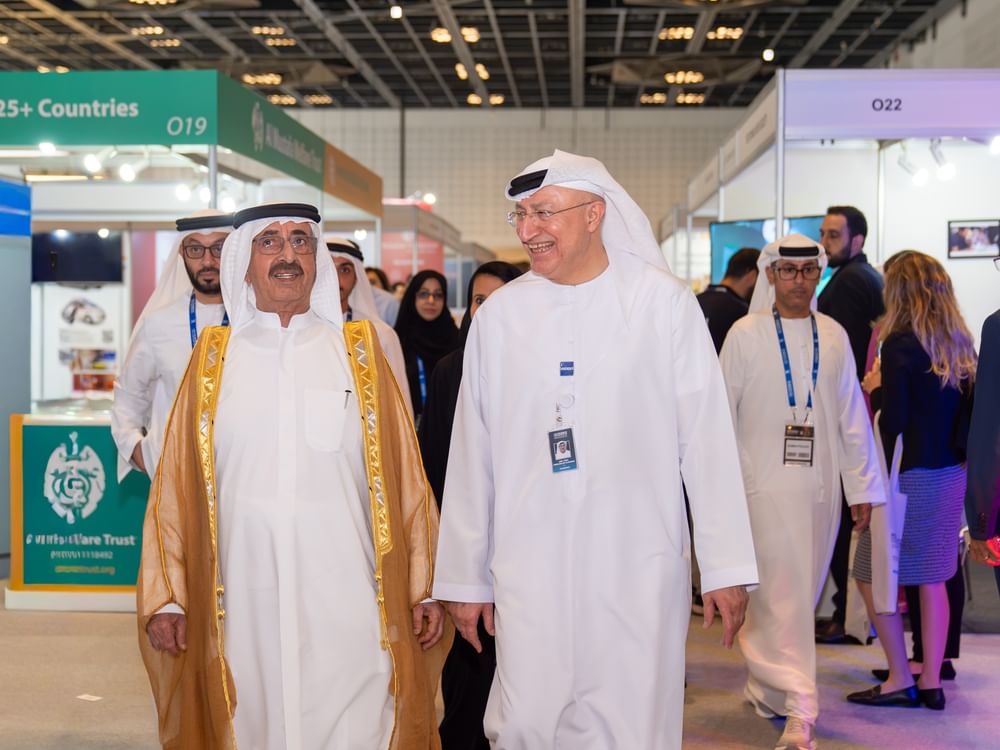
DUBAI, 24th August, 2026 (WAM) -- Under the patronage of His Highness Sheikh Mohammed bin Rashid Al Maktoum, Vice President and Prime Minister of the UAE and Ruler of Dubai, H.H. Sheikh Hasher bin Maktoum bin Juma Al Maktoum, Chairman of Dubai Media Incorporated, inaugurated the 22nd edition of the Dubai International Humanitarian Aid and Development Conference and Exhibition (DIHAD 2026).
The three-day event, being held at the Dubai World Trade Centre, brings together senior decision makers from government entities, United Nations agencies, the Red Cross and Red Crescent Movement, international and regional organisations, non-governmental organisations (NGOs), academic and research institutions, the private sector, philanthropic foundations and organisations, financial institutions and development banks, and the media, to explore ways of aligning efforts and developing more effective and sustainable responses to support communities affected by crises and disasters.
This year’s edition is being held under the theme ‘Humanitarianism in Transition: Shaping the Future of Humanitarian Action,’ at a time when the humanitarian sector is undergoing rapid transformation driven by increasingly complex crises, changing global needs, and evolving operating environments, underscoring the need for new approaches to collaboration, innovation, and response.
Following the opening ceremony, H.H. Sheikh Hasher toured the exhibition, accompanied by several ambassadors, heads of participating delegations, and representatives of international organisations.
Sheikh Hasher also witnessed the launch of the Awqaf Dubai and DIHAD Endowment Fund for Humanitarian Action.
The initiative jointly undertaken by the Endowment and Minors’ Trust Foundation in Dubai (Awqaf Dubai) and DIHAD Sustainable Organisation is aimed at leveraging endowments to support sustainable humanitarian action and finance humanitarian and development projects and initiatives with lasting impact.
Ambassador Prof. Abdulsalam AlMadani, Chairman of DIHAD Sustainable Organisation and Chairman of DISAB, Roving Ambassador of the Parliamentary Assembly of the Mediterranean (PAM) for the GCC Region, said: “DIHAD 2026 is taking place at a pivotal moment for humanitarian action worldwide, amid increasingly complex crises and rapidly growing needs that call for more proactive, flexible, and sustainable approaches.
The theme of this year’s edition, ‘Humanitarianism in Transition: Shaping the Future of Humanitarian Action,’ highlights the need to align efforts and rethink humanitarian response mechanisms in ways that strengthen their impact and keep pace with global change.
“DIHAD serves as a global platform bringing together all stakeholders across the humanitarian ecosystem, from governments, international organisations, and the private sector to experts and decision makers, to exchange knowledge, build partnerships, and develop innovative solutions. From Dubai, we reaffirm that the future of humanitarian action depends on moving from response to preparedness, from individual efforts to partnerships, and from temporary solutions to sustainable impact that strengthens community resilience and preserves human dignity.”
The refugee issue remains one of the most pressing challenges on the global humanitarian agenda, as escalating crises continue to place growing pressure on refugee communities and their basic needs.
Dr. Maitha bint Salem Al Shamsi, Minister of State and Chairperson of the Supreme Committee of the Sheikha Fatima Fund for Women Refugee, delivered an address outlining the vision of Her Highness Sheikha Fatima bint Mubarak, the ‘Mother of the Nation’, Chairwoman of the General Women’s Union, President of the Supreme Council for Motherhood and Childhood, and Supreme Chairwoman of the Family Development Foundation, on many issues that H.H. considers central to the development and modernisation of strategies addressing refugee-related challenges.
This vision aligns with the challenges and crises facing refugees, which centre primarily on essential needs, including shortages of shelter, food, and medicine, difficulty accessing education and employment opportunities, as well as psychological, economic, and legal challenges.
In his address during the opening of the event, Ahmed Darwish Al Muhairi, Director-General, Islamic Affairs and Charitable Activities Department (IACAD), Dubai, said: “This year’s conference is being held under the theme ‘Humanitarianism in Transition: Shaping the Future of Humanitarian Action,’ a theme that not only reflects the transformation we are witnessing, but also calls on all of us to rethink how we shape the future of humanitarian action, measure its impact, and ensure its sustainability.
The world today is not facing a single crisis, but an unprecedented accumulation of challenges, from conflicts and natural disasters to climate change, economic crises, and rapid technological shifts that are reshaping the realities of communities.
“Against this backdrop, humanitarian action is no longer an option, but a strategic necessity and a fundamental component of achieving stability and development, while strengthening the ability of communities to navigate future challenges.”
In recognition of her outstanding contributions to humanitarian action and her efforts to advance innovation and international partnerships, DIHAD 2026 honoured Rania Dagash-Kamara, Assistant Executive Director for Partnerships and Innovation, World Food Programme, with the DIHAD International Personality Award for Humanitarian Relief 2026, celebrating her exceptional contributions to developing sustainable solutions for communities affected by crises around the world.
The award is one of the most distinguished recognitions in the global humanitarian field and is presented by the DIHAD International Scientific Advisory Board (DISAB) to individuals and leaders who have made significant contributions to supporting people in need and advancing humanitarian action worldwide.
Speaking on the occasion, Rania Dagash-Kamara noted: “For more than two decades, DIHAD has brought the humanitarian community together here in Dubai: governments, humanitarian organisations, the private sector, innovators and young people – around one shared responsibility; supporting people affected by crisis.
For WFP, gathering here in the United Arab Emirates is especially meaningful. The UAE is a key partner with whom we have responded to emergencies, advocated for vulnerable communities, and worked side by side to overcome challenges.The UAE is also home to the largest humanitarian response depot in WFP’s global network, helping pre-position and dispatch life-saving supplies for WFP and the wider humanitarian community to crises around the world.”
The scale and diversity of international participation at DIHAD 2026 reflect the event’s growing standing as a global platform bringing together stakeholders from across the humanitarian ecosystem.
The event welcomes more than 1,000 participating entities and partners, more than 21,000 participants and visitors from 165 countries, over 320 speakers across more than 260 sessions and workshops, as well as more than 180 buyers from leading United Nations agencies, foundations and charities from around the world, creating broad opportunities for knowledge exchange, partnership-building, and the exploration of innovative solutions to evolving humanitarian challenges.
The UAE Aid Agency reinforces its leading role in advancing humanitarian action as the Official Partner of DIHAD 2026, while the Kingdom of Denmark is the Guest of Honour of this year’s edition, reflecting its commitment to international cooperation and humanitarian action and enriching dialogue on advancing humanitarian response and strengthening global partnerships.
Eng. Khaled Al Attar, Director General, DIHAD Sustainable Organisation, highlighted the importance of understanding the drivers of change in humanitarian action, saying: “Humanitarian action is undergoing rapid transformation as crises increase in scale and humanitarian needs become more complex. This requires stronger multilateral action and greater integration of efforts among governments, international organisations, humanitarian actors, and the private sector.
“At DIHAD Sustainable Organisation, we believe that the next phase requires expanding the scope of cooperation and making more integrated use of available expertise, resources, and capabilities, while further developing response mechanisms to keep pace with change and strengthen their ability to reach communities most in need. Through DIHAD, we continue to support dialogue, knowledge exchange, and partnership-building that contribute to the development of practical and sustainable solutions and translate commitment to humanitarian action into tangible impact in the lives of affected communities.”
The first day of DIHAD 2026 focused on ‘Understanding the Transition: Drivers of Change in Humanitarianism,’ highlighting the rapid global developments reshaping the humanitarian landscape and the need to reassess traditional approaches and established response models.
The programme also examines the key transformations affecting the sector, from the changing nature of crises and the evolving needs of affected communities to the growing role of innovation, technology, and partnerships, and their implications for the future of humanitarian response, and the need to develop models that are more flexible, proactive, and capable of delivering sustainable impact.
The first day of DIHAD 2026 featured a comprehensive programme of high-level discussions and activities, including high-level round-table meetings hosted by DIHAD Sustainable Organisation in collaboration with various international humanitarian organisations. These meetings brought together leading officials and experts to examine the rapid transformations affecting humanitarian action and development and to explore new pathways for strengthening international cooperation and developing more integrated, effective, and sustainable responses.
Roundtable discussions on the first day addressed several critical issues directly linked to community resilience and humanitarian response, including water and water resource management, with particular attention to the role of responsible artificial intelligence in advancing humanitarian and sustainable development outcomes.
The first-day programme also included the Donor Appreciation Event, hosted by Zayed University in collaboration with DIHAD, celebrating the valuable contributions of the university’s donors and partners and recognising their role in supporting its academic and community mission and strengthening its impact across education, knowledge, and community service.
DIHAD 2026 is taking place alongside the 17th International Emergency and Catastrophe Management Conference and Exhibition (IECM 2026), which brings together leading experts and specialists from around the world to explore the latest solutions, technologies, equipment, and services in disaster and emergency management, with a focus on strengthening preparedness and enhancing effective response to crises and emergencies.
The Dubai International Humanitarian Aid and Development Conference and Exhibition (DIHAD) is an annual event organised by INDEX Conferences & Exhibitions, a member of INDEX Holding. It is officially supported by the UAE Aid Agency, the United Nations, the International Federation of Red Cross and Red Crescent Societies (IFRC), Mohammed bin Rashid Al Maktoum Global Initiatives, the Dubai Future Council for Humanitarian Work, Emirates Red Crescent, and the Mohammed bin Rashid Al Maktoum Humanitarian and Charity Establishment. The Islamic Affairs and Charitable Activities Department (IACAD), Dubai, and Dubai Charity Association serve as the event’s Platinum Sponsors.