
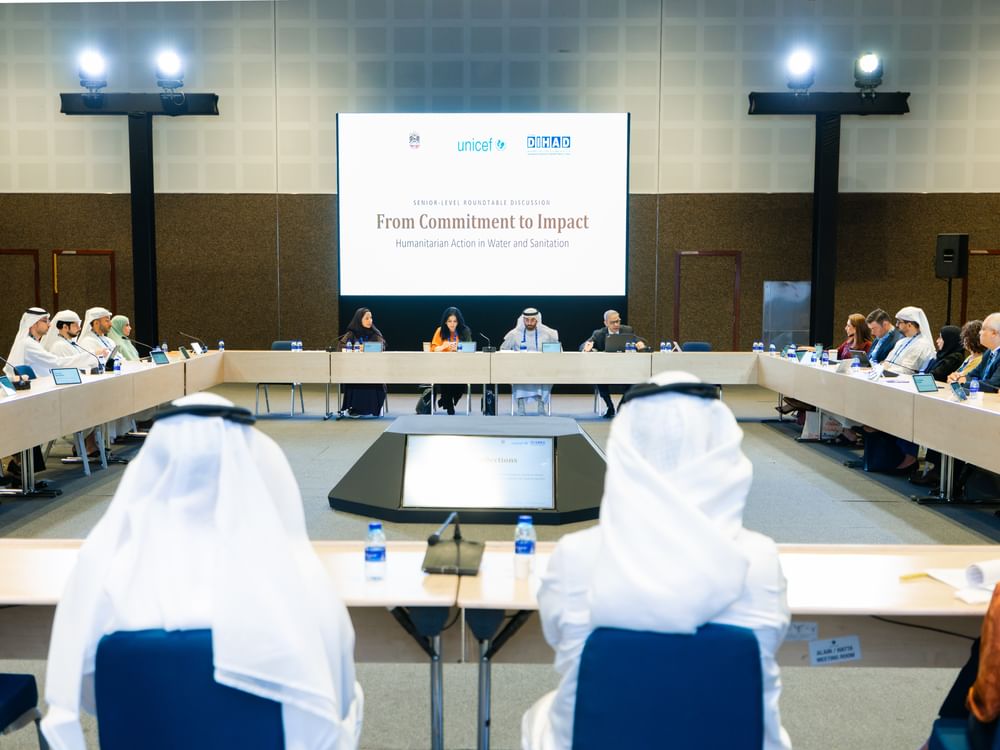
DUBAI, 25th August, 2026 (WAM) -- The UAE Aid Agency and the United Nations Children’s Fund (UNICEF) held a roundtable titled “From Commitment to Impact: Humanitarian Action in Water, Sanitation and Hygiene,” as part of the agency’s participation in the Dubai International Humanitarian Aid and Development Conference and Exhibition (DIHAD 2026), held this year under the theme “Humanity in Transition: Shaping the Future of Humanitarian Action.”
The discussions brought together leading figures from humanitarian and development organizations, donor institutions, innovators and the private sector, with the aim of building more resilient water, sanitation and hygiene (WASH) systems.
Participants stressed the importance of water resilience and how humanitarian response, preparedness, recovery and systems strengthening can be better integrated to reduce future needs, as well as how partnerships, financing, technology, innovation and artificial intelligence can accelerate investment in sustainable water and sanitation systems.
Recommendations from the discussions will be submitted to the organizing committee of the 2026 UN Water Conference, to be held in Abu Dhabi from 8 to 10 December, co-hosted by the UAE and Senegal.
Commenting on the significance of the roundtable, Sarah Jasim, Director of Sustainable Development in the Operations Department at the UAE Aid Agency, said humanitarian response is essential to saving lives, but investing in resilient and sustainable water and sanitation systems is equally critical to ensuring readiness for future crises.
She added that the agency, in cooperation with UNICEF and other partners, is committed to shifting from an emergency-only response model toward one centred on preparedness, recovery and capacity-building — while deploying innovative solutions and harnessing technology and artificial intelligence to strengthen water and sanitation services for the most vulnerable communities.
For her part, Lana Wreikat, UNICEF Regional Office Director for the Gulf, said the ability to address water sector challenges is no longer solely a development issue but has become an urgent humanitarian imperative.
She called for moving beyond repeated humanitarian response cycles toward securing the financing, technology, innovation and human capacity needed to confront water and sanitation system challenges — particularly amid worsening crises — in order to protect children, safeguard development gains and reduce future humanitarian needs.
Over the past three years, the UAE has allocated USD 21 million to support the water, sanitation and hygiene sector as part of its global humanitarian response. Recent efforts include the establishment of desalination plants in El Arish, Egypt, producing two million gallons of clean water daily for one million displaced people in the Gaza Strip, alongside water infrastructure supporting refugees and host communities in Chad, South Sudan and elsewhere.