
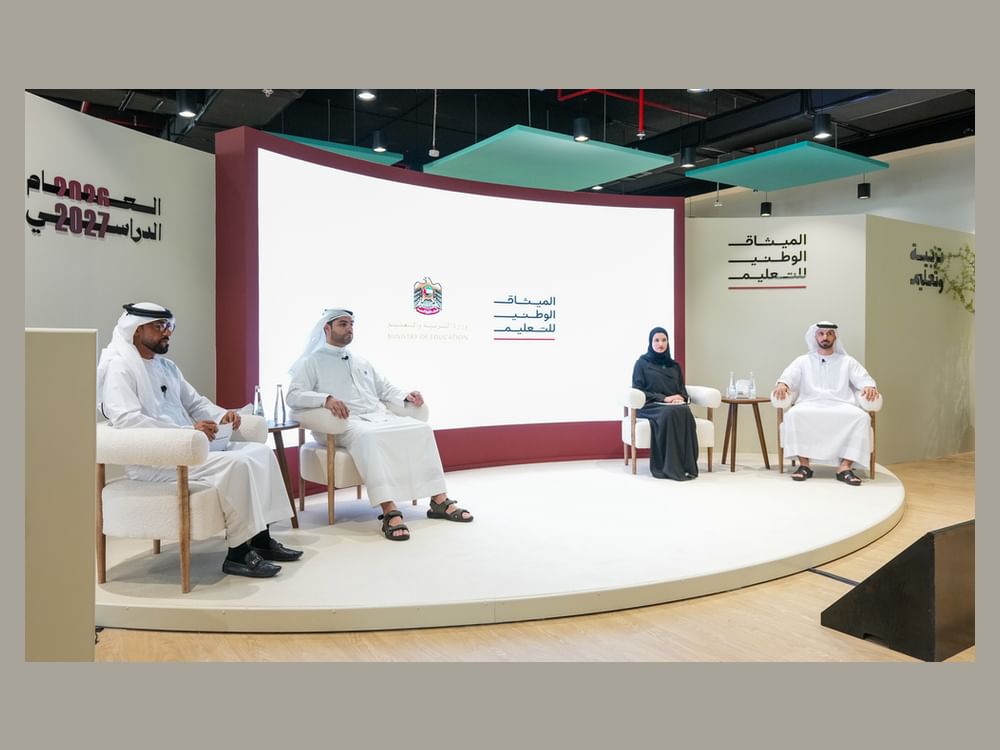
ABU DHABI, 26th August, 2026 (WAM) -- The Ministry of Education (MoE) announced the complete readiness of the UAE education system for the 2026-2027 academic year during a press conference at the Zayed Educational Complex in Al Warqaa in the presence of high-level ministry officials.
These included Sarah Al Amiri, Minister of Education; Eng. Mohammed Al Qasim, Under-Secretary of MoE; Sulaiman Al Kaabi, Assistant Under-Secretary for the Professional Development Sector; and Tariq Al Hashimi, Assistant Under-Secretary for the School Operations Sector (Dubai and Northern Emirates).
The briefing outlined academic, administrative, operational and technical preparations designed to ensure a seamless start.
MoE highlighted key updates and national initiatives aimed at elevating student and teacher experiences to align with the UAE's future-focused educational vision. These comprehensive preparations spanned all ministry departments, focusing on updated educational policies, enhanced evaluation frameworks, school and staff readiness as well as new professional development and innovation programmes.
Sarah Al Amiri said that the ongoing evolution of the UAE's education sector reflects the leadership's forward-looking vision that views human capital investment as the foundation of national development, adding that equipping the new generation with future-proof knowledge, skills and values remains at the forefront of national priorities.
Al Amiri noted that MoE continues to execute its development plans and programmes to meet government objectives through sustainable policies, initiatives and projects. These efforts seek to enhance the competitiveness of the UAE’s education system and consolidate the country's global standing in this space.
She stated that the Ministry achieved readiness for the new academic year by investing in students, teachers and schools, creating a safe and stimulating learning environment and translating the objectives of the National Education Charter into initiatives that improve educational outcomes.
Al Amiri emphasised MoE’s commitment to developing a more flexible, efficient and sustainable education system that is rooted in national identity and keeps pace with global advancements in science and technology.
Eng. Al Qasim explained that the Ministry has established proactive plans to ensure public schools are ready for the 2026-2027 academic year. These plans cover all components of the education system – policies, curricula, human capital, infrastructure, digital services and learning tools.
MoE works closely with its partners across the public and private sectors to provide a high-quality educational experience that meets student and parent aspirations and aligns with global best practices.
The Ministry announced the activation of the National Education Charter, which establishes a unified national vision for education, across six integrated pathways. These include linking the Charter’s principles to educational outcomes, empowering teachers to apply them, integrating them in daily practices, leveraging classroom and extracurricular activities to reinforce them, aligning the student code of conduct with them, and engaging families in supporting their implementation.
MoE also kicked off a back-to-school campaign under the theme ‘Guided by the Charter, Building Tomorrow’ to embed these principles into everyday life and strengthen collaboration between schools, families and the wider community.
To reinforce Arabic language as a core national and educational priority, the Ministry is launching the second phase of the Arabic language skills assessment, following a pilot phase, conducted in 100 public and private schools last year to establish student baselines. This next phase targets all 19,000 Grade-1 students across 162 public schools and 11,000 Grade-1 students across 130 private schools to support early skill development.
As part of its updates for the new academic year, MoE has announced that there will be no homework for students from Kindergarten through Grade 2. In line with early-childhood developmental needs, this decision optimises classroom learning and restores a healthy balance between school and family life.
The initiative replaces traditional homework with daily home reading to cultivate early literacy, enhance language and cognitive development and foster a lifelong curiosity and passion for learning.
MoE announced the expansion of the ‘Regulating the Use of Digital Tools in Education’ project to include all Grade-6 students across public schools. Last academic year, the Ministry conducted a study on 2,500 students across nine public schools, which compared two groups to evaluate the impact of regulating digital tool usage.
Preliminary results revealed a clear improvement in academic performance in non-digital classrooms, specifically in mathematics, science and Arabic, alongside better behaviour and increased classroom focus.
The initiative aims to balance technology integration with the reinforcement of fundamental skills to enhance academic achievement, critical thinking, cognitive development, educational interaction and discipline.
MoE introduced a project to evaluate all public and Ministry-licensed private schools across the UAE over two academic years, beginning in the first semester of 2026-2027.
The initiative seeks to measure performance against approved national standards, identify strengths and areas for improvement and enable schools to implement sustainable development plans that enhance learning outcomes.
As part of its ongoing investment in human capital, the Ministry launched an integrated suite of professional development programmes. Key initiatives include the National AI Capacity-Building Programme, co-designed with Hamdan Bin Mohammed Smart University (HBSMU), the Promising School Leaders Project and the Afaq programme, delivered in collaboration with Emirates College for Advanced Education (ECAE) to equip teachers with AI skills.
Additionally, the rollout features the Comprehensive Capacity-Building Programme for Educational Leaders, the Professional Fellowship Programme and the Certified Internal Trainers Programme. These initiatives reflect the Ministry’s belief that an investment in teachers is an investment in the future of the national education system.
MoE initiated the academic year with a Specialised Training Week for over 24,000 teachers, school leaders and specialists, featuring more than 80 training programmes and workshops, alongside a dedicated programme for more than 1,700 school leaders.
The Ministry updated the assessment weighting for Group A subjects in Cycle 3, adjusting school and central assessments to a 50/50 split. This balance aims to reflect actual student performance and strengthen the schools’ role within a unified national framework.
The updates include the implementation of teacher-led diagnostic tests at schools to assess students, identify learning gaps early and apply the results to lesson planning and targeted support.
Additionally, MoE is expanding the Project-Based Learning and Assessment (PBLA) initiative, which involves over 129,000 students across 366 schools nationwide. This includes the launch of the first integrated project for Grade 7, combining Arabic, English, mathematics and science to link theoretical knowledge with practical application and build future skills.
For the upcoming academic year, the Ministry opened 11 new schools and educational complexes, deployed 5,810 school buses and distributed 8 million textbooks.
Over 1,180 public and private schools across the UAE reopen their doors on 31 August, welcoming more than 1.277 million students. A total of 26,700 new students were registered in public schools.