
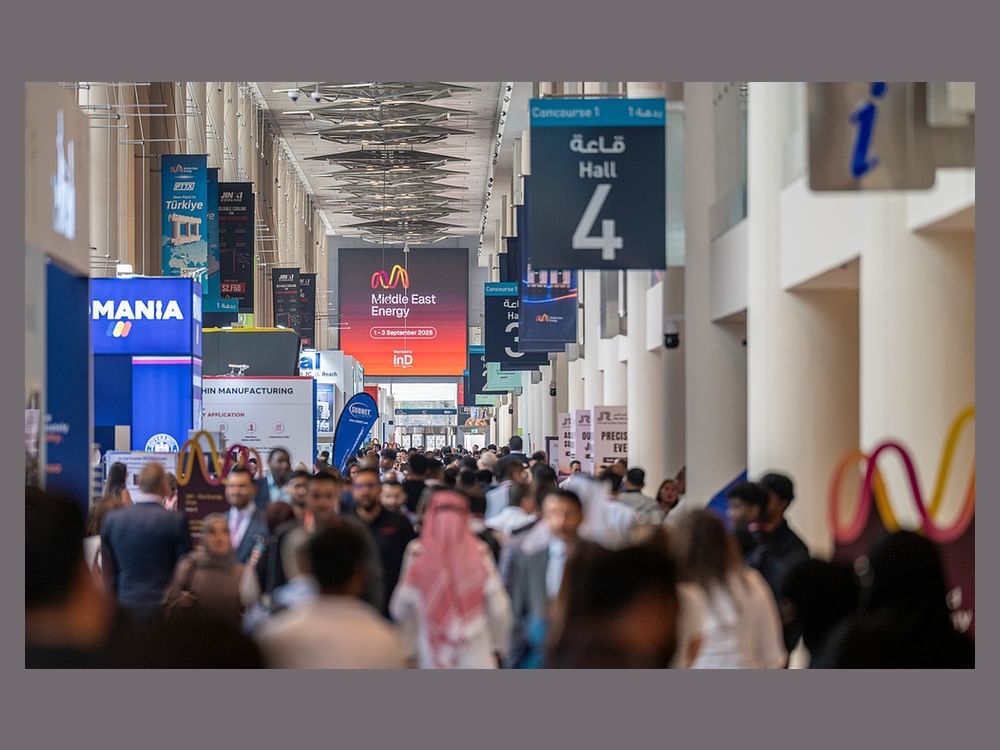
DUBAI, 2nd September, 2026 (WAM) -- The second day of Middle East Energy's 50th edition centered on the technologies and capital shaping the next phase of the region's energy transition. Today’s event opened with a Leadership Summit keynote from Sharif Al Olama, Undersecretary for Energy and Petroleum Affairs, UAE Ministry of Energy & Infrastructure (MoEI).
"Today, of course, energy has never been more important. Demand continues to grow, technology is advancing at an exponential rate, and artificial intelligence is reshaping how we produce, manage, and consume energy. These are not separate challenges; they are part of the same equation. The question before us is not simply how we generate more energy, but rather how do we build a cleaner, smarter, resilient, and sustainable energy system capable of supporting long-term economic growth," he said.
Focusing on the future of energy in UAE, Al Olama added, “For the UAE, the journey is guided by a simple belief: energy is not an end in itself. Energy enables progress. It enables industry. It enables technology. It enables mobility, it enables prosperity, and increasingly, it enables national competitiveness. That is why the UAE has followed a balanced yet pragmatic approach – one that combines ambition with realism, innovation with reliability and energy transition with energy security.”
Across the different speaking forums, senior voices from government, utilities and global finance presented investment cases for renewable energy and the commercial path forward with topics focusing on AI, digital technologies and transformation, grid flexibility and next gen-technology. These reflect an agenda that has moved beyond ambition to focus on delivery, financing, and execution.
Two fireside conversations at the Leadership Summit brought geopolitical and supply chain realities into sharp focus. In "Navigating the Geopolitics of Europe's Clean Energy Transition," Alvaro Nadal, former Spanish Minister of Energy, Tourism and Digital Agenda (2016–2018) and Patricia Espinosa, Founding Partner & CEO of onepoint5 and Former Executive Secretary of UNFCCC examined the role of shifting strategic partnerships in accelerating Europe’s energy transition and the need for policy, investment and grid infrastructure to deliver a secure, affordable and low-carbon energy future.
This was followed by "Re-engineering the Energy Supply Chain: Who Is Reshaping Global Energy Delivery?" featuring Peggy Liu, Chairperson of JUCCCE (Joint US China Collaboration on Clean Energy), and Rebecca Harding, CEO of the Centre for Economic Security. The discussion tackled the global realignment of clean energy manufacturing and critical mineral supply chains, and the importance of logistics and shipping corridors in moving the energy transition going forward.
Elsewhere on day two, the Technical Excellence Forum's "Energy Transition & Decentralisation" session, explored how distributed generation, microgrids and demand-side flexibility are becoming essential building blocks of the region's net zero pathway.
Red Sea Cables launched its 132 kV High Voltage Cable, marking a strategic milestone in the company’s growth and the expansion of its manufacturing capabilities. The launch further strengthens Red Sea Cables’ position as a growing provider of advanced cable solutions for the energy, utilities, infrastructure and industrial sectors across the Kingdom of Saudi Arabia and the wider Middle East.
Other key events were the Global Energy Efficiency Alliance roundtable held under the patronage of MoEI, with participation from Sharif Al Olama and 30 CEOs from a wide range of global energy companies. This was followed by Siemens, Honeywell, Schneider Electric, First Abu Dhabi Bank (FAB), Hitachi Energy, Siemens Energy, Net0 signing a memorandum of understanding with the MoEI to take the Global Energy Efficiency Alliance agenda forward.
Middle East Energy celebrated the brightest minds in energy innovation with brilliance and ground-breaking products amongst exhibitors across vital product categories in the energy sector. These awards recognised exceptional contributions from visionary individuals and provided an opportunity to showcase cutting-edge technology and revolutionary products.
Exhibitor awards winners were:
• Distribution Excellence Award – Rolycab Industries
• Energy Efficiency Champion Award - Momentive
• The Power Resilience Award – CE+T Power
• Renewable Energy Innovation Award - PVFARM
Across the show floor, exhibitors highlighted their innovative products engineered for tomorrow. These included Comacon's sustainability-focused engineering solutions for intelligent infrastructure; Lucy Electric's newly launched Nuventura Nu1, a sustainable SF6-free switchgear for a sustainable future delivering reliable performance up to 36kV; Saudi Meters' smart water and electricity metering solutions for real-time utility monitoring and management; and Astro Cables showcasing low-voltage copper and aluminium power cables, building wires, fire-resistant and solar cables, delivering reliable cable solutions for residential, commercial, industrial, infrastructure and renewable energy applications.
On the AI innovation front, InfiVR showcased AI-powered safety and HSE trainings. China's Shandong Taikai exhibited high-voltage power transmission and transformation equipment, while Hunan Guochuang Electric highlighted precision-engineered transformer components for the new energy and ultra-high voltage sectors.
Hash House highlighted its H1-630, a compact cryptocurrency mining device designed to work with solar and battery systems, helping users convert excess energy into digital income.
Exhibitors continue to launch their products on the show floor, with Middle East Energy running until 3 September.