
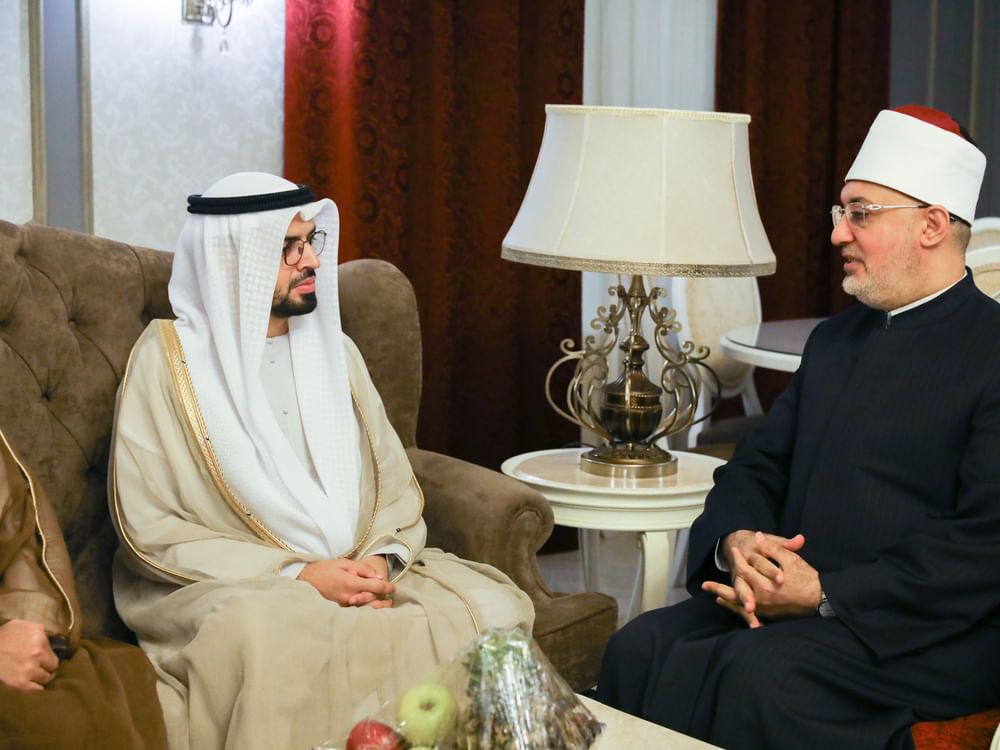
CAIRO, 3rd September, 2026 (WAM) -- Dr. Omar Habtoor Al Darei, Chairman of the General Authority of Islamic Affairs, Endowments and Zakat, and Vice Chairman of the UAE Council for Fatwa, met Dr. Nazir Mohammed Ayyad, Grand Mufti of the Arab Republic of Egypt and Chairman of the General Secretariat for Fatwa Authorities Worldwide, on the sidelines of the Egypt's Dar al-Ifta 11th International Conference.
The meeting was attended by Dr. Saba Salem Al Kaabi, Secretary-General of the UAE Council for Sharia Fatwa, and the accompanying delegation.
The two sides discussed ways to strengthen scientific and institutional cooperation in the field of fatwa, and to exchange expertise and knowledge between the UAE Council for Fatwa, Egypt's Dar Al-Ifta and the General Secretariat for Fatwa Authorities Worldwide, in a manner that contributes to developing fatwa work and keeping pace with contemporary issues and developments.
The meeting focused in particular on family issues amid rapid social and technological changes, and the importance of developing fatwa approaches that combine sound Islamic jurisprudential foundations with an understanding of contemporary realities and consideration of outcomes, while contributing to family stability, cohesion and the preservation of values.
The two sides also discussed prospects for benefiting from artificial intelligence technologies in developing fatwa services and content, and exchanging experiences in the institutional and responsible use of modern digital tools to enhance the quality of fatwa knowledge, improve access to services and maintain the reliability and accuracy of fatwas and their outputs.
The meeting stressed the importance of continuing coordination and the exchange of expertise among fatwa institutions, and of strengthening scientific partnerships in areas of mutual interest, in support of the development of institutional fatwa work and its ability to respond to social and technological transformations and anticipate future issues.