
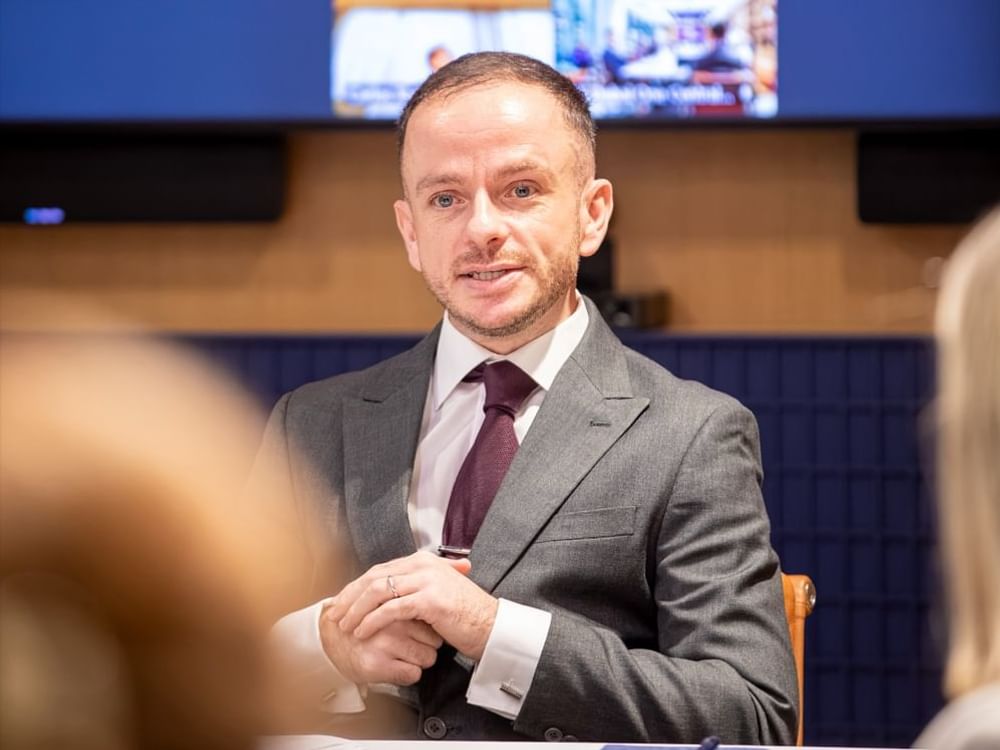
DUBAI, 3rd September, 2026 (WAM) -- Mark Ring, Group Director Middle East Energy, said the rapid growth of artificial intelligence and data centres is reshaping energy demand and driving the sector towards greater focus on flexible generation, storage, critical power and smart energy management as economies become increasingly reliant on electricity.
Speaking to the Emirates News Agency (WAM) on the sidelines of the exhibition's 50th edition, Ring said the UAE has played a key role in the sector's evolution globally and continues to help shape its future. He praised the partnership between Middle East Energy and the Ministry of Energy and Infrastructure and its role in advancing the energy agenda.
He noted that attracting more than 30,000 energy professionals over three days requires infrastructure capable of accommodating a global audience, which Dubai provides through its position as a global travel hub connecting East and West, alongside its hospitality sector and infrastructure supporting the meetings, incentives, conferences and exhibitions industry.
Ring said Middle East Energy has become a global platform bringing together industry leaders, policymakers, decision-makers and investors, helping move ideas, partnerships and opportunities from discussion to implementation.
He announced that the exhibition will move to Dubai Exhibition Centre at Expo City Dubai in 2027, expecting it to further strengthen its impact as the energy sector evolves, supported by the UAE's focus on innovation, sustainability and energy security.
Ring said the exhibition reflects a clear shift in the energy sector's priorities, with growing attention to technologies needed to build a more resilient and adaptable system, including renewables, storage, electricity transmission, reliable backup power, efficient distribution and smart energy management.
He explained that products related to renewable energy and energy efficiency attracted significant interest during this year's edition, alongside switchgear, transformers and electricity transmission products designed to meet rising demand.
Ring pointed to PVFarm's Innovation Award for its pre-construction intelligence software for solar-plus-storage projects, saying such solutions reflect the growing role of long-term planning in energy project decision-making.
He said AI and data centres have emerged as a significant new source of energy demand, citing forecasts by Rystad, Middle East Energy’s Intelligence Partner, that electricity demand in the Middle East and North Africa will rise from 1,671 terawatt-hours in 2025 to 3,670 terawatt-hours by 2050. Data centres, alongside hydrogen, industry and transport, are expected to accelerate consumption growth.
Ring said this shift was clearly reflected in the exhibition through its dedicated Powering AI track, alongside the growing presence of flexible generation, energy storage, critical power and smart energy management solutions. Companies, he added, are no longer focused solely on producing more electricity, but also on delivering reliable and efficient power for an increasingly electrified economy.
He said one of the key messages from this year's edition is that the region's energy transition is moving from ambition to implementation, pointing to the Global Energy & Efficiency roundtable held under the patronage of the Ministry of Energy and Infrastructure, which brought together 30 global companies, with plans to sign a memorandum of understanding on mechanisms to advance implementation.
Ring said the move reflects the shift from discussion to concrete action, alongside the emergence of new technologies and models at the exhibition aimed at generating additional value from power production.
In this context, he highlighted a solution showcased by one exhibitor that combines solar power and storage while using surplus energy for cryptocurrency mining, saying such technologies offer indications of possible future trends in the energy economy.
Ring added that energy storage, grid modernisation and digitalisation are among the sector's most significant trends.
He said the UAE's plans to develop large-scale solar projects coupled with battery storage systems provide a model for expanding renewable energy sources alongside the infrastructure needed to manage fluctuations in generation and maintain grid stability.