
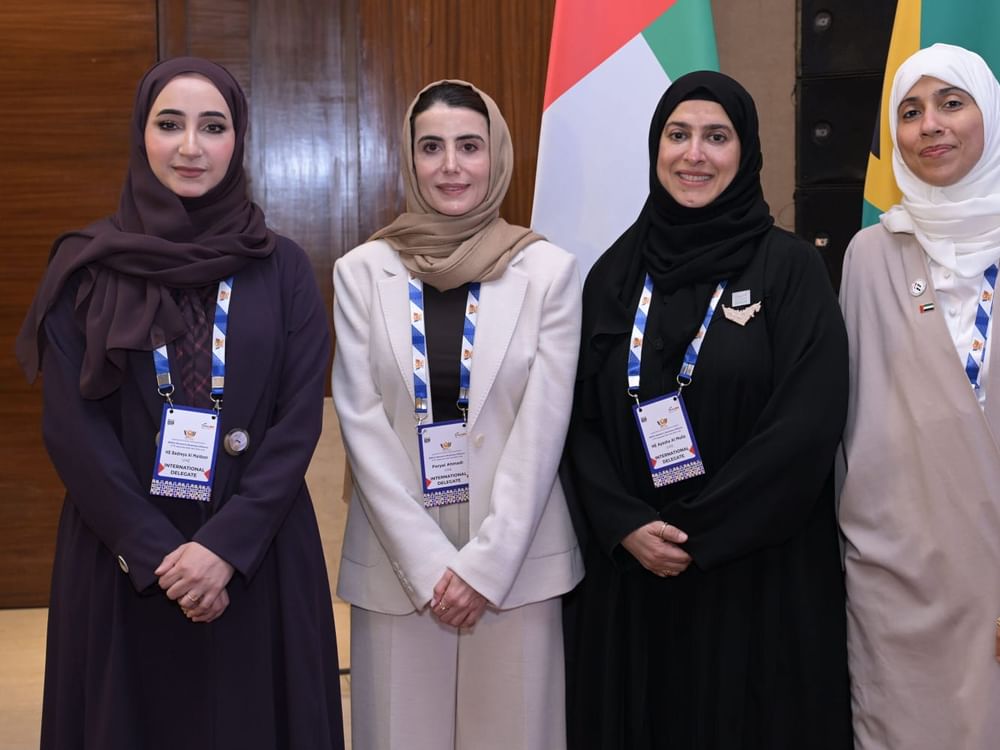
NEW DELHI, 9th September, 2026 (WAM) -- The UAE delegation participated in the BRICS Women-Led Development Summit 2026, organised by the BRICS Women’s Business Alliance (WBA) in New Delhi under India’s 2026 BRICS Presidency, bringing together government and business leaders, investors and women entrepreneurs from across BRICS economies.
The UAE Chapter is chaired by Feryal Ahmadi, Chairperson of the BRICS WBA UAE Chapter and Deputy CEO and Chief Operating Officer of DMCC.
Its leadership and working-group representatives include Ayesha Al Mulla, Co-Chair of the Tourism Working Group and Chairwoman of the UAE Businesswomen Council; Badreya Al Maidoor, Assistant Undersecretary at the Ministry of Economy and Tourism and member of the Inclusive Economy Working Group; Prof. Dr. Hoda Alkhzaimi, Co-Chair of the Creative Industries Working Group and National Expert in Advanced Sciences and the Future Economy; Dr. Ibtisam Al Bastaki, Co-Chair of the Healthcare Working Group; and Abeer Al Ameeri, Co-Chair of the Innovative Development Working Group and Director of Entrepreneurship Ecosystem Development at the Sharjah Entrepreneurship Center (Sheraa).
Together, the team reflects the breadth of the UAE’s contribution to the Alliance across trade and investment, tourism, inclusive growth, advanced sciences, creative industries, healthcare, innovation and entrepreneurship.
Ahmadi, Al Mulla, Al Maidoor and Alkhzaimi participated in the New Delhi programme, while Al Bastaki and Al Ameeri contributed to and led the UAE Chapter’s work within their respective specialised workstreams.
Feryal Ahmadi said the UAE Chapter is focused on moving beyond building networks towards developing practical, scalable economic, trade and investment partnerships, while leveraging the UAE’s position as a global hub connecting capital, companies and markets.
“We see the BRICS Women’s Business Alliance as a platform for translating relationships into tangible opportunities in trade, investment and market access, while leveraging the UAE’s ability to connect businesses, capital and opportunities across BRICS economies and global markets,” Ahmadi said.
Ayesha Al Mulla highlighted that the economic value of the Alliance lies in the strength of the BRICS network and its ability to connect opportunities and experience across markets, extending beyond investment to include business opportunities, use cases, knowledge exchange, successful policy models, partnerships and market access.
“The value of the BRICS Women’s Business Alliance lies in the strength of the network it brings together. We are connecting women not only to investment, but also to opportunities, use cases, expertise, policies, partners and markets across different economies,” Al Mulla said.
She emphasised that economic interventions should remain measurable, tracking the partnerships and investments generated, businesses entering new markets, commercial opportunities created, and the successful transfer of knowledge and proven models between economies.
Badreya Al Maidoor said women’s economic empowerment goes beyond providing opportunities to participate. It requires women to have the knowledge, confidence and capital needed to build, grow and transform local opportunities into businesses capable of competing across global markets.
“Empowerment means ensuring that women have the knowledge, confidence and capital to build sustainable businesses. Our ambition should not stop at creating local opportunities; women must be enabled to build partnerships, access markets and create economic opportunities across borders,” Al Maidoor said.
She noted that the diversity of BRICS economies creates significant opportunities for SMEs and women entrepreneurs to progress from domestic markets into international value chains and cross-border markets.
Prof. Dr. Hoda Alkhzaimi said the next phase requires expanding the concept of women’s empowerment beyond participation to enabling women to lead emerging and future economies, create economic value, own it and scale it.
“We are not speaking only about enabling women to enter existing sectors. We are speaking about enabling women to be among those building the new economies—as founders, investors, innovators, decision-makers and owners of the economic value these economies create,” Alkhzaimi said.
She said the distinctive strength of BRICS lies in the collective value of its 11 economies and the diversity of talent, capabilities, capital, infrastructure, markets and knowledge they bring together.
“We should not look at the 11 economies as separate markets, but as an interconnected economic architecture. Talent may exist in one market, scientific or industrial capability in another, capital in a third, and infrastructure and opportunities for scale elsewhere. Catalytic economic value is created when we connect these assets and translate them into shared economic capacity,” Alkhzaimi said.
She added that funding is a critical part of this architecture, but that capital should be understood more broadly to encompass human, knowledge, financial and institutional capital, connected to infrastructure and markets to enable women-led businesses to grow across borders.
“We also need to build intergenerational economic infrastructure, so that the next generation of women does not begin again from zero, but builds on the knowledge, capital, networks, institutions and market access created by the generations before them. When we connect talent, capabilities, capital, infrastructure and markets across BRICS economies, we are not only empowering women; we are creating a new engine for shared economic growth and value creation,” Alkhzaimi said.
The UAE Chapter’s approach is therefore centred on creating pathways that take women from knowledge to confidence, from capability to capital, and from local opportunity to global markets, while developing the BRICS network into a practical platform connecting women entrepreneurs with investors, companies, institutions and markets.
The UAE’s participation reflects a broader shift towards a new phase of women-led development in which success is measured not only by participation or representation, but by economic value created, businesses scaled, capital mobilised, markets accessed and partnerships sustained across borders and generations.