
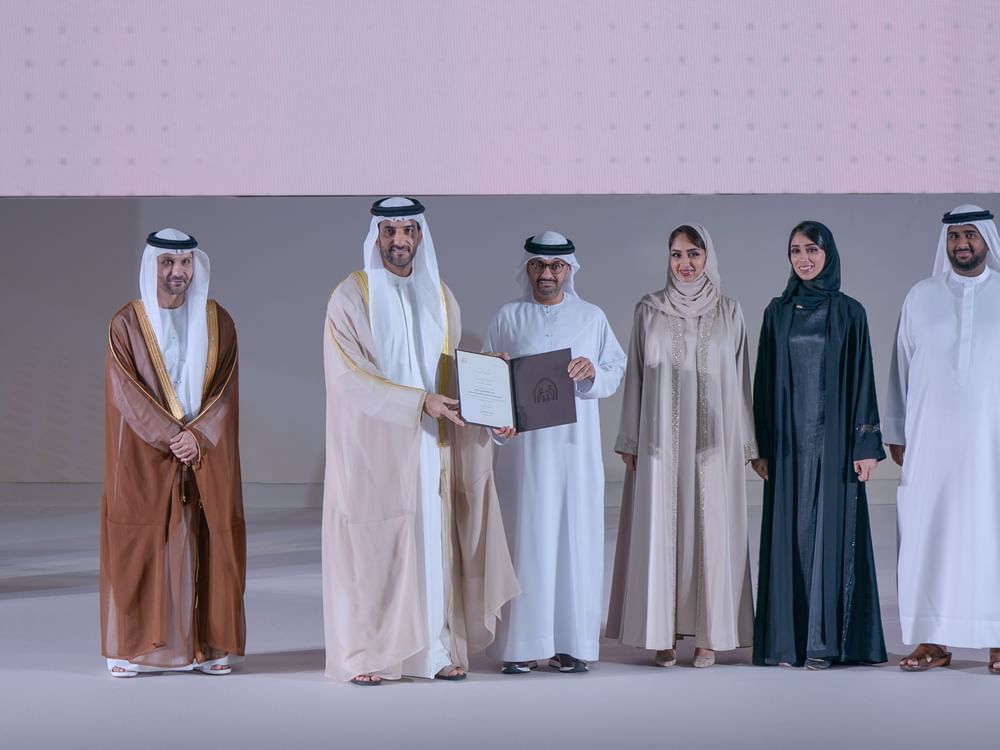
SHARJAH, 10th September, 2026 (WAM) -- H.H. Sheikh Sultan bin Ahmed bin Sultan Al Qasimi, Deputy Ruler of Sharjah and Chairman of the Judicial Council, witnessed on Thursday morning the launch of the Sharjah Legal Forum 2026, organised by the Legal Department of Sharjah in cooperation with the Judicial Council, at the Al Razi Hall of the University of Sharjah.
The ceremony began with the national anthem, followed by verses from the Holy Quran. Attendees then watched a video presentation on the forum, highlighting its concept, the role of law in society, its contribution to family stability, and the range of policies and legislation supporting families in the Emirate of Sharjah.
Mariam bint Ahmed Al Hammadi, Minister of State and Secretary-General of the UAE Cabinet, delivered the keynote address at the forum, expressing her thanks and appreciation to H.H. Sheikh Sultan bin Ahmed Al Qasimi for his generous patronage of the forum, which addresses an issue that affects society's present and future and brings together two fundamental pillars of community building: the family, which nurtures individuals, and legislation, which safeguards their rights and regulates their relationships.
Al Hammadi added that, under the directives of the President His Highness Sheikh Mohamed bin Zayed Al Nahyan, and in light of the country’s strong focus on the family, 2026 has been designated the “Year of Family.” This reaffirms that a strong society begins with strong families and underscores the importance of integrating policies, legislation, and initiatives that support families, safeguard their stability, strengthen their cohesion, and make investing in family stability a sustainable investment in the future of the UAE and its coming generations.
The Secretary-General of the UAE Cabinet highlighted the extensive care and support the United Arab Emirates provides to families at every level, saying, “The UAE Constitution stipulates that the family is the foundation of society, grounded in religion, morality, and love of the nation, and that the law safeguards and protects it. This constitutional provision does not merely establish a legal rule; rather, it lays the foundation for a clear national philosophy that recognises that the strength of the state begins with the cohesion of the family. This philosophy is clearly reflected in the approach established by His Highness Sheikh Dr Sultan bin Mohammed Al Qasimi, Supreme Council Member and Ruler of Sharjah, who has made building people and strengthening family cohesion the foundation of the Emirate’s development project. The development of society begins at its roots, and the Emirate of Sharjah has translated this vision into an integrated system of institutions, policies, and initiatives that support families at every stage, strengthen their cohesion, protect children, empower parents, and promote culture, identity, and authentic values.”
Al Hammadi reviewed the UAE’s federal legislative framework and its recent updates, which constitute one of the key pillars of the country’s comprehensive and sustainable development, the consolidation of the rule of law, and the enhancement of the UAE’s competitiveness and global standing. She also highlighted personal status and family legislation, as well as child-related legislation, noting that the family has therefore been accorded a special status within the UAE’s legislative framework.
The Secretary-General of the UAE Cabinet concluded her keynote address by noting that protecting the family and ensuring its stability is a shared responsibility that requires enhanced coordination and integrated efforts among federal and local institutions, the private sector, and civil society organisations to ensure the sustainability of this legislative and social framework and the integration of their respective roles.
Counsellor Dr Mansour Mohammed bin Nassar, Chairman of the Legal Department of Sharjah, also delivered a speech in which he expressed his appreciation for the generous patronage of H.H. Sheikh Sultan bin Ahmed Al Qasimi and for His presence, which honoured the opening of the forum’s activities.
He noted that the forum stems from a firm belief that the strength of legislation lies not only in the precision of its structure and drafting, but also in its ability to address reality, respond to change, and enhance community stability.
Ben Nassar highlighted that, in Sharjah, human development has been closely linked to an integrated approach established by His Highness the Ruler of Sharjah, his wife, H.H. Sheikha Jawaher bint Mohammed Al Qasimi, Chairperson of the Supreme Council for Family Affairs, and H.H. the Crown Prince and the Deputy Rulers of Sharjah. Culture, knowledge, and values have occupied a central place across policies, initiatives, and legislation. This approach has reinforced the conviction that genuine development begins with people and that family stability provides a strong foundation for a more cohesive society capable of addressing challenges.
The Chairman of the Legal Department concluded his remarks by noting that rapid social and technological changes are creating new challenges that require the continuous development of the legislative framework. This should strike a balance between preserving values and established principles on the one hand and keeping pace with developments on the other, highlighting the importance of the forum, which brings together a distinguished group of officials, judges, legal professionals, academics, and experts to discuss an issue closely linked to the stability and future of society.
The opening ceremony featured a panel discussion titled “Legal Text between Stability and Evolution,” with contributions from Counsellor Dr Obaid Ali Al Ali, Assistant Secretary-General for Legislative Affairs at the General Secretariat of the UAE Cabinet; Counsellor Dr Ahmed bin Meshar, Secretary-General of the Supreme Legislative Committee in Dubai; and Counsellor Aisha bin Sufyan Al Suwaidi, Director of the Legal Department of Sharjah.
The speakers discussed how to strike a balance between maintaining the stability of legal texts and the need to develop them in line with the social, economic, and technological changes affecting the family, while upholding the principles of justice, dignity, and protection.
Counsellor Dr Obaid Ali Al Ali discussed the Personal Status Law, noting that its provisions are derived from Islamic Sharia and that it regulates the family, which is the nucleus of society and holds a special significance that distinguishes it from the regulation of other legal statuses. He explained that the question of whether legislative texts should remain unchanged is linked to definitive and established rulings in Islamic Sharia, such as those governing marriage and inheritance, which cannot be altered. Other provisions have a fixed basis in law, but their application may evolve. The principle is that established principles, values, and provisions relating to rights and obligations should remain unchanged, while the scope for change should be limited. Protective measures, however, should always remain open to development. For example, judicial procedures relating to family cases should be simple, accessible, and swift.
Counsellor Dr Ahmed bin Meshar focused his remarks on legislative amendments, noting that each piece of legislation is enacted with specific aims and objectives. He explained that the success of legislation is measured by its sustainability, its ability to achieve those aims and objectives, and its capacity to respond clearly and consistently to economic, social, and technological changes.
He added that legislation has a lifecycle that begins even before it is enacted, with the study of the problem or situation and the proposal of appropriate solutions that reflect the realities addressed by the legislation. This is followed by its publication in the Official Gazette. The legislation must then be monitored and evaluated during implementation to identify and assess the challenges it faces in practice.
Counsellor Aisha bin Sufyan Al Suwaidi addressed the legal text, emphasising the need for clarity and its capacity to respond to societal developments while balancing stability and flexibility. She emphasised the importance of clear definitions and concepts to ensure the text is applicable in practice.
She explained that legislative flexibility can be summarised as clarity in the rules, flexibility in the means, well-regulated cross-references, and the ability to review the text when circumstances change. She also discussed several points on enhancing the effectiveness of legislation through key foundations, particularly in family law, and stressed the need for rigorous and systematic review of legal texts both before and after their enactment to ensure that the intended objectives are achieved.
At the conclusion of the session, the speakers agreed on the positive role of technology and artificial intelligence in supporting data analysis, monitoring specific indicators, and facilitating the work of legislators and professionals in the judicial and legal fields.
H.H. Sheikh Sultan bin Ahmed Al Qasimi honoured the forum’s sponsors and participants, commending their efforts in contributing to the success of the forum and its activities.
The Sharjah Legal Forum is a dialogue platform that brings together officials, judges, legal professionals, academics, and specialists to discuss legal and societal issues relevant to society and responsive to its transformations. The forum is founded on the close connection between law and the social reality it regulates, recognising that family stability requires legislation, policies, and services grounded in justice and societal values while also responding to social, economic, and technological changes.
The forum aims to discuss the relationship between legislation and family stability amid social, economic, and technological changes; highlight the role of societal values in building cohesive families and strengthening shared responsibility towards them; examine the role of mediation, reconciliation, and family guidance in managing family disputes and protecting rights; raise awareness of digital challenges affecting families, children, privacy, and safety; promote dialogue and the exchange of expertise among legal, judicial, social, academic, and technology-related entities; and put forward ideas and proposals for consideration and development that contribute to supporting family stability and enhancing institutional collaboration.
The forum’s agenda includes a number of sessions covering its themes. The session under the second theme, titled “Societal Values in the Vision of His Highness the Ruler of Sharjah,” will discuss the status of societal values and their role in reinforcing the family’s position as the foundation of community stability and cohesion; how the values of identity, belonging, solidarity, and responsibility can be translated into policies, initiatives, and services that support families, promote prevention and protection, and respond to their members’ needs with dignity and privacy; and the integration of the roles of social, awareness, and service entities in promoting family stability, supporting and protecting children, and reinforcing shared responsibility among families, society, and institutions.
The session under the third theme, titled “Legal Alternatives for Resolving Family Disputes: Mediation and Reconciliation,” will discuss the role of mediation and reconciliation in addressing family disputes and the importance of directing each dispute, from the outset, to the most appropriate pathway based on its nature and circumstances, in a manner that safeguards rights and takes into account the interests of the family and its members. It will also address the safeguards necessary for the success of reconciliation processes, including preserving privacy, ensuring voluntariness, and guaranteeing the fairness of agreements, as well as identifying cases in which reconciliation is appropriate and those requiring protection or judicial intervention.
The session under the fourth theme, titled “Digital Challenges and the Future of the Family,” will examine the impact of the digital environment on family relationships and the family’s role in guidance and protection, as well as the roles of platforms, institutions, and relevant entities in reducing digital risks and promoting the safe and responsible use of technology. The theme will also address challenges associated with artificial intelligence, misleading content, identity theft, and blackmail, and the importance of raising awareness of content verification and of the appropriate ways to respond to risks when they arise.
On the sidelines of the forum, H.H. Sheikh Sultan bin Ahmed Al Qasimi visited the accompanying exhibition, where he wrote a message on the tablet dedicated to the occasion, in celebration of the “Year of Family” and its significance in highlighting the family as the main pillar of society, promoting family values, and strengthening bonds of affection and cohesion among its members.
He also viewed the initiatives and programmes showcased at the exhibition related to the family, highlighting the efforts undertaken by various entities to strengthen the family’s role and standing in building a cohesive society.
He listened to a briefing from representatives of the participating federal and local entities on key initiatives, programmes, and studies implemented in the field of family affairs, including the results and indicators recorded to date, as well as the solutions and practices offered by these initiatives to support families and empower their members. His Highness was also briefed on the key outcomes and results reflecting the impact of these efforts in promoting family and social stability, enhancing the quality of life of family members, and strengthening the family’s role in building a more connected and cohesive society.
H.H., Chairman of the Judicial Council, was briefed on key legislation and policies developed from studies, data, and indicators related to the family, and on the tangible impact they have had in supporting family stability and enhancing the quality of life of its members. These include updating legal and regulatory frameworks in line with the needs and developments of the family, and providing greater protection and support for its members, thereby helping to address the challenges facing families and translating the findings of studies and initiatives into effective legislation and practices that directly contribute to family cohesion and social stability.
The forum’s opening ceremony was attended by Sheikh Mohammed bin Humaid Al Qasimi, Chairman of the Department of Statistics and Community Development; Sheikh Majid bin Sultan Al Qasimi, Chairman of the Districts Affairs Department; Sheikh Sultan bin Abdullah bin Salem Al Qasimi, Director of the Department of Statistics and Community Development; Sheikh Faisal bin Ali bin Abdullah Al Mualla, Secretary-General of the Judicial Council; Abdullah bin Sultan Al Nuaimi, Minister of Justice; Mariam bint Ahmed Al Hammadi, Minister of State and Secretary-General of the UAE Cabinet; and a number of senior officials, heads and directors of government entities, and legal specialists.