
DUBAI, 10th September, 2026 (WAM) -- The Dubai Goviernment Human Resources Department (DGHR) has concluded the ‘Our Flexible Summer 2026’ initiative as part of its ongoing efforts to anticipate the future of work and enhance the government work environment.
This edition saw broader participation and greater diversity in implementation experiences, providing DGHR with a wider base of data and practical insights to support the continued development of the Dubai Government employee experience.
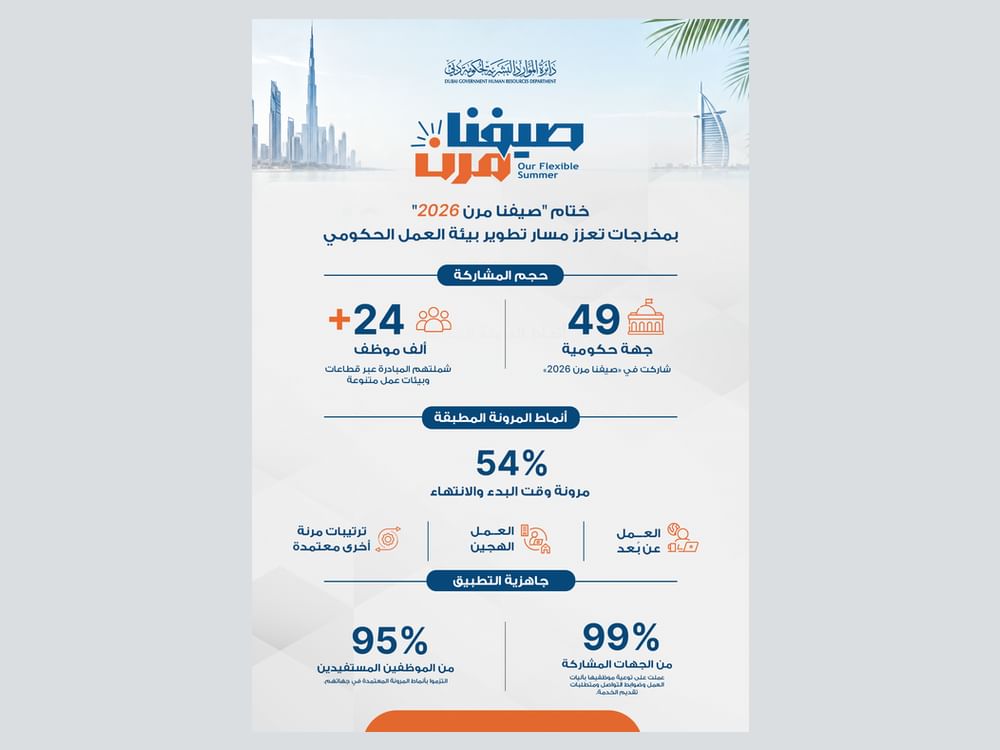
The initiative brought together 49 government entities and more than 24,000 employees, spanning sectors and work environments with varying functions and operational requirements. This provided a more comprehensive understanding of the factors that contribute to the successful implementation of flexible work arrangements and the balance between employee experience, performance efficiency, and service continuity.
Abdullah Ali bin Zayed Al Falasi, Director-General of the Dubai Government Human Resources Department, said that the evolution of ‘Our Flexible Summer’ and the expansion of its implementation reflect the importance of adopting work practices that respond to the rapid shifts shaping the workplace, while giving government entities greater flexibility to manage their needs in line with the nature of their functions and priorities.
He said, “The success of ‘Our Flexible Summer’ demonstrates that advancing the work environment requires practices that create greater value for both employees and government entities. The progress achieved across the different phases of the initiative provides us with a strong foundation to continue this journey, build on successful experiences to advance ways of working, and strengthen the ability of government entities to achieve their objectives efficiently, in line with Dubai’s ambitions and its leadership in shaping the future of government work.”
Participating entities adopted various approaches to implementation based on the nature of their operations and requirements. In service-oriented sectors, flexible work arrangements supported service readiness and continuity while maintaining customer satisfaction. In legal and institutional environments, clear responsibilities and workplace discipline emerged as important factors, while fast-paced sectors highlighted the need to manage priorities and strengthen teams’ ability to adapt.
This diversity underscores the importance of tailoring work arrangements to the specific nature of each entity, while maintaining shared objectives focused on performance efficiency, employee experience, and the sustainability of government services.
The implementation data revealed the breadth of flexible work arrangements adopted across participating entities, reflecting the distinct needs and nature of their operations. Flexible start and end times were the most widely adopted arrangement, representing 54% of the total, followed by remote and hybrid work, with other approved flexible arrangements making up the remainder. This diversity demonstrates the ability of government entities to adopt working models that align closely with the nature of their responsibilities and operational requirements.
Survey findings from participating entities also indicated high levels of organisational readiness and compliance. A total of 99% of entities reported raising employee awareness of work mechanisms, communication protocols, and service delivery requirements, while 95% of employees benefiting from the initiative complied with the flexible work arrangements approved by their respective entities. These results highlight the role of effective internal communication and clear implementation mechanisms in supporting the initiative’s success.
Azza Al Marzooqi, Director of the Human Resources Department at Dubai Municipality, affirmed that the 'Our Flexible Summer' initiative embodies Dubai’s approach to building a flexible and inclusive government work environment, one that places employee wellbeing and quality of life among its key priorities.
She noted that the initiative gives employees greater flexibility to balance their professional and personal responsibilities, strengthening their ability to perform efficiently and productively. It also demonstrates the readiness of Dubai Government’s work and performance ecosystem to adapt to evolving needs and future requirements.
She said, “'Our Flexible Summer' is a valuable practical experience that enables government entities to explore more flexible working models tailored to the nature of their responsibilities and operational requirements, while maintaining efficiency, quality, business continuity, and the standard of services provided to customers. It reinforces Dubai’s position as a global model for quality work environments and demonstrates its ability to advance government practices that place people at the heart of the ecosystem. At Dubai Municipality, we are committed to providing a work environment that offers our employees greater flexibility and comfort, enhances their satisfaction and happiness, and enables them to perform their roles more effectively. This, in turn, strengthens their productivity and positive impact, extending to the quality of services and the efficiency of projects across the Municipality’s areas of work, which directly contribute to the quality of life of Dubai’s residents.”
Nada Al Marri, Director of the Human Resources Department at the Dubai Department of Economy and Tourism, said that the 'Our Flexible Summer' initiative represents a forward-looking approach to developing government work models, particularly in vital sectors defined by multiple priorities and a fast-paced working environment, such as the economy and tourism sectors. She noted that the initiative offered greater flexibility in organising working hours and managing priorities, while maintaining operational efficiency and ensuring seamless coordination among teams.
Al Marri added, “This experience has demonstrated that flexibility, when underpinned by accountability and results, can contribute to enhancing performance efficiency while improving the employee experience. These models also support the development of a more flexible and attractive work environment that can keep pace with Dubai’s ambitions and the evolving requirements of its vital sectors, strengthening the future readiness of human capital in line with the objectives of the Dubai Economic Agenda D33.”
Service Quality and Efficient Delivery Remain Key Priorities
Ahmed Essa Al Kandari, Director of Support services at the Mohammed Bin Rashid Housing Establishment, affirmed that the 'Our Flexible Summer' initiative has contributed to achieving a balance between workplace flexibility and the continuity of efficient service delivery. He noted that the Establishment’s work is directly linked to serving citizens and meeting their needs, making service quality and efficient delivery key priorities.
He added, “The experience has demonstrated that employees can be given greater flexibility in organising their working hours while maintaining commitment to their responsibilities and the quality of services provided to customers. This enhances the employee experience and supports a work culture built on trust and results, while contributing to the future readiness of government entities.”
The results of the initiative provide DGHR with a practical foundation for identifying key success factors and the most effective practices. These insights will help inform priorities for the next phase and support the continued development of flexible work approaches across the Government of Dubai.
The journey of ‘Our Flexible Summer’ reflects the continued evolution of flexible work arrangements across the Government of Dubai. The initiative began in 2024 as a pilot involving 21 government entities, delivering positive results in productivity and workplace quality, while recording employee satisfaction and happiness levels of approximately 98%. The success of the pilot provided a foundation for expanding the initiative and rolling it out across Dubai Government entities in 2025 and 2026.