
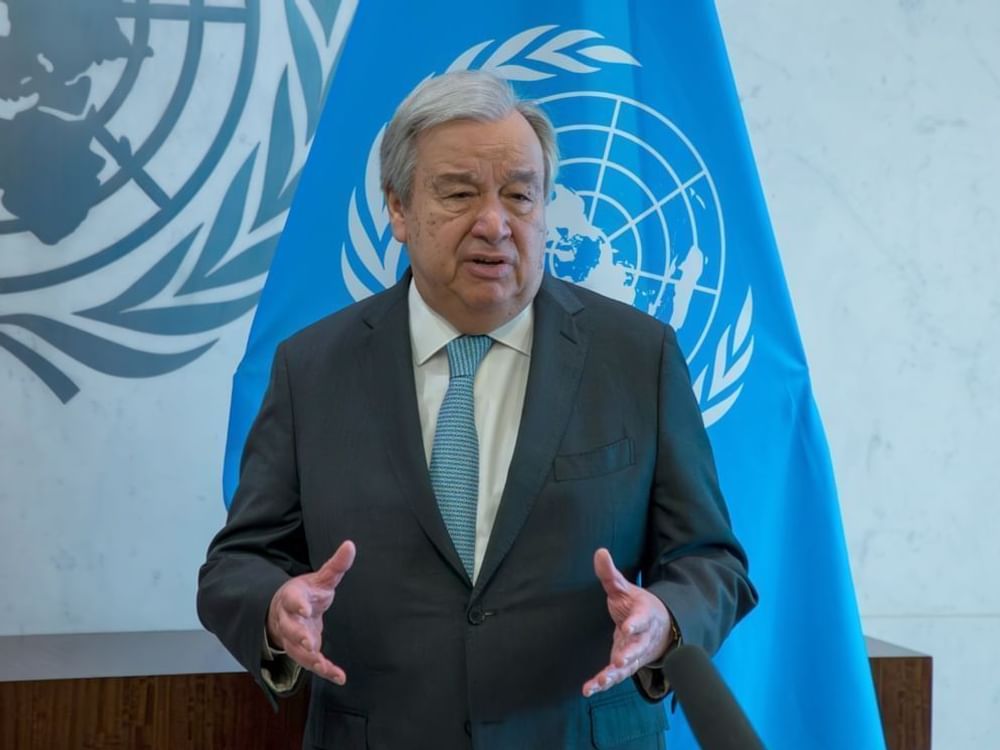
NEW YORK, 16th September, 2026 (WAM) -- UN Secretary-General António Guterres Aaffirmed that at this crucial moment in the Middle East, de-escalation must be priority one, priority two and priority three.
''All parties must cease any actions that harm civilians and ensure that humanitarian operations can proceed safely and without obstruction. Navigational rights and freedoms in and around the Straits of Hormuz and Bab al-Mandab must be fully restored and respected by all, in accordance with international law, he said in remarks at a press conference at the start of the 81st Session of the General Assembly today.
''The only path forward is de-escalation, diplomacy and dialogue and I will continue to press this message in my ongoing contacts with leaders.,'' he stressed.
Guterres said the world had entered “an era of deep uncertainty” and urged governments to embrace international cooperation to address global threats.
Speaking to reporters before world leaders gather in New York, Guterres identified “three existential threats”: runaway artificial intelligence (AI), the climate crisis and deepening inequalities.
He also reiterated calls for a two-State solution in the Middle East and also called attention to the suffering of the Palestinian people in Gaza and said Israel’s annexation of the West Bank “must stop.”
The Secretary-General dedicated nearly half his remarks to what should be done about the rapid advancement of AI technology.
He recognised AI’s “enormous potential” on issues surrounding health, education and climate, but added that the world “cannot afford to ignore concerns” that AI development is progressing faster than human understanding of its risks.
Comparing AI to other issues of international concern Guterres said governments must protect their citizens from AI’s risks and that “global cooperation is indispensable.”
“The world cannot afford a race to the bottom on AI safety,” he said.
Guterres pointed to the UN-founded Independent International Scientific Panel on AI, which he said will inform global discussions by providing the best available evidence on AI’s opportunities and risks.
As world leaders prepare to discuss solutions, the Secretary-General called for guardrails that build trust and “make AI safe, transparent and accountable, with human dignity at the centre.”
“International cooperation is more necessary than ever,” he said.