
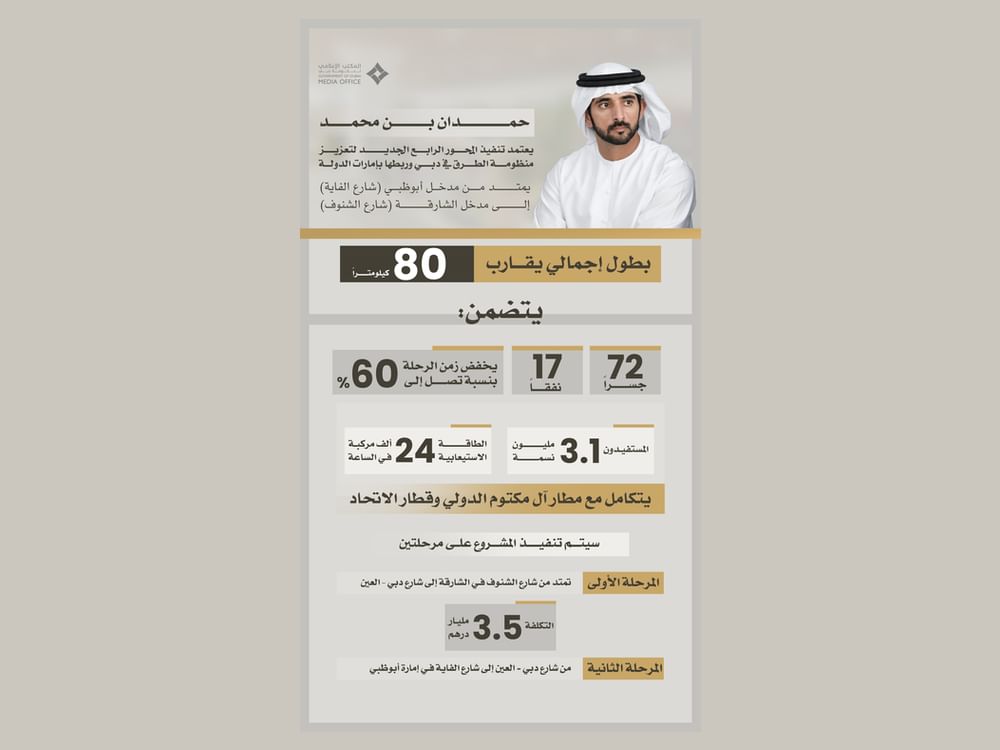
DUBAI, 16th September, 2026 (WAM) -- H.H. Sheikh Hamdan bin Mohammed bin Rashid Al Maktoum, Crown Prince of Dubai, Deputy Prime Minister and Minister of Defence of the UAE, and Chairman of The Executive Council of Dubai, approved the implementation of the New Fourth Corridor project in Dubai.
Extending from Al Faya Road in Abu Dhabi to Al Shanouf Road in Sharjah, the corridor will span approximately 80km and will be implemented in two phases. The first phase will extend from Al Shanouf Road in Sharjah to Dubai–Al Ain Road at a cost of around AED3.5 billion.
The project will include 72 bridges, 17 tunnels and 45 stormwater drainage culverts. It will support logistics traffic and pass through several key landmarks, most notably Al Maktoum International Airport, Al Marmoom Desert Conservation Reserve, Al Wohoosh Desert Conservation Reserve and the Etihad Rail route, in addition to several residential and development areas.
H.H. Sheikh Hamdan bin Mohammed said: “Guided by the vision and directives of His Highness Sheikh Mohammed bin Rashid Al Maktoum, Vice President and Prime Minister of the UAE and Ruler of Dubai, Dubai continues to build world-class infrastructure as a foundation for growth, a driver of development and a cornerstone of enhanced quality of life. Our vision is for Dubai to remain prepared for upcoming opportunities, to proactively meet future needs, and for every new project to be another step toward reinforcing its standing among the world’s most competitive and attractive cities.”
H.H. added: “We have approved the New Fourth Corridor project, spanning 80km, as a strategic addition to Dubai's road network. The project will strengthen Dubai’s connectivity with the federal road network, open new horizons for urban and economic growth, and support future projects in line with the Dubai Social Agenda 33 and the Dubai Economic Agenda D33, reinforcing Dubai’s position as the world’s best city to live, work and visit.”
He said: “Development in Dubai never stops, and building continues with a clear vision and unwavering determination. We remain committed to implementing major infrastructure and transport projects with high efficiency, working as one team to ensure that Dubai remains a global model for speed of delivery and leadership in development.”
The New Fourth Corridor will be the fourth strategic corridor linking the UAE’s emirates, following Sheikh Zayed/Al Ittihad Road, Sheikh Mohammed bin Zayed Road and Emirates Road. It will strengthen connectivity between the emirates and facilitate movement between different areas. The corridor will also support integration between the road network and the transport system through connections to key projects such as Al Maktoum International Airport and Etihad Rail. It will enhance the logistics and commercial transport sectors, supporting Dubai’s competitiveness as a global economic hub, keeping pace with urban expansion in new areas and enabling smoother traffic flow over the long term.
Mattar Al Tayer, Director General and Chairman of the Board of Executive Directors of Dubai’s Roads and Transport Authority, said that H.H. Sheikh Hamdan bin Mohammed bin Rashid Al Maktoum’s approval of the New Fourth Corridor project is part of Dubai’s plans and continuous efforts to develop integrated and sustainable infrastructure that enhances quality of life, keeps pace with the city’s rapid urban and population growth, and reinforces the emirate’s position as a global hub for smart mobility.
Al Tayer noted that the New Fourth Corridor represents a strategic addition to the UAE’s road network and reflects the leadership’s vision to strengthen connectivity between the emirates. The project will help divert through traffic, particularly trucks, away from urban areas, thereby easing pressure on existing road corridors and enhancing traffic flow and road safety.
Al Tayer explained that, given the scale of the project, which includes 72 bridges, 17 tunnels and 45 stormwater drainage culverts, and to accelerate implementation and ensure completion on schedule, the project will be divided into two main phases.
Phase 1 will extend approximately 30km from Al Shanouf Road in Sharjah to Dubai–Al Ain Road. It will include the construction of a through corridor comprising 12 lanes across both directions, reducing journey time by 60%, from 35 minutes to 14 minutes. The corridor will have a capacity of up to 24,000 vehicles per hour in both directions and will serve around 600,000 people.
This phase will also include approximately 55 lane-kilometres of at-grade roads, 2.5km of tunnels and 21km of bridges and ramps. It will also involve widening Dubai–Al Ain Road from three to four lanes in each direction between Emirates Road and Lehbab Road, in addition to upgrading four major intersections.
Al Tayer added: “Phase 2 will extend 50km from Dubai–Al Ain Road to Al Faya Road in Abu Dhabi. It will comprise roads with 12 lanes across both directions and a capacity of 24,000 vehicles per hour. This phase will reduce journey time by 52%, from 50 minutes to 24 minutes, and will serve around 3.1 million people.
The second phase will also include approximately 190 lane-kilometres of at-grade roads, 3.5km of tunnels and 157km of bridges and ramps, he said.