
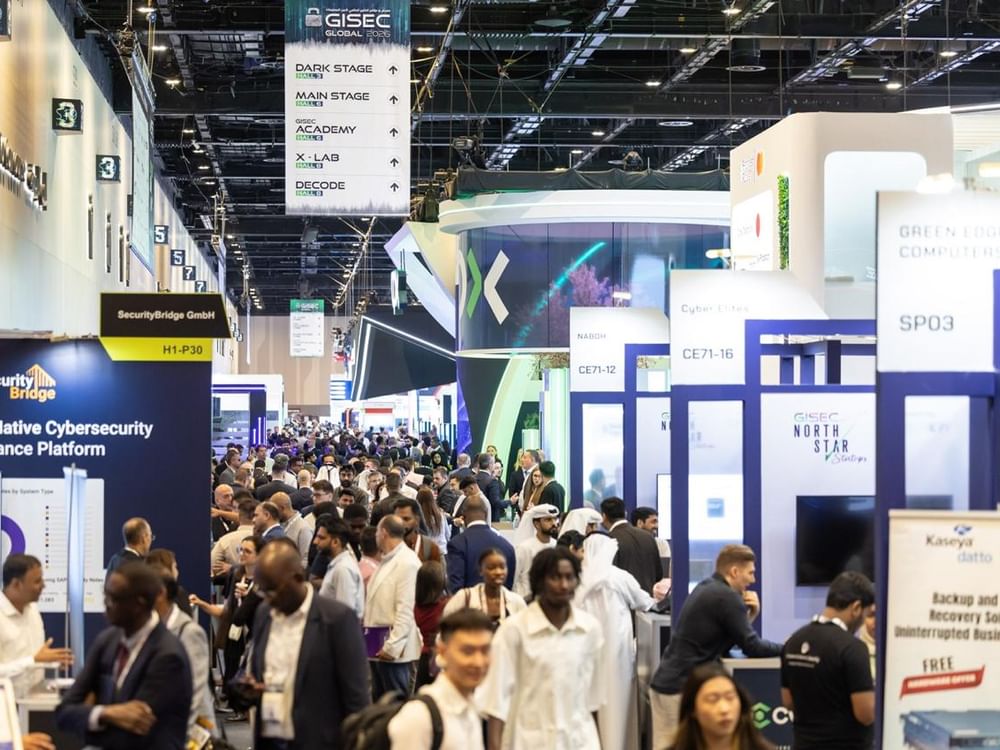
DUBAI, 17th September, 2026 (WAM) -- Participants at GISEC Global 2026 said cyber threats are evolving rapidly as artificial intelligence becomes more widely used, increasing in speed, scale and sophistication and requiring organisations to strengthen readiness and adopt proactive approaches based on early threat detection and the protection of data, systems and digital supply chains.
Hadi Anwar, CEO of CPX, told the Emirates News Agency (WAM) that AI-powered cyber threats are escalating rapidly in speed, scale and sophistication, requiring organisations to move beyond traditional defensive approaches.
He made the remarks on the sidelines of GISEC Global 2026, taking place at Dubai Exhibition Centre in Expo City Dubai.
Anwar said organisations face a growing range of risks, including deepfake-enabled fraud, identity-based attacks and AI-powered social engineering.
As AI moves from experimentation to large-scale operational deployment, organisations must also prepare for emerging risks such as ungoverned AI use, data leakage and model manipulation, which can significantly affect data integrity, he added.
Anwar said generative AI is transforming security from a purely technical issue into a direct business and governance challenge, requiring effective AI governance, security throughout the AI system lifecycle and stronger protection for complex digital supply chains that rely on third-party models.
He said these risks require the highest levels of preparedness from governments, organisations and critical infrastructure operators, particularly as they manage interconnected physical and digital environments responsible for essential services.
As digital ecosystems become increasingly interconnected, regional cybersecurity needs are shifting from isolated controls and reactive responses towards proactive, evidence-based approaches focused on resilience against AI-related risks and maintaining operational continuity, Anwar said.
He added that critical infrastructure operators and businesses are increasingly adopting evidence-based models such as CPX’s Sovereign Resilience Response, which brings together readiness, protection, automated containment and rapid recovery through a continuous UAE-led defence model.
Anwar said Secure AI, Physical Security and OT Security are currently among the areas seeing the strongest demand within the six core capabilities showcased by CPX at GISEC Global 2026, as organisations focus on maintaining operations during disruptions.
He said CPX would continue strengthening its Sovereign Resilience Response model, advancing its Securing AI capabilities and expanding talent-development initiatives such as She Protects to support national digital sovereignty.
Ashraf Koheil, Vice President of Sales, META and ANZ at Group-IB, told WAM that the company’s Prediction-First approach does not claim to predict every cyberattack with a specified level of accuracy, but seeks to provide earlier visibility and give defenders more time to act.
He said Group-IB continuously monitors threat actors, malicious infrastructure, compromised credentials, sales of access to corporate networks and emerging attack techniques.
By correlating these indicators with investigation data and AI, patterns and potential threats can be identified before they develop into actual incidents, he said, adding that the effectiveness of the approach is measured by whether intelligence enables preventive action before damage occurs.
Koheil said Group-IB has conducted more than 1,600 successful investigations into high-tech crime worldwide since 2003. While the company does not currently disclose a separate UAE figure, its regional intelligence demonstrates the scale of the challenges facing organisations.
He said GCC countries were among the world’s top 10 targets for supply-chain attacks in 2025, while the financial services sector accounted for 28.5 percent of phishing attacks in the Middle East and Africa.
Threats now extend beyond an organisation’s own security perimeter to suppliers, fintech companies, payment providers and other trusted third parties, he added.
Koheil said a strong local presence is particularly important because cyber threat intelligence requires an in-depth understanding of local conditions. Group-IB has around 150 experts across the Middle East, Türkiye and Africa, with technical specialists accounting for 80 percent of the workforce, alongside its Digital Crime Resistance Centres in the UAE, Saudi Arabia and Egypt.
He said the company’s regional experts understand local languages and threat patterns and continuously gather intelligence from across the region. Combining this local knowledge with Group-IB’s global threat visibility helps identify country-specific risks and assess their relevance to UAE organisations more quickly.
Koheil stressed the importance of public-private cooperation, noting that cybercrime transcends geographical borders.
In 2025 alone, Group-IB supported 52 law-enforcement agencies worldwide, with joint efforts contributing to operations that resulted in the arrest of 1,809 cybercriminals and the dismantling of more than 34,800 pieces of malicious infrastructure.
He said Group-IB works with UAE government entities and law-enforcement agencies through intelligence sharing, technical expertise, investigation support and capacity building.
Koheil added that combating cybercrime remains central to Group-IB’s mission and that the company considers it its responsibility to support partners with intelligence, expertise and capabilities when needed.