
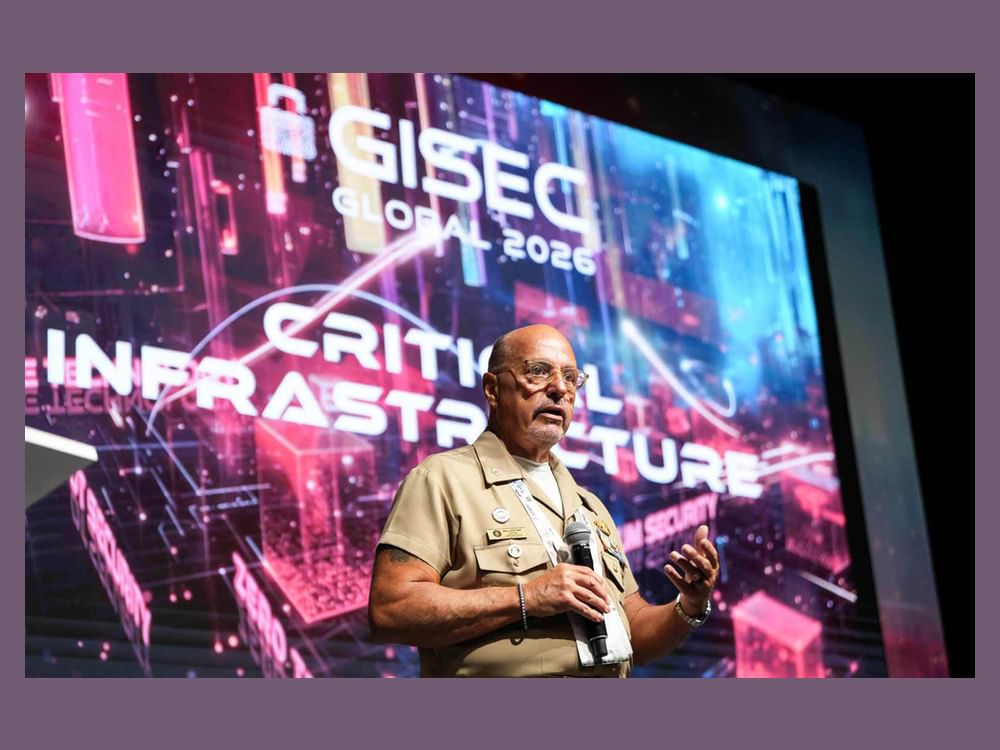
DUBAI, 17th September, 2026 (WAM) -- The second day of GISEC Global 2026 focused on critical infrastructure protection, AI-powered security operations and the geopolitical dimensions of cybersecurity, bringing together government leaders, experts and specialists from across the sector.
Participants examined how increasingly connected digital environments are reshaping national and industrial risks, alongside ways to strengthen cyber resilience in energy, industry and critical infrastructure.
Held at Dubai Exhibition Centre (DEC), Expo City Dubai, under the theme “Cyber First: The New Digital Order”, GISEC Global is hosted by the UAE Cyber Security Council, with the Dubai Electronic Security Center (DESC) as Official Government Cybersecurity Partner and support from the Ministry of Interior and Dubai Police.
The event runs until 18th September with participants from 182 countries.
Sessions addressed incidents involving industrial control systems (ICS) and operational technology (OT), including vulnerabilities in human-machine interfaces, programmable logic controllers and industrial safety systems, and their potential operational consequences.
Experts highlighted the importance of moving beyond traditional perimeter security towards risk-based approaches that assess cyber threats according to their potential impact on essential operations.
Sessions also examined risks affecting digital twins, including manipulated sensor inputs, compromised models and data feeds that can distort virtual representations of physical assets and affect critical sectors such as energy, oil and gas.
Artificial intelligence’s role in accelerating both cyberattacks and defensive operations was also discussed.
Fady Younes, Managing Director for Cybersecurity at Cisco METAC, said, “As AI and agentic AI accelerate innovation, they are also expanding the scale and complexity of cyber risk.”
He added that organisations must secure AI agents with the same rigour applied to people and applications while using AI-driven defence to respond to threats operating at machine speed.
Workshops also explored enterprise use of AI agents, including identity controls, runtime monitoring, anomaly detection and autonomous containment.
Alex Attumalil, Global Chief Information Security Officer at Under Armour, said the cybersecurity talent gap cannot be addressed through recruitment alone as AI increases the scale and speed of threats.
He noted that AI can automate repetitive tasks and enable cybersecurity professionals to focus on higher-value decisions, while stressing that human oversight remains essential.
The second-day programme also examined Dubai’s critical infrastructure security ecosystem and approaches to strengthening cyber resilience amid the rapid growth of the digital economy.
GISEC Global concludes tomorrow with sessions addressing emerging threats and capabilities in artificial intelligence, quantum security, data privacy and cybercrime.