
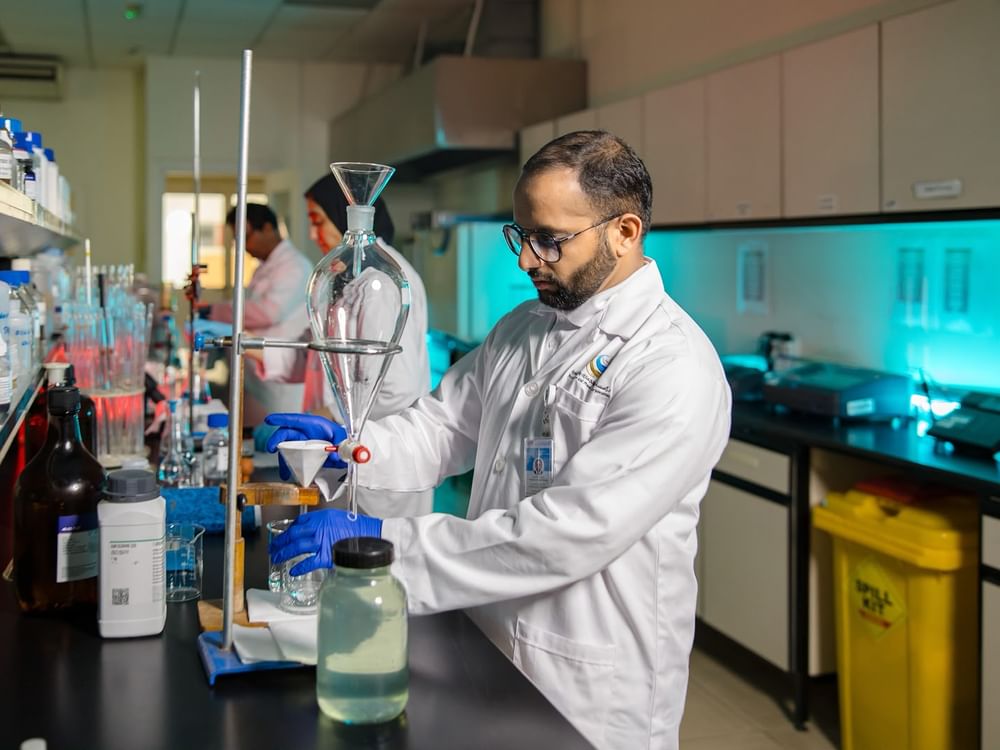
DUBAI, 24th September, 2026 (WAM) -- The Central Laboratory at the Ports, Customs and Free Zone Corporation (PCFC) conducted 2,459 laboratory tests during the first half of 2026, compared with 2,368 during the same period in 2025, as part of efforts to strengthen environmental monitoring and support Dubai’s sustainability objectives.
Abdulla Mohamed Belhoul, CEO of the Department of Planning and Development (Trakhees), said the results reflect Trakhees’ role as an integrated regulator extending beyond licensing to support safe and sustainable development across its jurisdiction.
He said the laboratory continues to develop its testing capabilities in line with high standards of quality and efficiency and Dubai’s efforts to expand the use of advanced technologies in environmental monitoring and analysis.
The most frequently requested tests during the first half included stack emissions analysis, sewage tank aeration analysis, comprehensive swimming pool and drinking water-quality analysis, wastewater and harbour water analysis, as well as marine analyses covering phytoplankton, zooplankton and benthic organisms.
During the period, the laboratory provided services to 334 customers and conducted 1,566 regulatory tests to monitor environmental conditions and verify compliance with approved standards.
Belhoul said the laboratory carried out 4,385 tests and analyses in 2025 across 46 specialised categories, including environmental, chemical, metals, microbiological, marine and water-quality testing.
Stack emissions analysis was the most frequently conducted test in 2025, with 1,021 analyses, while benthic organism analysis in sediment samples recorded 118.
The laboratory also supported the Dubai Air Quality Strategy 2030 through stack emissions testing and air-quality monitoring.
Within PCFC’s jurisdiction in Jebel Ali, results supported reductions in 2025 of 179 tonnes of sulphur dioxide against a target of 21 tonnes, six tonnes of non-methane volatile organic compounds against a target of 0.6 tonnes, and 596 tonnes of fine particulate matter (PM2.5) against a target of 71 tonnes.
The Central Laboratory also supported the Dubai Reef project in 2025 by providing marine analysis and biodiversity assessment services.
It analysed 126 phytoplankton samples, 150 zooplankton samples and 114 benthic organism samples, supporting efforts to restore marine biodiversity and strengthen the sustainability of Dubai’s coastal ecosystems.
Salem AlHammadi, Director of the Environment, Health, Safety and Sustainability Department at Trakhees, said the laboratory continues to strengthen its technical capabilities through advanced systems, including the EXO multiparameter sonde for monitoring water-quality indicators at different depths.
Other technologies include continuous 24-hour noise monitoring and the Laboratory Information Management System (LIMS), which has automated processes while improving operational efficiency, data accuracy, integrity and traceability.
AlHammadi added that the laboratory is accredited by the Emirates International Accreditation Centre (EIAC) in accordance with ISO/IEC 17025 and operates under specialised technical supervision.