
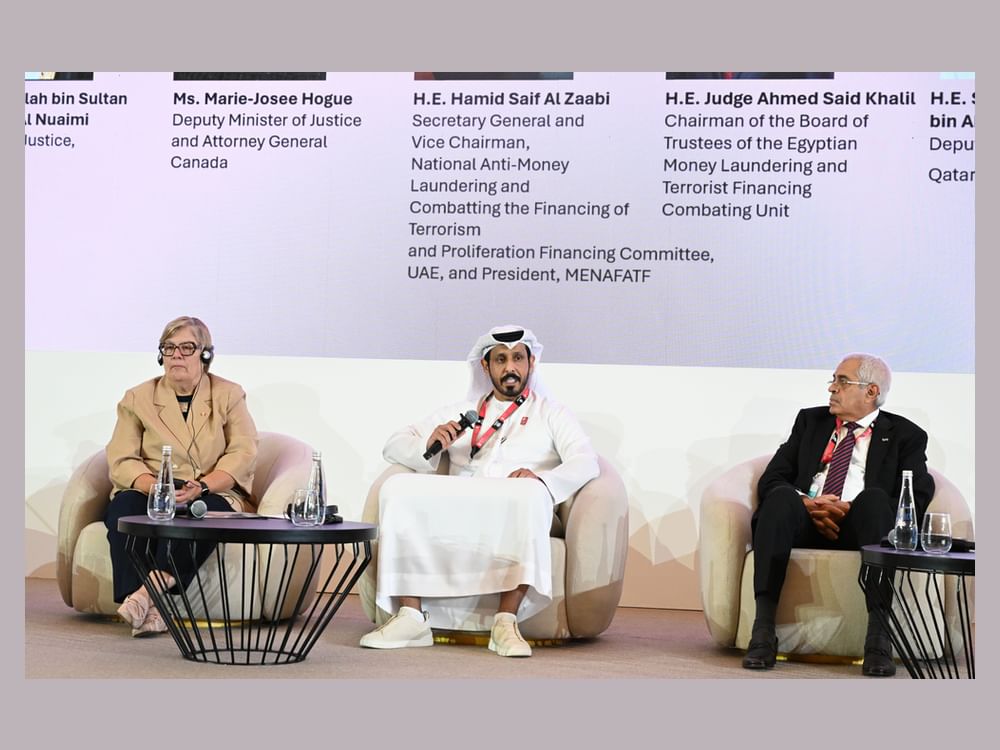
ABU DHABI, 27th September, 2026 (WAM) -- Hamid Saif Al Zaabi, President of the Middle East and North Africa Financial Action Task Force (MENAFATF), stressed that effective anti-money laundering and counter-terrorist financing (AML/CFT) systems depend on coordinated national efforts and regional and international cooperation.
He emphasised the importance of translating standards and evaluations into practical outcomes that protect the financial system and deprive criminal networks of the funds that enable them to sustain and expand their activities.
He was speaking during the session “Following the Money to Disrupt Transnational Organised Crime,” held as part of the 15th United Nations Congress on Crime Prevention and Criminal Justice in Abu Dhabi. His remarks addressed the role of regional bodies in helping countries implement effective AML/CFT frameworks and respond to the challenges of the digital age.
He explained that MENAFATF recognises the differing risks, needs and capabilities across the region and supports countries according to their priorities. This includes sharing expertise, building capacity and linking national development efforts to shared regional objectives that strengthen the effectiveness and protection of financial systems.
He noted that mutual evaluations provide an important means of identifying areas for improvement and setting priorities. He explained that MENAFATF’s support extends to the periods before, during and after evaluations, with technical assistance and capacity building directed towards areas requiring further development.
He stressed the importance of political will and coordination among national authorities, noting that the Group’s presidency has worked to strengthen direct dialogue with countries and relevant leaders, linking technical support to national reform priorities and ensuring its lasting impact.
He said that MENAFATF had worked directly with several countries this year, including Syria, Jordan and Palestine, to support preparedness, capacity building and risk assessment, strengthen coordination among authorities, and protect banking relationships and legitimate financial channels. The Group aims to continue this direct engagement with more countries in the period ahead.
On international cooperation, he affirmed that MENAFATF works closely with the Financial Action Task Force (FATF) and other regional bodies to exchange expertise and strengthen cooperation on shared priorities, particularly combating fraud, applying the risk-based approach and improving information sharing.
He noted that the digital age has changed the nature and speed of fraud. A single case may span several countries, with victims, offenders and funds located in different jurisdictions. Alongside risks associated with virtual assets, these developments call for faster cooperation among competent authorities, across borders and with the private sector.
In this context, he discussed plans to put forward a regional initiative to combat cross-border fraud under the UAE’s presidency of MENAFATF. The initiative would focus on prevention and early warning; information sharing among authorities, banks and digital platforms; rapid tracing of proceeds and virtual assets; and returning funds to victims. He explained that the aim is to develop a regional response that accelerates detection, information sharing and action across borders.
He. explained that combating financial crime involves tracing, freezing, confiscating and recovering criminal proceeds in accordance with legal procedures. He highlighted the role of MENA-ARIN, the asset recovery network for the Middle East and North Africa, in supporting direct contact and information sharing among competent authorities and accelerating cross-border cooperation.
Concluding his remarks, he said that MENAFATF aims to further strengthen the effectiveness of regional efforts, support the risk-based approach, build capacity, make use of technology and deepen cooperation with the private sector and international partners, helping to uphold the integrity of the financial system and protect the economy and society.