
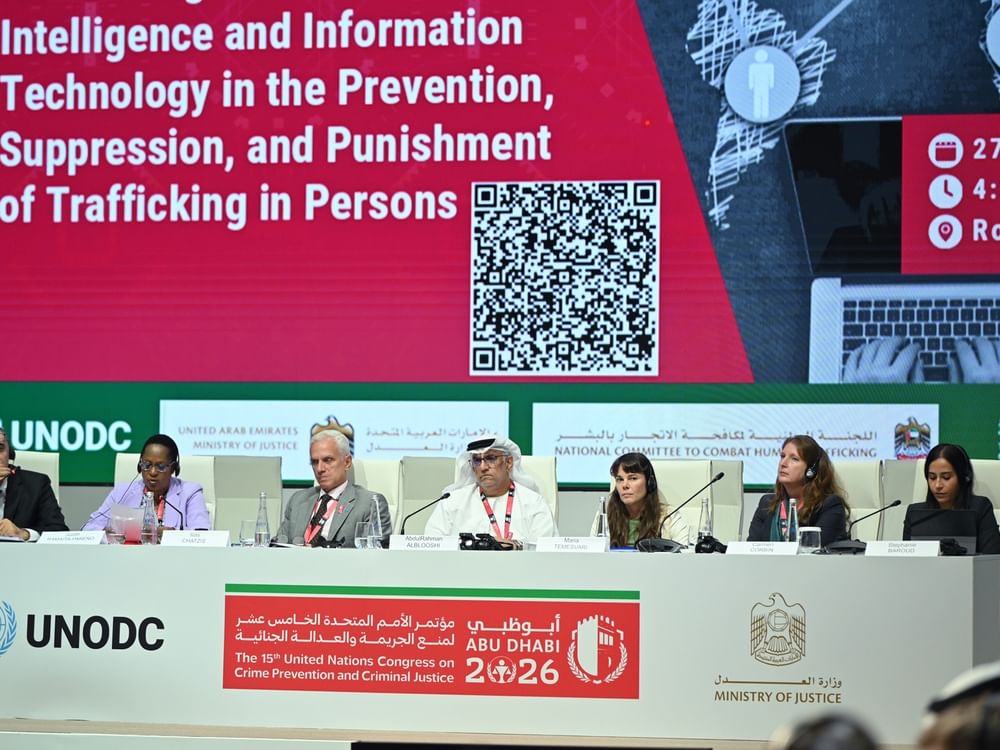
ABU DHABI, 28th September, 2026 (WAM) -- Abdulrahman Murad Al Blooshi, Vice Chair of the National Committee to Combat Human Trafficking (NCCHT), reiterated that the UAE has developed an integrated national model that combines legislation, technology, artificial intelligence and institutional coordination to protect victims of human trafficking, strengthen early detection and prosecution efforts, and prevent the re-exploitation of victims.
His remarks were delivered during the side event “Combating Trafficking in Persons in the Digital Age: Harnessing Artificial Intelligence and Information Technology in the Prevention, Suppression, and Punishment of Trafficking in Persons”, held as part of the 15th United Nations Congress on Crime Prevention and Criminal Justice – Abu Dhabi 2026.
The session was organised by the UAE with the support of the UNODC Office for the Gulf Cooperation Council Region.
Al Blooshi explained that the UAE's approach places people and human dignity at the centre of the national response and is built on five key pillars: prevention, prosecution, punishment, victim protection and international cooperation.
He noted that the UAE was among the first countries in the region to accede to the Palermo Protocol and has continued to strengthen its legislative and institutional frameworks to keep pace with evolving forms of crime.
He added that NCCHT 's 2025–2027 Action Plan integrates modern technologies into victim protection, data collection and analysis, and capacity-building for law enforcement agencies in handling and leveraging electronic evidence during investigations and prosecutions.
The plan also includes digital awareness campaigns and post-rehabilitation victim follow-up programmes.
Al Blooshi noted that Federal Decree-Law No. (34) of 2021 On Countering Rumors and Cybercrimes established a legal framework for the use of digital evidence and strengthened its evidentiary value in criminal proceedings, supporting efforts to trace and prosecute offenders while addressing attempts to conceal or tamper with evidence to obstruct investigations.
He also highlighted the UAE's Smart National Referral Mechanism System for Combating Human Trafficking, which currently connects 14 national ministries and entities and is used by approximately 200 officials and specialists.
Artificial intelligence technologies support the system by analysing data, identifying crime patterns, enabling early risk detection, and enhancing the referral and monitoring of victims throughout protection, care and rehabilitation processes.
The system also includes dedicated notification mechanisms for national authorities when cases involve women, children or people of determination, ensuring timely intervention and the delivery of support tailored to the specific needs of each group.
Al Blooshi stressed that the increasing use of technology by criminal networks for recruitment, exploitation and trafficking requires the development of equally advanced digital capabilities for detection, analysis and investigation.
He noted that international cooperation, information-sharing, exchange of expertise and sound digital governance are essential pillars in addressing this transnational crime.
The UAE's experience aligns with the priorities of the Abu Dhabi Declaration, particularly in advancing people-centred justice, protecting victims and groups most vulnerable to risk, addressing evolving criminal threats, and promoting the responsible use of technology and artificial intelligence.