
ABU DHABI, 29th September, 2026 (WAM) -- The fourth day of the 15th United Nations Congress on Crime Prevention and Criminal Justice – Abu Dhabi 2026 focused on advancing people-centred criminal justice systems, addressing emerging forms of crime and harnessing digital transformation to strengthen prevention, justice and law enforcement while protecting rights and upholding the rule of law.
Discussions continued under agenda item three on advancing innovative and evidence-based crime prevention strategies, while debate began under agenda item four on inclusive, responsive and people-centred criminal justice systems, and item five on combating crime, including organised crime and terrorism in all their forms.
Abdullah Sultan bin Awad Al Nuaimi, Minister of Justice and President of the Congress, held four bilateral meetings with representatives of Montenegro, the Dominican Republic, Uganda and the Czech Republic to strengthen legal and judicial cooperation and exchange expertise.
The meetings highlighted the Congress’s role as a platform for translating international dialogue into institutional partnerships, expanding cooperation against organised and transnational crime and improving the effectiveness of criminal justice systems.
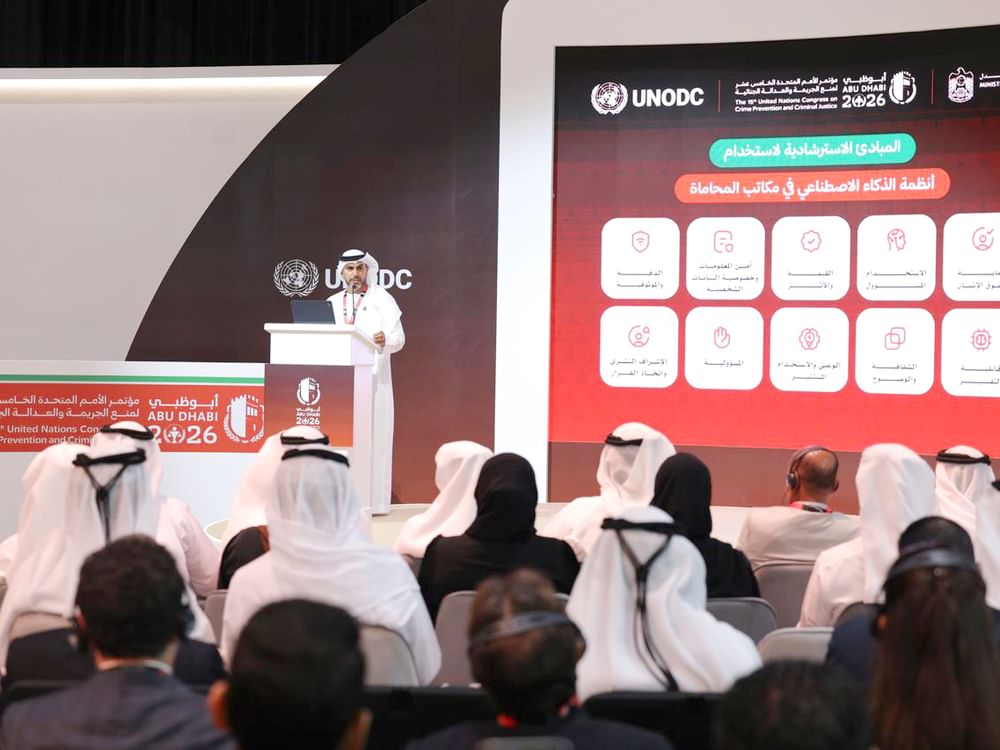
Al Nuaimi also launched the “Guiding Principles for the Use of Artificial Intelligence Systems by Law Firms” initiative in the presence of Maryam bint Ahmed Al Hammadi, Minister of State and Secretary-General of the UAE Cabinet.
The initiative aligns with the Abu Dhabi Declaration and its emphasis on the responsible use of artificial intelligence (AI), ensuring that advanced technologies in the justice sector operate within clear professional and ethical frameworks.
Discussions on people-centred justice addressed investigative interviewing techniques, the role of judges in crime prevention and the rule of law, the integrity and independence of criminal justice institutions, and equal access to justice.
Sessions also examined alternatives to the death penalty, the mental health and professional well-being of law enforcement personnel, UN standards for professional policing and implementation of the Bangkok Rules on women prisoners and non-custodial measures for women offenders.
Workshop Four, titled “Turning the Digital Age into an Opportunity: Promoting the Responsible Use of Technologies in Crime Prevention and Criminal Justice”, explored how digital solutions can improve institutional efficiency, access to justice, investigations and law enforcement while safeguarding transparency, accountability, privacy, fundamental rights and human oversight.
A fireside chat titled “AI, Data and Digital Technologies: Shaping the Future of Crime Prevention and Law Enforcement” examined the role of AI, advanced data analytics and digital technologies in anticipating risks, supporting operational decisions and strengthening real-time law enforcement capabilities.
Other meetings addressed the misuse of information and communication technologies, AI and social engineering for criminal activities, as well as the use of AI in public prosecution services.
Discussions on evolving crime focused on organised criminal networks, terrorism and terrorist financing, transnational criminal organisations and cooperation among prosecution authorities in ASEAN Member States to combat scam centres.
A special session on terrorist groups’ exploitation of AI examined the risks of emerging technologies being used to strengthen operational capabilities and stressed the need for stronger legal, operational and law-enforcement responses.
Sessions also discussed preventing the recruitment of young people into organised crime, strengthening youth resilience through sport and evidence-based prevention policies, and empowering young people as digital innovators in crime prevention and criminal justice reform.
Environmental crime featured prominently, with discussions covering threats linked to outer-space activities, the role of shipping in combating environmental crime, economic crime in the gold sector and money laundering in art and antiquities markets.
The UAE organised a session titled “Towards a Balanced Strategy for Wildlife Protection: From Enforcement to Conservation”, highlighting the importance of combining legal and regulatory measures with ecosystem protection, conservation and biodiversity objectives.
The fourth day featured 35 ancillary meetings addressing community policing, safer communities, digital governance, violence prevention, human trafficking and community resilience against organised crime.
The United Nations Crime Prevention and Criminal Justice Programme Network Lab also examined implementation of the Kyoto Model Strategies for reducing reoffending and opportunities for cooperation in research, training and technical assistance.
The Congress continues at ADNEC Centre Abu Dhabi until 1st October, bringing together broad international participation to advance a shared and more proactive vision for crime prevention, criminal justice and the rule of law.